
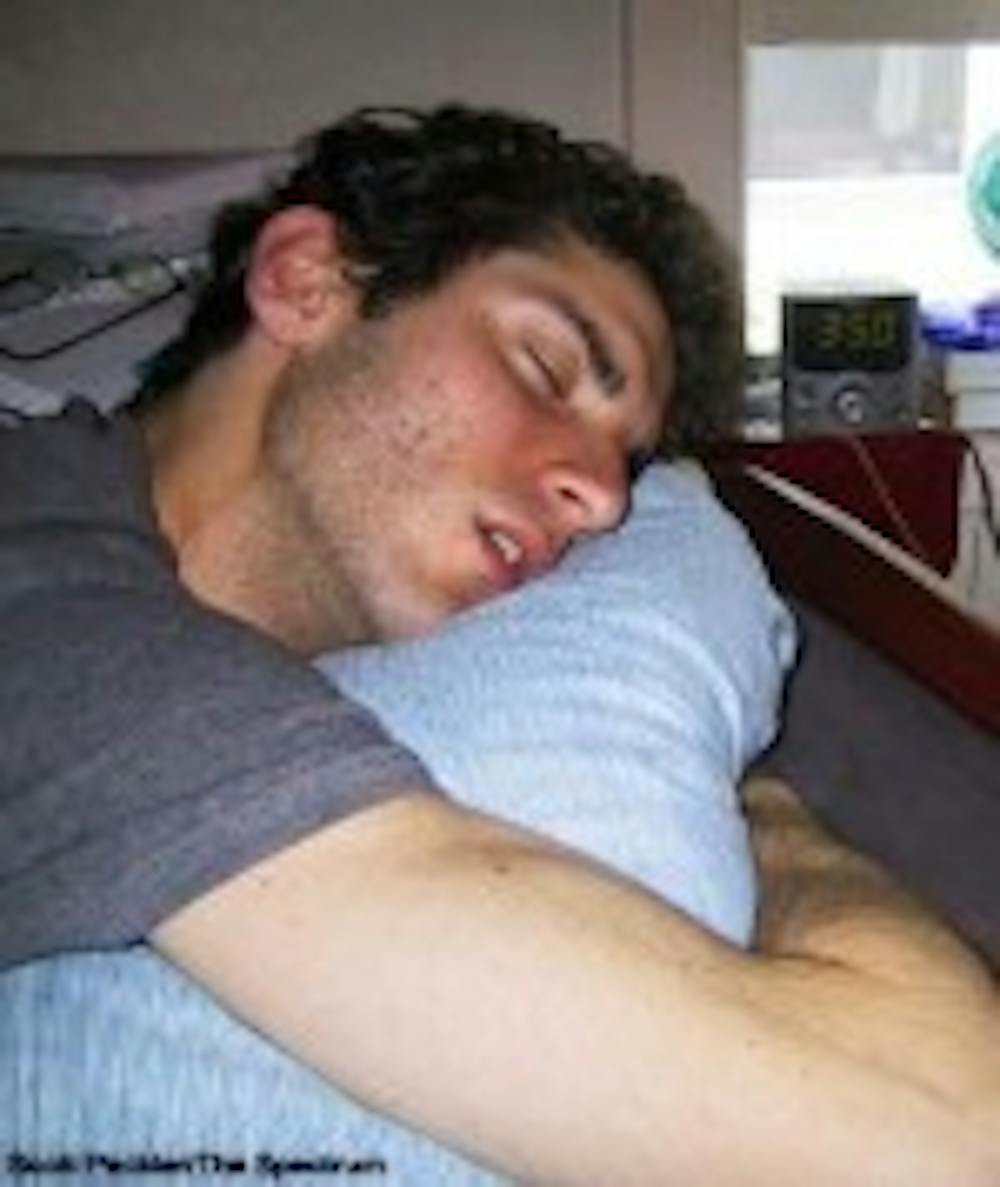
Between managing an academic and social life and putting in hours at a steady job, it is not surprising that the average college student is not getting enough sleep.
Though a puffy face and under-eye bags can be an aesthetic nuisance, a new study finds that a student's appearance is not the only thing that suffers from lack of sleep.
According to Dr. Carol A. Rice, a Texas Agricultural Extension Service health specialist, busy students who lose sleep can see the adverse effects in their ability to perform daily activities.
"Sleep helps encode memories and improves learning," Rice stated in an article at www.agnews.tamu.edu. "If you do not give your brain enough sleep, when you see a multiple choice question after staying up all night to study, you may not be able to make those finer discriminations necessary to choose the best answer."
Recent studies find that university students are getting less sleep than they need as well as less that they used to.
According to the National Sleep Foundation, college students are averaging 6.8 hours of sleep each night, which is comparably low to the recommended 8 to 9.25 per night.
The Sleep and Chronophysiology Laboratory at the University at Michigan Depression Center finds that today's students are getting even less than students in the 1980s, who averaged 7 to 7.5 hours.
According to Bernard Lubin, students today sleep less because there are new reasons for them to stay awake.
"Other college students can distract you from sleeping. If they're doing something interesting you get sucked into it," he said. "If someone sends you a juicy IM you just can't stop typing. (Its like) your fingers are on crack or something, but that only distracts you if you let it."
Freshman engineering major Mariah Ireland said, "school, work and partying" are what keeps her from a good night's sleep.
"I've been up till early in the morning almost every night, I get up early for classes, and I end up sleeping during the day," said Ireland.
According to Assistant Psychology Professor Eduardo Mercado III, getting less than the recommended hours of sleep regularly can seriously hinder learning.
"If you are sleep deprived for only two or three days, this will not have much effect on your ability to learn in the classroom, other than that you might find it more difficult to stay awake in class," he said, adding that your brain tends to compensate for the lack of sleep.
"Sleep deprivation over longer periods reduces memory and attention, so you will definitely learn less in the classroom if you never get enough sleep,' he said.
According to Rice, loss of sleep can also lead to other undesirable consequences such as insomnia, sleep abnormalities, negative attitudes, depression, higher stress levels, sickness, frequent colds, headaches, acheyness, a slow reaction time, destruction to the immune system and motor skills and a host of other mental health problems.
"Sleep is restorative, allowing the brain time to organize itself, store things properly, replace essential brain chemicals, and even solve problems," stated Rice, in the article.
Sleep deprivation can have more serious effects than academic difficulties, as it contributes to illness and is also associated with a greater risk of accidental death and disability, particularly while driving.
According to the National Highway Traffic Safety Administration, exhaustion and drowsiness are the leading cause of a minimum of 100,000 police reported car accidents every year, taking the lives of over 1,500 Americans, and injuring another 71,000. These findings should be cause for concern among college students as drivers under the age of 25 are involved in over half of all sleep-related collisions
Despite reports on the dangers of under-sleeping, some students believe sleeping less can have positive results.
Jon Bielicki, a freshman media studies major said staying awake longer allows him fuller days.
"Sleeping detracts from the hundreds of activities that you could be doing through out the night," he said.
Adam Card, a sophomore electrical engineering major, agreed.
" I don't sleep much to begin with. It's a waste. You only need six hours of sleep," he said. " I do a lot of schoolwork and socializing."
There are studies underway to determine if too much sleep can also be detrimental.
A tentative study performed by the American Association for the Advancement of Science published online at www.telegraph.co.uk/news and entitled "Too Much Sleep Can Kill You" by Roger Highfield concluded that "too much sleep can shorten one's life."
The study, conducted over six year time period, found that of over one million people, the group which slept eight hours a night were more likely to have a higher death rate than those sleeping seven hours. Further studies are required to determine if less sleep will improve one's health.
According to Joel Jueckstock, freshman computer engineering major, not getting enough hours of sleep is often times a problem that cannot be avoided.
"There is much to do and not enough time in the day."



