
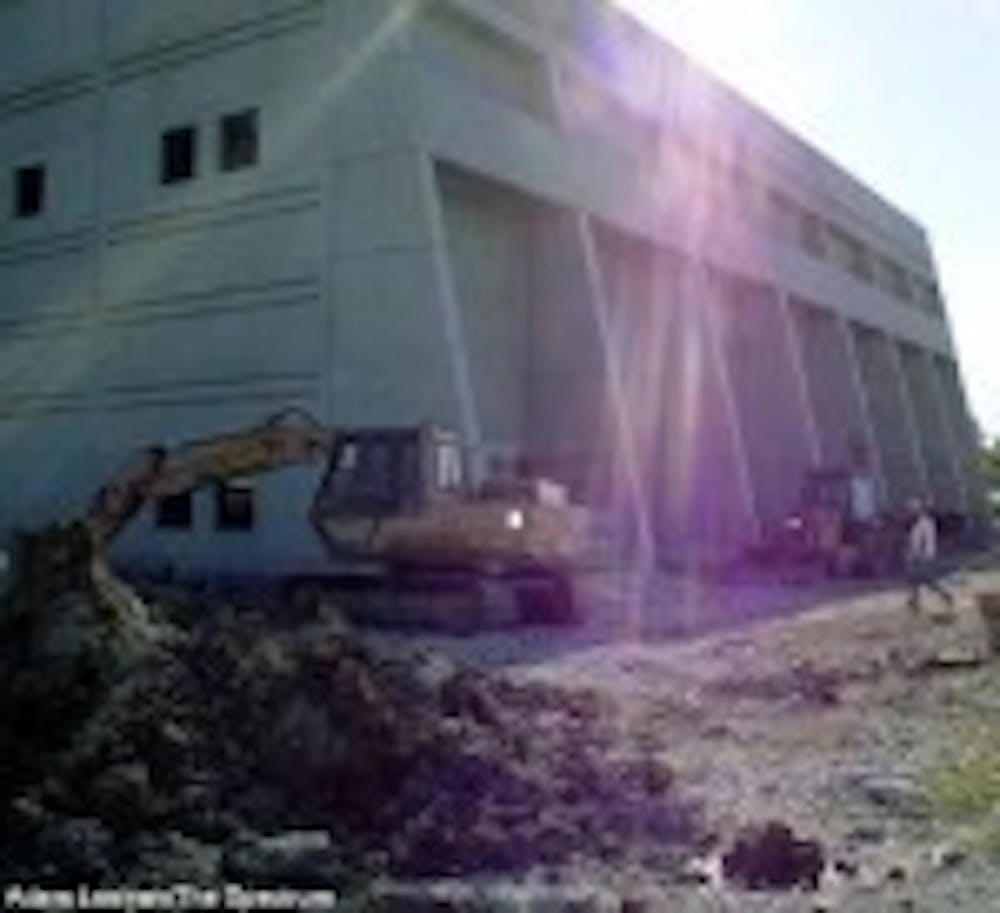
Visitors, prospective students, and the student and faculty at UB have all been witness to the construction that has been taking place for the last two years near the front of North Campus, next to the faculty parking lot near the Student Union.
When all the dust and noise settles, an addition to Ketter Hall will remain. This addition will become home to some of the largest and most innovative earthquake research simulators and equipment in the world.
Three years ago, the National Science Foundation held a contest regarding earthquake simulator proposals. The following spring, the NSF awarded the University at Buffalo a $10.5 million grant to build a new earthquake simulator and research center scheduled to be operational by February 2004.
In addition, SUNY and the University at Buffalo Engineering Department contributed another $9 million to fund this groundbreaking project.
Dr. Mark H. Karwan, dean of the School of Engineering and Applied Sciences and professor of industrial engineering, emphasized the importance of the grant from the NSF.
"This is the largest grant of its type ever in National Science Foundation history," he said.
According to Karwan, there are several reasons for the high cost of the project, including the equipment planned for the new building, which will include at least $1 million worth of computing equipment. The rest of the money will be used for various aspects of the outer building, but more importantly, constructing the shake tables, strong wall and strong floor.
"It's more of a machine than a building," said Karwan.
Another reason for UB's securing the grant was the originality of the proposal, said Dr. Andrei M. Reinhorn, a professor of structural and civil engineering and co-principle investigator of the project.
According to Reinhorn, this facility will be the first in the world to contain two separate shake tables, as well as a strong wall and strong floor. The tables will be 120 feet long and will have a capacity of up to 100 metric tons. The separate shake tables will allow researchers to test how, for example, a bridge that has stress put on it in two different fashions in two different places will react. The strong wall and strong floor are designed to allow researchers to drop things or pull on the structure being tested until it breaks.
Equally impressive is the implementation of the earthquake center into a grid of real-time dynamic hybrid resting, said Reinhorn.
Some students said the future happenings in the new Ketter Hall would be beneficial to UB.
"I'm happy that the engineering program is expanding, and hopefully this will increase UB's recognition," said Mike Zaccheo, a sophomore mechanical engineering major
UB will become the flagship laboratory of the George E. Brown Jr. Network for Earthquake Engineering Simulation, a grid that allows real-time collaboration between 15 universities, facilities and laboratories across the country that are conducting simultaneous experiments, said Reinhorn.
The grid will allow streaming video and audio exchange during experiments, and the instruments in the various labs will exchange data instantaneously as it is gathered, creating a "co-lab." This will allow for a more in-depth and accurate analysis of the information, Reinhorn said.
According to Reinhorn, while the School of Engineering and Applied Sciences is the actual owner of the research facilities, several other groups will take advantage of the new technology.
The Multidisciplinary Center for Earthquake Engineering Research is a group of researchers who have been using UB's existing shake table for research and will continue their research at the new facility, once it is operational, Reinhorn said.
Some students, though initially unaware of the project, were impressed when informed of the details.
"I've been here a year and never knew what the construction was for," said sophomore art history major Crystal Bowe. "I was surprised to find out how important UB is in the earthquake engineering field."
According to Karwan, only a few of the roughly 1,100 graduate and 2,600 undergraduate engineering students at UB will be able to use the facility. However, the launch of the new center is greatly anticipated by those who have been involved with the project from its conception.
"It's going to make UB one of the best earthquake engineering schools in the country, and in the world," said Dan Fenz, a graduate student in civil engineering who worked in the original lab last summer. "It will definitely bring more graduate students and better faculty to UB."



