
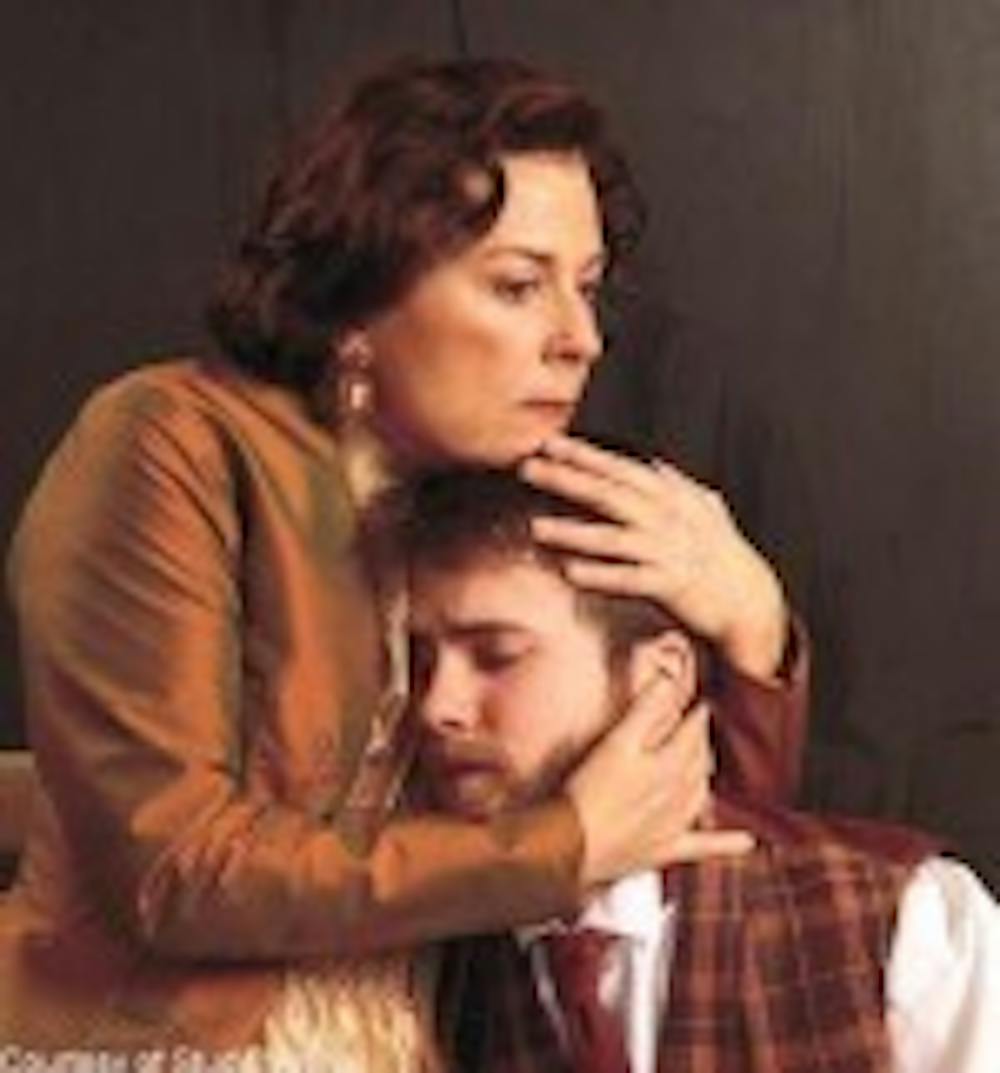
Mrs. Alving stops dead in the middle of the room, the color drained from her face, and tells the Pastor, "I am half inclined to think that we are all ghosts."
Such instances of haunted pasts and lingering secrets reign throughout the 19th-century play "Ghosts," now showing at the Studio Arena Theatre.
"Ghosts" is written by Norwegian playwright Henrik Ibsen, a man who is famous for his unabashed handling of social issues that were considered controversial in his day.
It deals with the backlash caused by a loveless marriage that destroys or damages several lives.
Mrs. Alving has tried over the years to keep the secrets of her family from others in order to maintain an appearance of perfection, but Ibsen depicts her as being liberal-minded and strong. This contradiction in her character is what creates most of the conflict in the play.
The audience learns through discussions with her friend Pastor Manders that she was trapped in a horrible marriage with her now-dead husband. No one outside of the marriage knew what a bad person he was, one who forced their former housemaid to have sex with him, an act that resulted in the birth of Regina, one of Mrs. Alving's servants.
All of the action of the play takes place within a garden room. The set is beautifully adorned. Wicker furniture, fine china dishes, silver serving trays, candlesticks, and an ornately decorated chimney convey the atmosphere of a wealthy country estate.
And yet, things are not as lovely as they seem. Mrs. Alving struggles with herself to hide the truth of her husband's behavior, and she says that she sometimes feels surrounded by the ghosts of her dark past.
"I can never be free of the ghosts that haunt me," she tries to explain to the pastor, who is hell-bent on getting her to remain silent in order to preserve the honor of her dead husband, and of their son.
A casual observer will not understand this play at first. Knowing the background story is essential for following the plot, and most of the prior histories of these characters are told through rapid conversations, arguments, or whispers, many of which are interrupted and resumed later.
"It was a little tough to follow," said Moira Schwartz, a bookstore clerk from Buffalo. "But, I thought that the play itself was really good."
Ibsen's incredible skill and stark style is appreciated, however, it seems that the audience is on the outside looking in for most of the play, and not allowed to be a part of it until the very end when all is revealed.
This is a professional production, put on by the Studio Arena Theater, a company that is well known for its skilled actors and elaborate sets. Cynthia Mace portrays Mrs. Alving as a woman on the verge of independence, but who is still caught up in the conventions of the late 19th century.
"The mother really captured Ibsen's portrayal very well," said Janet Gane, a Niagara University professor. "She was a spokesperson for the changing times of this period."
The actor that stands out most is Mark Thornton, who plays Mrs. Alving's son Oswald. Oswald is just as contradictory as his mother. He is an artist who has returned from living in Europe to find that his family is no longer the stable, loving unit that he had once thought. Thornton convincingly reacts as any man would when his world is completely crushed.
"The sins of the father are visited on by the son," Oswald tells his mother as he tries to explain a doctor's prognosis of an unknown illness that he has contracted.
The subtitle for "Ghosts" is another appropriate summation of the story: "A Domestic Tragedy." Ibsen offers a perspective on the unspoken demands of society, and shows just how far people are willing to go in order to preserve the identities that have been placed upon them, even though those identities may be false.
"Ghosts" is playing through March 5 at the Studio Arena Theater.



