
Approaching one-year since its opening on Feb. 20, 2025, the Indigenous Studies Hub has become a safe space for Indigenous faculty and students. It is rare in architecture to see something built with a deeper meaning behind it.
Located on the sixth floor of Clemens Hall, there is a space designed to represent Haudenosaunee and Indigenous cultures, and is continually serving as the ground we strive for success on. The space is meant to feel welcoming, comforting and purposeful.
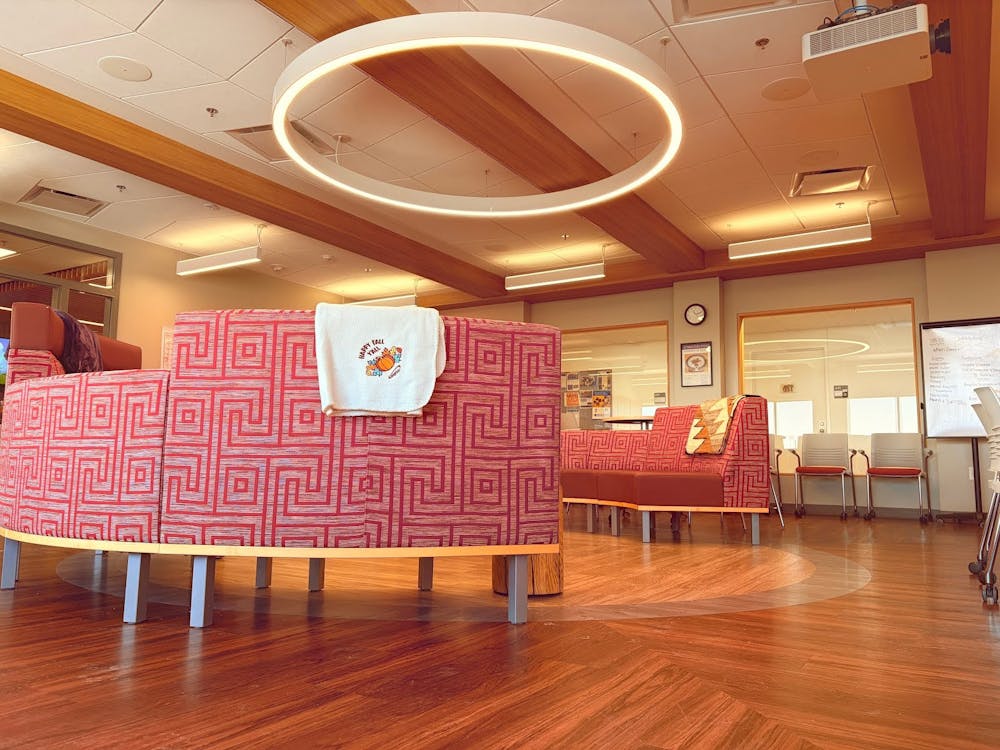
In the middle of the gathering space, a circle is ingrained into the floor. Not to be mistaken as only a shape, the circle stands for shared community and sacred origin stories. Its influence is vast, finding itself present in various indigenous artworks, and is seen as a way of life.
Throughout Haudenosaunee culture, land-based community learning is the primary way of introducing knowledge to others. Serving as the location of cultural workshops and community centered classes, it plays an important role in modern-day Haudenosaunee society. The new food sovereignty kitchen adjacent to the gathering space is used for cooking demonstrations for traditional foods, another one of the intentional design choices introduced. Gathering everyone for a meal is a recurring way of quality time seen in the culture.
Yet it is not only meals, but quality time is also weaved into everyday life in a holistic lens. The everlasting traditions of fostering relationships and unity among nations are held up in these rooms. Haudenosaunee translates to "people of the longhouse".
Typically, around this time of year is when the midwinter ceremony happens. All longhouses independently decide exactly when this will occur since they are not on the same timeline across territories. As the first ceremony of the year, it is filled with new year intentions of new goals and new semester schedules. The Department of Indigenous Studies and Indigenous Hub held a welcome back pizza event in the main gathering space on January 29, 2026. A time for faculty and students to sit down to catch up.
“I love the workshops they do here; the community is made those days. The big windows and the sun that comes in” said Delaney McNulty, a graduate student majoring in philosophy. The position of the social room in the building gives it a view overlooking Lake La Salle.
Alyssa Warrior, a graduate student majoring in physics, has said, “I like the coffee machine, and my beads are in here.” Crafting beadwork and jewelry occurs on Thursday afternoons. This space has taken its potential and made something truly inspiring. It provides hope in times of stress and uncertainty.
Four years of work after The Andrew W. Mellon Foundation Grant was received in 2020, the grand opening was a profound move in the right direction for Indigenous inclusion. The department has already taken the next step in making sure the awareness is known through student outreach day, where Indigenous high school students from the Western New York area visited the campus to learn about the department.
The Indigenous Hub's existence is proof of Indigenous resurgence providing endless opportunities and awareness to Indigenous presence, culture and knowledge. All Indigenous students who attend the university, those majoring or minoring in Indigenous Studies, and friends and allies are welcome to use the rooms. The gathering space is typically open Monday through Friday 8:30 a.m. to 5:00 p.m. Students go there to study, grab a snack and warm up with the blankets — making it convenient for commuters, a place to come to in between classes.
Support staff and the resources they provide make a difference in student success. Tianna Porter, Associate Director of Indigenous Academic Engagement, stated “The space can transform based on what the event is.”
The multifunctional room is representative of the cultural phrase, “extend your rafters.” It is always in accommodation.
It is a responsibility of Indigenous peoples to work, preserve, and look out for future generations.
The features desk can be reached at features@ubspectrum.com
 Photo: Credit: Kishaun Proctor


