
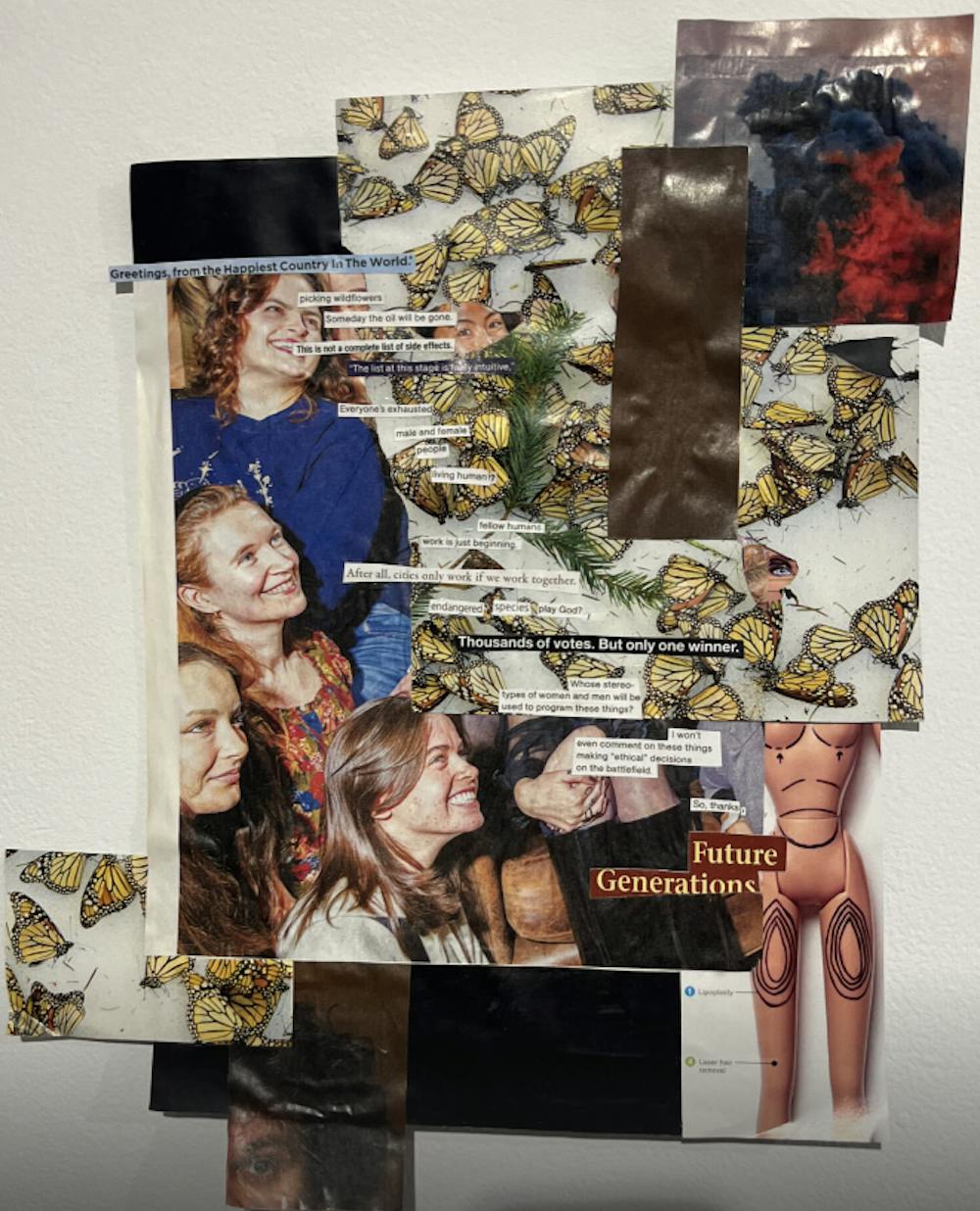
The “Greetings From the Happiest Country in the World” greets its visitors with images of destroyed land and pictures of smiling people.
Bella Rosenthal and Caitlin Andrejova, studio-mates and MFA candidates, connected their contrasting creative processes through the exhibition, which was held from Sept. 16 to Oct. 2 at UB’s Project Space at the Center for the Arts.
Rosenthal says her work centers on “socio-political commentary that is cynical but has humor layered within it.” On the contrary, Andrejova’s usual work is largely emotions-based.
It was their studio conversations that brought the two together.
“Lately, our conversations in the studio have delved into frustration with the different systems we live within and the increasing chaos of life,” Rosenthal wrote in a text to The Spectrum. “In a way, because of this, we are always collaborating with each other and growing ideas through constructive feedback and in-depth conversation.”
The entryway’s pieces — done by Andrejova — pop with bold text, which at first seemingly contrast the text, however, upon further inspection, it reinforces the irony of the text. For example, in the piece “Unlimited,” images of a barren wasteland are contrasted with statements of special offers and investments, shaking the viewer's perception of the relationship between money and war. Another piece, “GFtHCitW,” was the origin of the exhibition’s title.
“For this show, we did not entirely discuss what we wanted to put into it before we were to install. We had decided to show up to the Project Space with all the work we were considering, and curate from there.” Rosenthal wrote, “When we came together and showed each other the work, we both laughed because it all unintentionally fit together. When she read that line to me while she was gluing them together, we both knew that had to be the title.”
Immediately next to Andrejova’s collages are two pieces by Rosenthal. The cyanotype — a slow photographic printing process — piece, “Flag of Youth Before iPads,” is immediately eye-catching for both its name and its content.
The piece features four scans of a friendship bracelet, which Rosenthal sees as a connection to pre-technological childhood since they represent a time that has long passed. The same hands that were filled with arts and crafts that led to connection now carry technology that severs it.
“I remember a time when string friendship bracelets were everywhere; filling hands with an activity and wrists with a handmade connection to one's own creativity or to a loved one,” Rosenthal wrote. “These bracelets have become a relic, as they are a beautiful symbol of that past that highlights a change in activity and physical capability.”
Some other fascinating pieces are Andrejova’s “Consume,” “Months” and “THANKYOUTHANKYOUTHANKYOU” which use ordinary, everyday items such as plastic bags and receipts. They are scattered and shredded; pinned onto the wall, receipts and bags spanning months of purchases, acting as an average consumer’s diary of purchases.
“I wanted to call attention to the absurdity of the shopping bags’ messaging. They show such a great appreciation for our consumerism.” Andrejova wrote in a text to The Spectrum, “They’re loyal to this appreciation regardless of where they end up after we are done with them.”
In a similar way, Rosenthal, in her pieces, “Ladder to Success (Prototype),” “Fortune Wallpaper,” “Colorful Advice,” “World Go Round” and “U.S. Coins, Distorted 2,” use ordinary items such as fortune cookies and coins. These cyanotype and acrylic pieces continued to emphasize the humor of our consumerist-based lifestyles.
“With objects such as these, I want the viewer to think about the little, insignificant items that exist within their lives that have a large impact on the way they feel day to day,” said Rosenthal. “I want people to think about how experiences and objects are designed by a larger system to make us feel certain ways, and to control how we behave.”
Despite not being entirely planned, Rosenthal and Andrejova’s exhibition had great cohesion. Their exhibits are a reminder that modern America is united in our alienation towards the current state of the so-called “happy” country.
The arts desk can be reached at arts@ubspectrum.com.
 Photo: Courtesy of Wikimedia Commons
 Photo: Courtesy of Nicc Williams; photographed by UB Athletics
 Photo: Courtesy of Wikimedia Commons
