A student-led organization recruited staff, hosted training sessions and launched a fundraiser for operational equipment, advertising itself as UB’s new student-run emergency medical service.
The university says they have “no plans” to use a student-run EMS.
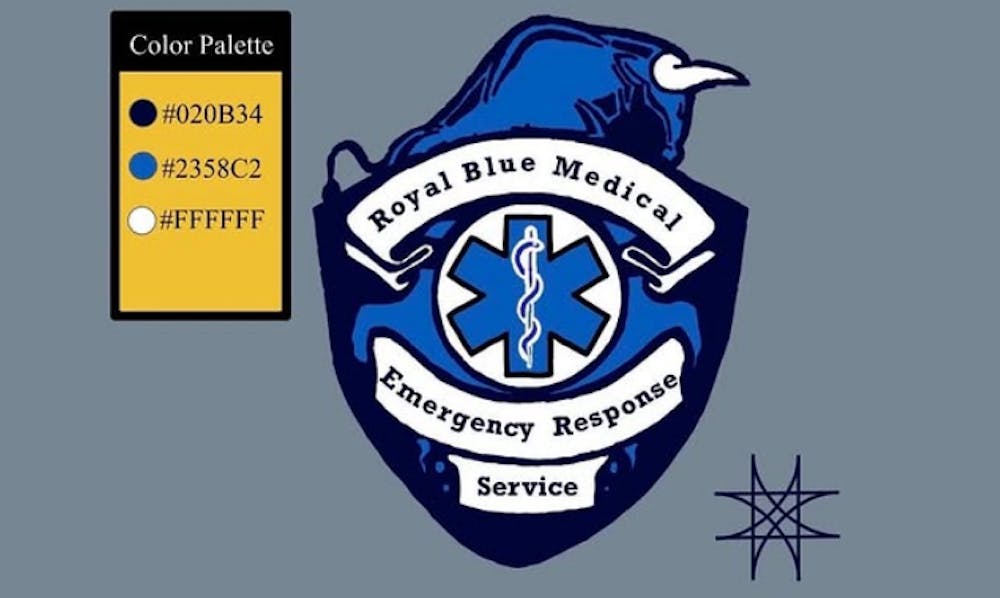
Since January, the Royal Blue Medical Emergency Response Service (RBMERS) has called itself UB’s student collegiate EMS agency, where students would respond to on-campus emergencies in collaboration with university police and local EMS agencies.
The agency is meant to be a “complement” to UB’s current emergency response system, in addition to hosting community events and professional development activities, according to RBMERS President Matthew Messina.
“We aim to strengthen on-campus emergency care by offering advanced volunteer-based response, emphasizing service before self, and collaborating closely with university departments, faculty, and medical oversight,” Messina wrote in an email to The Spectrum.
RBMERS is recognized by the Jacobs School of Medicine and Biomedical Sciences’ emergency medicine department.
The university appreciates the club’s enthusiasm and public health mission, but has no plans to merge a student-run service with its current emergency response system, a spokesperson told The Spectrum.
“The breadth and complexity of UB’s three-campus community is best served by existing local EMS providers, municipal first responders and UB’s highly trained police department,” the spokesperson said in an emailed statement to The Spectrum.
Training sessions underway
15 out of 130 applicants were accepted to the organization, after undergoing a 50-question interest form along with group and student interviews, Messina said.
Those accepted are now undergoing a six-week preparatory course run by Messina, who is EMT-certified, and other e-board members that began Mar. 24.
In the course, students would learn basic EMS skills — such as taking vital signs and administering medication — and undergo Title IX and mandated reporter training. Afterwards, the members would take four 12-hour shifts and attend two training sessions every month.
The organization released advertisements last Tuesday for student volunteers to act as patients for those training sessions.
The course is not for credentialing purposes, Messina said. Students would be expected to obtain their credentials through an outside state-approved EMS program within a year of being accepted into RBMERS; those without are allowed to attend calls but are limited to the “most basic tasks” such as handing over objects and assisting with lifting.
The group has been reserving spaces in Greiner Hall for the sessions, but is in talks with the university to secure a permanent place, Messina said.
RBMERS has no external funding as of now, with a fundraiser released Friday to pay for medical gear and communications equipment for the organization.
Initial efforts to raise money from alumni donors for RMBERS were complicated by another ambulance initiative that the university called “an almost identical program,” according to emails provided to The Spectrum by Messina.
“We’re happy to help with exploring fundraising options for an initiative like this, however we would need all the disparate groups to get on the same page regarding the future of the initiative as we cannot ask donors to contribute to competing efforts like this,” an email from March 17 read.
Jack Koscinski, an SA senator and incoming president next year, was leading this “almost-identical” initiative where he was in contact with university shareholders to work towards providing low-cost or free ambulance transportation to UB students.
Koscinski told The Spectrum that he supported Messina’s initiative as they are both working towards the same goal, but the efforts are “moving disjointed.”
“He’s very passionate but I think he can sometimes be moving a little faster than what other stakeholders are prepared to do,” Koscinski said by phone.
EMS service at UB “well-managed”
A student EMS agency on UB’s campus isn’t unfamiliar: the Baird Point Volunteer Ambulance Corps handled medical emergencies and ambulance transport from 1982 to 1997.
The university suspended the program in Oct. 1997, pending review which would reassess whether the services were still needed and beneficial.
When students presented a report two months later to get BPVAC reinstated, officials brought up concerns of reliability and consistency. Bill Hooley, executive director of Sub-Board I, Inc. — the university’s fiscal agent before the Faculty Student Association, said he was concerned that the program did not file required reports with the Internal Revenue Service for three years.
The university officially ended the BPVAC program in March 1998 in favor of the mutual aid system used now, citing “significant regulatory, operational and financial difficulties.”
A university spokesperson told The Spectrum that EMS service for UB’s campuses are “well-managed” by the local municipalities and that UB doesn’t play a role in selecting or determining EMS service providers.
Additionally, UPD officers are the first to respond to on-campus emergencies with an average response time of one to two minutes, the university spokesperson said. The officers are also regularly trained in CPR, automated external defibrillators and Narcan, with the equipment stored in their vehicles.
Amherst’s Twin City Ambulance and Getzville Fire Company provide EMS services to the North Campus. The American Medical Response and Buffalo Fire Department respond to the South and Downtown campuses.
Mutual aid agreements are in discussion with Twin City Ambulance and Getzville Fire Company, according to Messina.
Getzville Fire Company has not responded to The Spectrum’s request for comment.
Twin Cities Ambulance CEO Bryan Brauner confirmed that discussions were held, but no agreements had been signed.
“I do support the concept provided it is well thought out and properly executed,” Brauner told The Spectrum in an email.
Messina says that universities rarely start collegiate EMS programs themselves.
“These squads are usually created by coalitions of students and supportive departments, who identify a need and submit proposals to demonstrate that the program is viable and safe,” Messina wrote in an email to The Spectrum. “As with PhD or research proposals, you have to prove that this deserves support.”
CORRECTION: The Spectrum misquoted Jack Koscinski in saying "shareholders." The article has been updated to correct it to "stakeholders." We regret this error.
Mylien Lai contributed to the reporting of this article.
The news desk can be reached at news@ubspectrum.com.

 Photo: Wikimedia Commons | Courtesy of Quintin Soloviev