University Police will start a Flock pilot program this spring semester.
Beginning March or April, approximately 20 artificial intelligence-assisted License Plate Readers run by Flock Safety will be installed at entrances and exits across UB’s North Campus.
Police had been moving closer to the free 60-day trial for months to use it as a tool to solve vehicle-based crimes, with the cameras recording vehicle characteristics in addition to the license plates. Audit logs show that UPD had run a search on Cheektowaga Police’s database on April 6, which UPD Deputy Chief Gregory Sauers said was a training demonstration.
No cameras have been installed as of yet.
Outcry from students, faculty and community members have grown since then — accusing UPD of instigating mass surveillance and raising concerns over possible misuse.
A petition that demanded UB President Caroline Genco abandon the pursuit drew over 930 signatures, and the Faculty Senate — a government representing UB faculty — passed a resolution Oct. 20 in support of the petition. The undergraduate student government’s elected body, the SA Senate, explicitly criticized the use of Flock cameras in a unanimously passed resolution on Sept. 30.
Tensions came to a head during Wednesday’s town hall meeting with over 60 in attendance.
Throughout the session, leadership repeated reassurances that access will only be for crime-related purposes; no outside agency will have access to the database and that the decision for permanent installation is still in consideration.
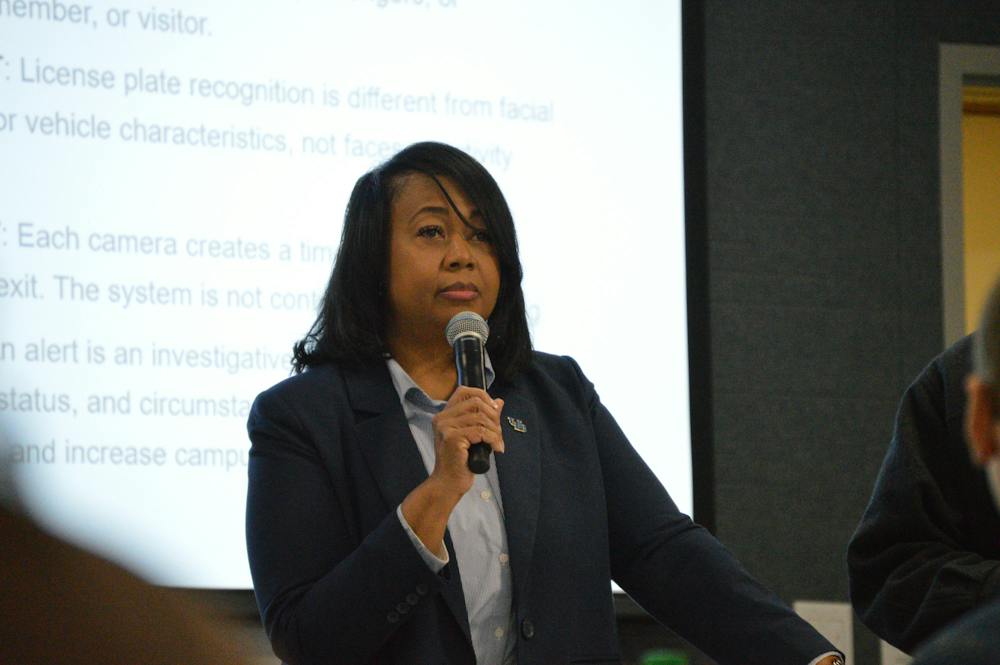
“They offered us a 60 day free trial,” UPD Chief Kim Beaty told attendees. “And the only thing that does is give us an opportunity to see if it’s something we want to utilize.”
The reassurances had fallen flat.
“I am a product of this university,” Brendan Gilbert, local attorney and UB alum, said. “I want police to do better because it’s embarrassing us and ourselves.”
Na’Dia Carter, SA’s vice president for advocacy, compared the use of Flock cameras to touching a stove.
“It’s like asking a child ‘Hey don’t touch that stove, you’re gonna get burned,’ and then the child touches it and they’re like ‘Ow, you’re right. I shouldn’t have touched it,’” said Carter, “So my question is, what’s the point of having town halls if you’re already going to do what you’re going to do?”
Stephanie Mejia, executive director of the Western New York Peace Center, described it as a “slippery slope.”
“And while I would like to believe you folks have the best intentions, the thing is that not everybody does,” Mejia said. “I don't trust this administration not to take advantage of what data that you guys are eventually gathering.”
Frustration had risen in UPD leadership as audience members relentlessly questioned and criticized the use during the hour. They repeatedly referred to the "efficiency" of Flock cameras, that the decision to choose them over other cameras was for “budget” reasons and that the trial period is only 60 days.
“There’s a lot of misinformation out there,” Sauers said. “What's the difference between Flock, Axon or Motorola? What’s the difference between the companies? That one's safer than the other?”
Attendees were still dissatisfied by the end, with some still shouting questions and concerns as Police were wrapping up.
“I'm asking you the questions,” Alyssa Martin, a third-year history doctoral student, said. “You keep asking us rhetorical questions, but we're here to ask you so you answer.”
Beaty told The Spectrum that she believes the town hall meeting went well, stating “People were able to express themselves freely, and we’ll have more sessions so that we can talk more. I appreciate people saying how they feel about things. I’m all for the First Amendment.”
Mylien Lai contributed reporting to this article.
Dorothy Similien is the assistant news editor and can be reached at dorothy.similien@ubspectrum.com.

 Photo: Courtesy of Aryan Vali Baharvandi