
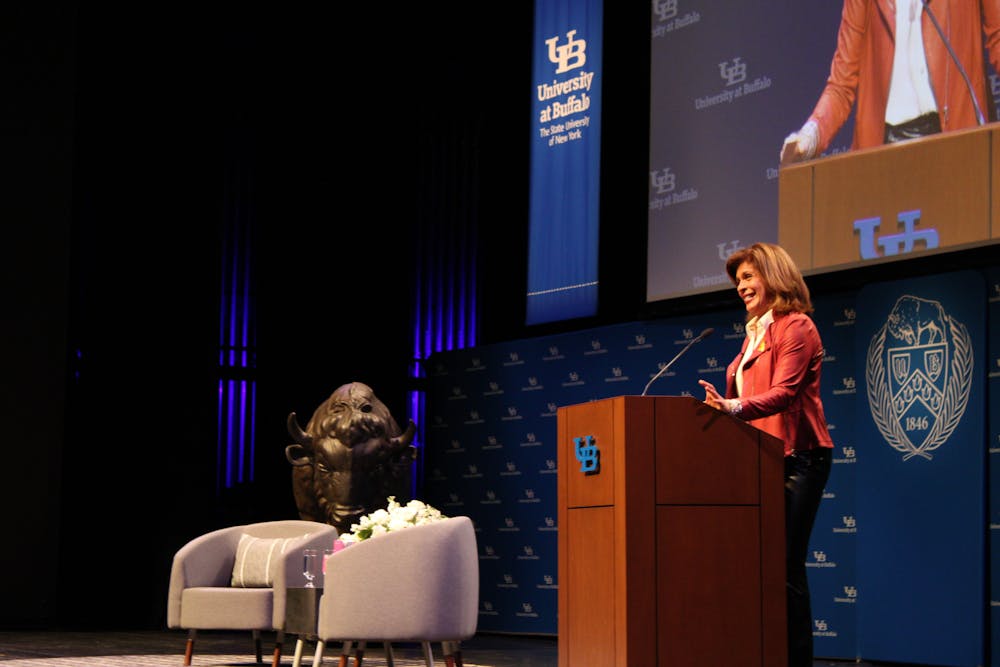
Hoda Kotb co-anchored an episode of NBC’s “Today” show Tuesday morning in New York City.
She then got on a plane at 12:30 p.m. and flew to Buffalo, where she was scheduled as the final speaker in UB’s 2025-26 Distinguished Speakers series Tuesday night.
Kotb spoke to The Spectrum and UB students in a group Q&A format prior to the event, touching on her 17-year long history on the “Today” show as a former co-anchor, the resilient people she met and how light moments can still be found in the often-heartbreaking world of journalism.
While university officials told The Spectrum to avoid questions about Kotb’s temporary return to the “Today” show to fill in for current co-anchor Savannah Guthrie early February amidst the abduction of Guthrie’s mother, Kotb didn’t shy away from the topic. She briefly acknowledged her return to the “Today” show and called the abduction “shocking.”
This interview has been edited for length and clarity.
The Spectrum: You have a long career in journalism. Who are some of your inspirations, and favorite people you worked with? What about their personalities made them memorable?
Hoda Kotb: When you work in this business, you run into so many incredible people. That’s the beauty of being a journalist, if anyone’s thinking about it. You get a front-row seat to history. You get to interview everyone from newsmakers to celebrities.
One of my inspirations is a journalist named Meredith Vieira, who used to anchor the “Today” years ago. What I loved about Meredith was that she showed me you could be kind and wildly successful. You could work hard and not have sharp elbows to get your seat at the table. She showed me you could operate the way I like to — with kindness. I didn’t know if I was going to make it in this business because I’m not mean. I don’t like that kind of behavior.
Everyone says, “If you’re going to be at the network, get ready. You’re swimming with sharks.”
I thought, “Really? Why?”
I decided I was going to live my life my way. If I interviewed someone and another reporter asked how I got that interview, I was going to tell them. Whenever I got something, I gave it away. I didn’t hoard it. Many of the people I interviewed over the years also showed me what resilience looks like. I’ve been in hurricanes, in war zones. Every time, I look at someone and think, “I can’t believe you withstood that. I can’t believe you’re standing here talking to me.”
I interviewed one man after a tsunami in Southeast Asia. His daughters, who were probably your age, were on spring break in Phuket, Thailand. The tsunami came. One daughter was found, but he couldn’t find the other. He was going around unzipping body bags, looking for blonde hair. It was horrifying.
When it was over, he said he’d like to sit down and talk. I asked him how he made sense of it — one daughter alive and the other missing. I asked, “What do you say to God?”
He said, “Thank you for not taking both of them.”
Student: With your life as a journalist, how do you balance your job with things outside your normal work responsibilities?
HK: What’s funny is my normal wake-up for the “Today” is 3:00 a.m. I never hit snooze. If you hit snooze, you’re dead. I don’t care what time your alarm goes off — never hit snooze. You fall back into the REM cycle, and when you get up again, you feel worse. Just get up.
So I get up at 3:00, take a shower and do a little morning routine. I do it every day because if I just run out the door and grab a coffee, I feel terrible. I write in my journal and use four prompts: body, intellect, emotions and spirit. I write down what each one needs. For my body, maybe it’s rest, a manicure, a shower or going for a run — whatever it is. For my intellect, I might read a chapter of a book by my bed that I haven’t opened in a month. For emotions, I might think about slowing down with my kids at bedtime instead of rushing through it. And for spirit, I think about how I’ll connect more with God that day.
Student: There’s a lot going on in the world right now. It can feel like a dumpster fire. How do you stay sane as a human being outside of all that?
HK: I’m a big believer that if there’s something you can do to help fix what’s wrong, do it. If there’s nothing you can do, life becomes about where you fix your gaze.
I interviewed Sheryl Lee Ralph, who I love. She stars in Abbott Elementary. Everyone knew her face but couldn’t quite place her. At 66, she was nominated for a Primetime Emmy Awards for the first time and she won. At 68, she got her star on the Hollywood Walk of Fame.
When I interviewed her, she told me that earlier in her career, Robert De Niro once said to her, “You’re a magnificent actress. It’s too bad I don’t have roles for Black women.”
She said, “Did you hear what Robert De Niro said?”
I said, “Yeah.”
She said, “Robert De Niro said I was a magnificent actress.”
That’s what she chose to focus on. That’s where she fixed her gaze.
So much of life is about what you decide to look at. If you see dumpster fires everywhere, find the people with the water and be with them. Focus on them. I like to be around people who are affecting change.
Student: When I watch the “Today” show, I feel at home. Do you think journalism is shifting away from heartfelt stories?
HK: What “Today” does that’s unique is how it presents the news. If you go to most news sites, you’ll probably see similar headlines — this happened, this happened, this happened. The difference with our show is that we know people are watching in the morning. You’re drinking coffee, eating cereal. It’s an intimate time of day. There’s a certain coziness to it that you don’t necessarily get at night or midday.
We still report what happened. We’re not watering it down or pretending everything is perfect. But we try to present it in a gentler way. Two people can tell you the same news, and one delivery can make you feel terrible while another makes you feel like you can handle it. We try to be the second one.
The news is also getting increasingly complicated. It’s harder to find things that feel completely objective because everyone brings their life experiences into a story. We all come with our luggage. Everything you’ve lived through affects how you see things.
But I take great pride in what the “Today” show does because it gives you the news while also helping lighten the load. When people start their day, there’s already a lot on their minds: work, family, whether everything will be okay. Sometimes you need someone to help you set down the heavy backpack for a minute. That’s why we include humor, music and lighter moments. Life isn’t only serious and scary. You can cook, laugh, bring on a comedian and have those moments too.
Student: I know you've interviewed a lot of people over the years. Who is your favorite person you've ever interviewed?
HK: Gosh, that's so hard. I know — that's got to be hard. It's a hard question because I feel like I've interviewed a lot of people. I've interviewed elected leaders. There was this woman who was the democratically elected leader of Burma. Her name's Aung San Suu Kyi. I was able to sit down with her and do an interview, and it was life-changing. She's someone who's been through everything and back. I remember sitting in her presence and thinking, “Wow.”
I love to interview Olympic athletes. Simone Biles — she crushes. It's fun to interview them because not only are they best in class, they literally sacrifice everything to get to this one tiny moment.
Do you remember when Simone had the “twisties” [a mental disconnect between the brain and the body midair] in Tokyo? I remember her windup. I knew everything she was going through and what happened that day. Later we learned about Larry Nassar, that horrible doctor who was abusing the kids. I remember she came on the “Today” after all of that. She had won all these accolades and had gone through all these things just head down, strong. Larry Nassar finally got sentenced. She said it took a lot for her to speak up and say it happened to her. She didn't want to. When it was over, she was sitting there on the set.
I looked at her and said, “You know, he can't hurt you anymore.”
She said, “He can't hurt me anymore.” She looked like a little girl again.
The best in class will show you their vulnerability and then become the best in class again, like she did at the following Olympics.
Student: As a woman, did you face any adversity?
HK: You know what's funny? I just did my thing. There were people who thought a lot about stuff like that. I don't think I did, and I'm not sure why. I just thought, “If this boss doesn't want me, this one will. If this one doesn't think I'm good, this one will.”
I just kept going until I found my person, my people. Sometimes you just have to muscle through.
Was there adversity? Probably. I know I got paid half of what my male counterparts got paid for a long time. Instead of saying, “That's it, I'm never doing this, I was like, I'll have my time.” And trust me, I had my time. When it came time, everything worked for me.
But I tried not to wear that. I tried to do every story. I rolled with it when they wanted me to. I went to war zones when I was asked. I just did it. I'm sure it was there. But again, it's the whole Sheryl Lee Ralph thing — where you fix your gaze. What are you going to look at? So I just tried to push through.
Ciah Courtney contributed to the reporting of this article.
Jacob Wojtowicz is the senior features editor and can be reached at jacob.wojtowicz@ubspectrum.com.
The news desk can be reached at news@ubspectrum.com.


 Photo: Courtesy of Wikimedia Commons
