
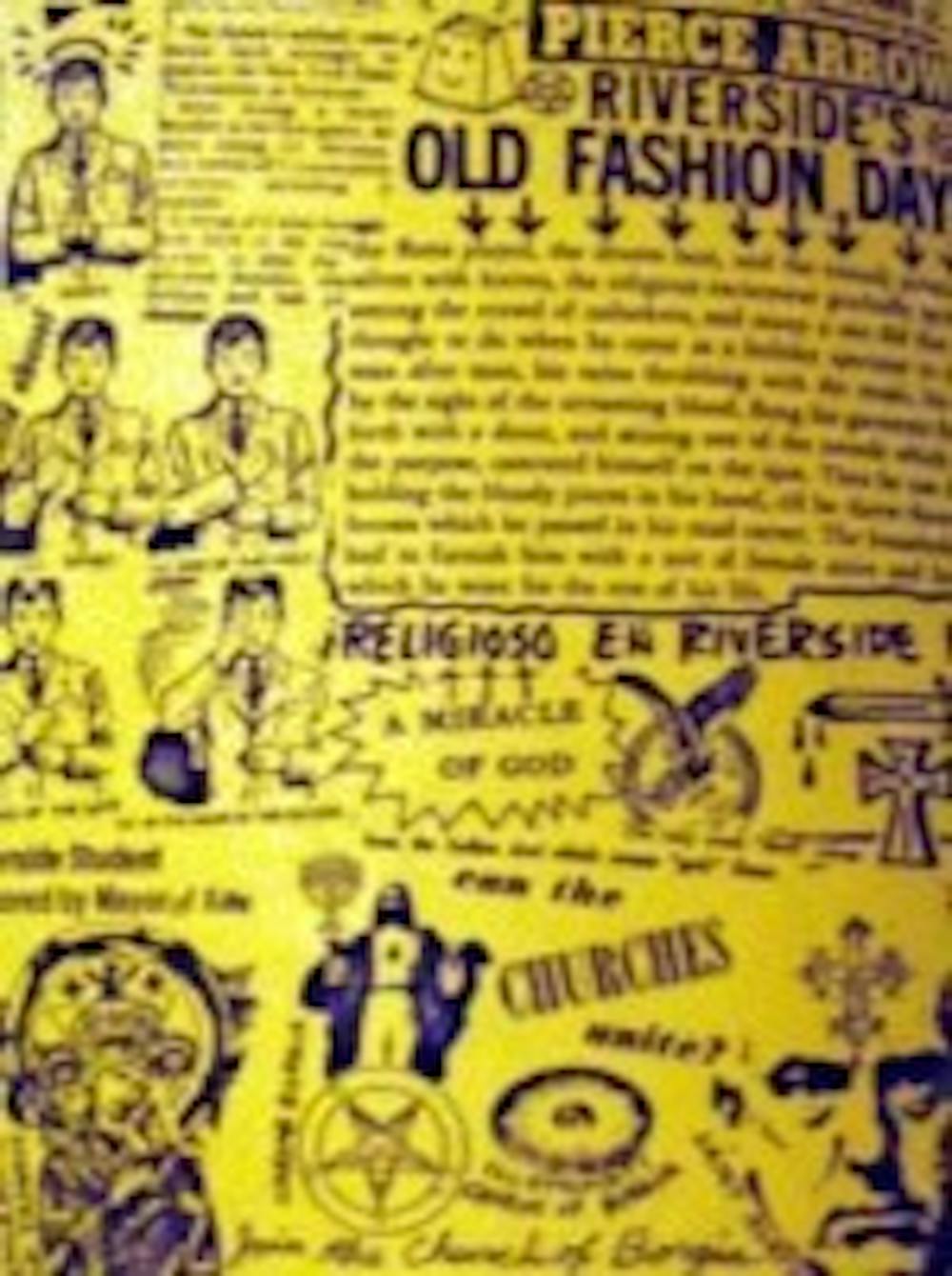
The underground 'zine culture' of do-it-yourself publications is celebrated in a new exhibit in the Undergraduate Library in Capen Hall as a part of UB's poetry and rare books collection.
The unusual publications usually arise from the voices of individuals in a community whose values differ from the traditional mainstream magazines such as Time or Newsweek. Over the years, they have come to be known as zines.
According to Colleen Hubbard, a UB graduate student who has conducted research on zine collections and has been active in cataloguing the UB archives, the nation's only other prominent zine holdings are in Salt Lake City, Utah, San Francisco, Calif., and Bowling Green State University in Ohio.
Over 60 titles have been collected from the 1980s and 1990s to form a unique genre of what Michael Basinski, curator of the poetry and rare books collection calls "fugitive publishing." The zines in the exhibit were acquired through donations.
Zines in the UB archives reveal a prevalence of underground publications in the Western New York region.
"They are produced by people with low-paying day jobs who come home and write about their ideas," said Hubbard.
Material appears in the form of essays, short fictional excerpts, band reviews, anecdotes and random thoughts about society and culture. Many of the columns are written in the first person, reflecting individual points of view.
Subjects of the zines vary widely. A zine called "Punks Before Profits" for example, includes a listing of stores that sell locally grown produce.
Hubbard described the typical zine layout as a "scrappy punk aesthetic," with "design clip art."
"There's a lot of screw-around energy to it," said Basinski.
Distributed for free, or at minimal cost, zines are often produced on photocopy machines or desktop printers.
Marc Moscato, a 1998 UB graduate and producer of "Go Guerilla" and "Generation Latex," two zines included in the archives, said that he used to distribute his publications at hardcore band shows in Buffalo, as well as local businesses.
"Stores in Buffalo used to be more accommodating to selling zines, places like New World Record and Talking Leaves," said Moscato.
To keep the production going, Moscato ran ads for local businesses in his publications.
Some believe that the new archive is an important historical resource for generations to come.
"It's a reference of what was important to certain people at certain times," said Hubbard.
Moscato said he is glad to see such out-of-the-ordinary publications receive attention.
"A lot of libraries collect things that are watered down by 12 editors," Moscato said. "They collect anything with a UPC label, and that determines what history is."
Not everyone can afford to have a UPC - a number and bar code label that identifies a consumer product - for their publication however, and as a result, individual points of view are lost due to corporatism, said Moscato.
Moscato said that producing zines has been a transformative experience for him.
"Being involved with zines has definitely influenced and changed my life through gaining skills, confidence and entrepreneurial experience," said Moscato. "That was so much more valuable than things I learned in my formal education. Seeing it all being able to work was really mind-opening; to really be free from commercial interest."
This is a progressive collection, according to Basinski, and he said he hopes that other universities will follow the example of recognizing zines as a credible resource.
"There's a lot of publishing in Western New York that people don't know about," he said.



