
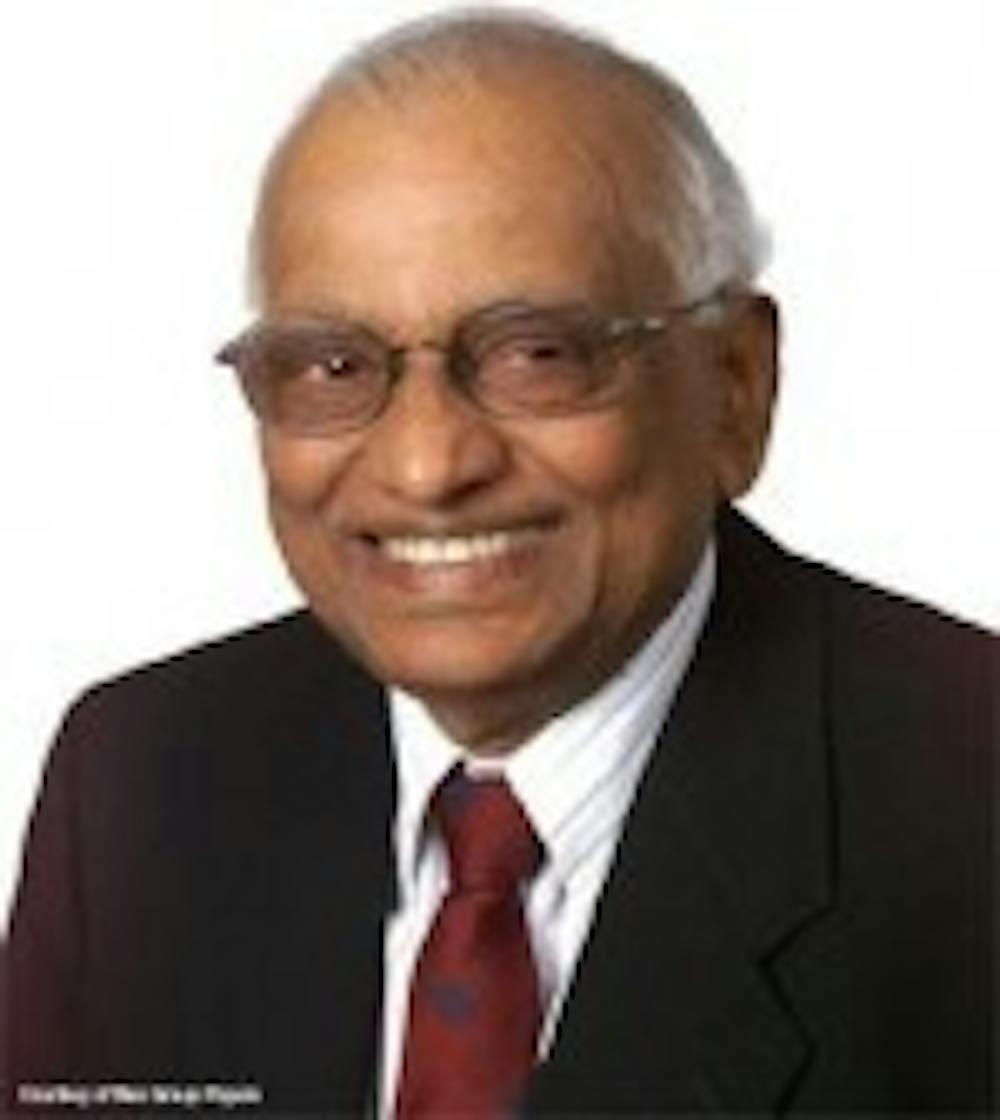
As a political novice and outsider, Satish Mohan has already ruffled feathers within the current Amherst and Erie County power structures.
In less than a month on the job as Amherst Town Supervisor, Mohan has challenged county tax breaks for big corporations and called for reduced overtime and a smaller workforce. Both decisions have launched criticism from other supervisors and town employees.
"I'm learning, so I do not know how to deal with politicians," Mohan said. "I'm not seen as very impressive in the Town Board, but I can see they're coming around."
Mohan's first brush with criticism came within a week of taking office. Instead of rubber-stamping his signature on all town checks - including employee paychecks - Mohan wanted to personally review and hand-sign every check. The process was, as expected, time consuming and resulted in employees not getting their paychecks on a Thursday, as usual, but on a Friday, Jan. 6. The checks weren't technically late, being dated for that Friday, but Mohan still issued an apology to those expecting checks a day earlier.
Mohan said the reason he signed the checks personally was to ensure the town's payroll was accurate. He also signs all checks to vendors and for contracts, ensuring those are accurate as well.
"It's not a show," he said. "We pay $10 million a month and each check is different. I want to make sure I am signing on a check that is justified."
Mohan said he won't continue signing payroll checks now that he has a complete employee summary, but he will continue signing vendor checks.
Last week, Mohan ran afoul of the Erie County Industrial Development Agency, or at least several of its members, by not being willing to grant a $623,500 tax break for a FedEx expansion.
Mohan's reasoning was that an established company like FedEx didn't need a tax break under lenient rules designed to promote business growth, especially for a company that wouldn't be creating any new full-time jobs. Fedex's $2.7 million expansion would create only 16 new part-time jobs.
"We can't give money to the rich and not to the poor," he said. "This money will go to a business that is well established, but they qualify according to policy guidelines."
Mohan said he believed most on the committee realized the situation, but voted for the tax break because it was expected. The board voted to pass the tax incentives by a margin of 11-2, with County Executive Joel Giambra joining Mohan as the only other dissenting vote.
Recent Buffalo News stories have said Giambra has been seeking a new image in Erie County, picking a new political track to improve his battered reputation of a nearly bankrupt county. Was Giambra's vote against FedEx an effort to piggyback on the reformer image that Mohan has?
If it is, Mohan wasn't clued in.
"I'd heard about him, read about him, but that was my first meeting with Joel Giambra," Mohan said. "We shook hands and he took his chair. I didn't know he voted with me until I read it in the paper."
Mohan did say he agreed with some of Giambra's points at the ECIDA meeting, particularly the idea of changing the policy of tax breaks for building new commercial areas with no tenants.
"Emptying of old buildings is the beginning of slums. Businesses should be able to manage themselves," he said. "If a business depends on government subsidies, that's not a good business."
Mohan compared his plan for improving Amherst to that of a Western New York peer, Greece, a suburb of Rochester.
"They are 20 percent smaller in population and 20 percent smaller in area, but their budget is 40 percent smaller," he said. "Our budget right now is $100 million. According to their formula, we should be spending $60 million."
Mohan's next focus is retaining college graduates in the area, particularly those from UB and other Western New York colleges.
"I want to start co-op programs with businesses and students, where employers will hire students and, after some time, hire those students as employees," he said.
"It's not a government business," he added. "But someone has to do it. We want to be a facilitator between the colleges and businesses."



