
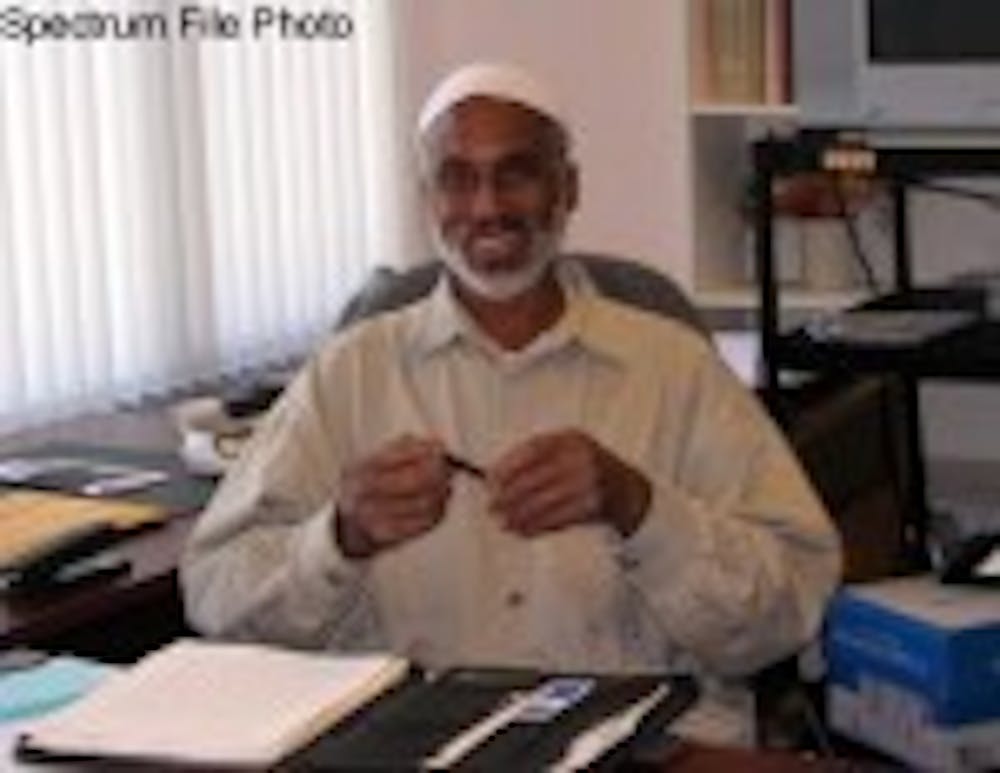
At 8 a.m. on Tuesday and Thursday mornings in the basement of Clemens hall, 20 or so students pull their desks into a squashed circle and get ready for discussing the idea of racial taboos in Luis Nieves' Intro to African-American Studies course.
Half African-American and half Puerto Rican, Nieves brings a diverse approach to teaching his classes.
The students have joined the class for different reasons, but Nieves hopes that they will leave at the end of the semester as global citizens who are fully aware of both the ecological and economic systems that are in place for African-Americans, how they came to be in place and what they can do to change them for the betterment of mankind.
Known to his students as "Khalil," Nieves has been teaching at UB for almost 11 years as an adjunct professor in the African-American studies department. He moved to the Buffalo area in 1990 because of the public Islamic seminary located in Medina, N.Y.
As a professor, Nieves has managed to have an impact on his students based on the course material he chooses to teach.
"He makes us think critically about things," said Dominique Davis, junior African-American studies and philosophy major. "He teaches us things that aren't normally taught."
Islam has been a major factor in both Nieves' personal and professional life. A Muslim since he was 20, Nieves said Islam has become a driving force behind his ideas for the future. Over time, he gained a different understanding of the ecological system and hopes to improve the situation.
"Eventually I moved to St. Croix and began building a house and planting an avocado orchard. I understood the ecological destruction that the plantation system wreaked on many Caribbean islands," he said.
Nieves emphasized the effects that the slave trade, and later, colonialism, had on Africa, Latin America, and the Caribbean. He gears his class towards the ramifications of slavery and what removing such a huge labor force does to a country.
Nieves said he tries to keep the students thinking about the surrounding community as an example of a lack of effort.
"Think about Buffalo," Nieves said. "This city keeps getting behind. We have a first-hand perspective of what happens when the young people leave."
Nieves said he believes that reparations need to be made for the slave trade and its ever-present consequences. Abraham Lincoln's promise after the Civil War to give every freed male slave 40 acres and a mule were appealing to him.
"I want a tractor!" Nieves said. "Times have changed a little. But you can keep your food stamps, give me land."
Nieves believes that in order to close the racial gap that affects today's society, reparations need to be allocated to rebuilding the infrastructure of primarily black neighborhoods. This would include housing developments, better roads, schools and parks.
Nieves pointed out that such a program is implemented by Canisius College, which gives incentives for its faculty to move into the city.
He said encouraging home ownership could help reduce crime and other problems in a neighborhood.
"There is a direct relationship between home ownership and drug use," Nieves said. "As home ownership increases, drug use goes down."
"We need to encourage racially mixed neighborhoods, we need diversification to break down the apartheid," he added.
Nieves' classes are not only unique in subject matter, but they are unique in method as well. He does not give formal exams, and this year is incorporating a relatively new media technology into his class and his students feel that his course material is at a higher level of learning.
"It's a 100-level class but we're learning more at a 400 level," Davis said.
This semester his students are collectively creating three blogs: one on the global apartheid, one on women and information technology in South Africa, and one on women and info-tech in Jamaica.
In addition to promoting awareness of the global apartheid, Nieves believes that global warming is an issue that needs sufficient attention.
His colleagues see him as an encouraging individual who is a pleasant addition to the department.
"He has a lot of knowledge in different areas that adds a pleasant piece to the department," said Deborah Pierce Tate, secretary in the African-American studies department.
As popular as he has been in Buffalo, Nieves plans on leaving the area soon, moving to Atlanta next year, where he will continue teaching and working to promote his vision for a "just and equitable" system.
"As a father, cultural worker and teacher, I am committed to preparing people for generations of struggle to stop this war and to continue creating a new world. My contribution is in writing, organizing and teaching others to help do this work," Nieves said.
As a teacher, he believes it is his role to help his students discover and cultivate their talents.
"In Islam, we have a saying," Nieves said. "Every person is a universe within themselves. It is their challenge to discover and cultivate their inner beauty."



