
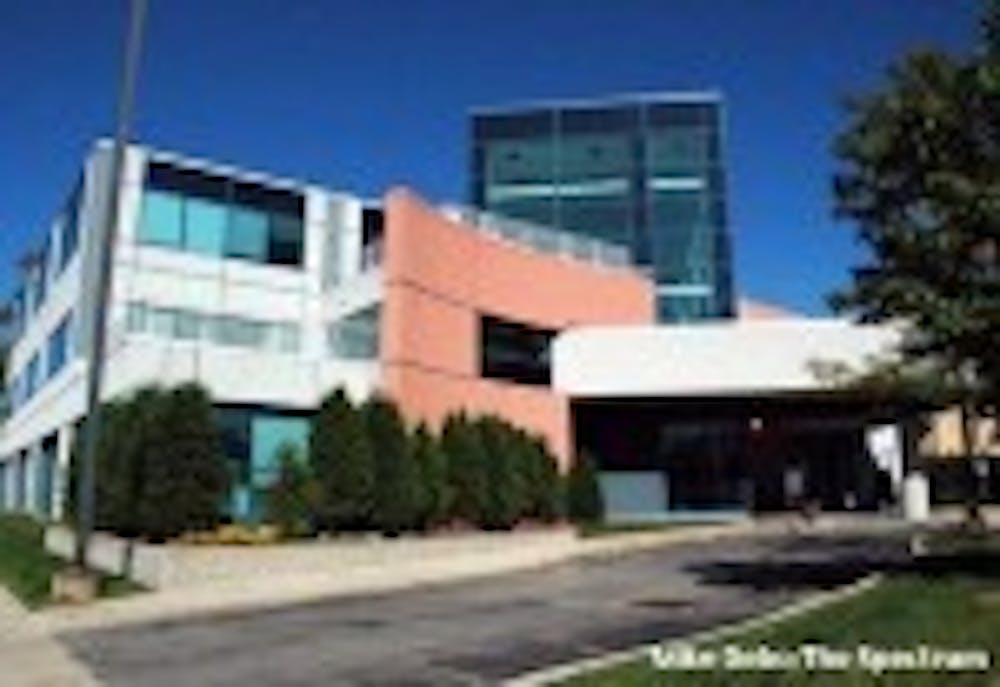
UB's cutting-edge bioinformatics program continues to come together this semester with construction on the downtown Center for Excellence scheduled to finish in 2005 and academic programs currently in development.
According to UB officials, the program is now in the final 30 days of a strategic planning stage and preliminary undergraduate courses are now being offered.
"We are doing academic planning right now to see how we move forward," said Provost Satish K. Tripathi.
According to Tripathi, the planning committee is focused on several different elements of the program's development, including academics and community networking. All of this planning, Tripathi said, is part of President John Simpson's greater comprehensive plan for the university.
"This process is a little bit ahead of the rest of it," he said.
While the term "bioinformatics" is still foreign to many people, several UB officials agreed the concept is neither new nor should be considered foreign.
"Some of (bioinformatics) exists in every major research institute," said Bruce Holm, senior vice provost and member of the planning committee.
According to Holm, bioinformatics is the complex analysis of tens of thousands of individual analyses at once, ranging from scientific fields to management. Much of it, however, revolves around biology.
"What we're really talking about is all of biology is undergoing a revolution. It's the post-genomic era," Holm said, referring to the recent de-coding of various gene sequences.
"Now we have the capability to move at a much greater speed than has been made before," he added.
Tripathi echoed Holm's sentiments on the bioinformatic revolution, saying it has already had a great impact in areas that were once science fiction, like nanomedicine.
"It's changing how were doing engineering, how we're doing science," he said. "You can compare this with what happened with computers 15 to 20 years ago."
As for how this cutting-edge field will affect UB, Tripathi said the completion of the Center for Excellence in Bioinformatics and Life Sciences will give UB a unique advantage.
"I hope it will make us one of the top (programs) in the country," he said. "We would definitely have a good infrastructure here, but we still need to achieve in terms of the research and the intellectual property."
According to Holm, the Center for Excellence has the opportunity to be one of the "pre-eminent centers in the world." Already, there are a number of Nobel laureates working within the program, and a national search for faculty is going well, Holm said.
When the three-building complex is completed next year, it will be home to one of the world's largest computer clusters and will work closely with both the Roswell Cancer Institute and other local hospitals, Tripathi said.
"The center definitely has a role and an interface with the community in terms of jobs creation and cutting-edge advancements," Tripathi said.
"This will offer the opportunity to put a core group of faculty from all campuses in one downtown location," Holm added.
Tripathi said he doesn't currently know the comprehensive cost of the center, faculty searches, and academic development.
"I look at the whole thing as an investment rather than a cost, because once its done you need to look at what are the benefits," he said.
And for the first time this semester, undergraduate students will not just be able to abstractly look at those benefits, but actually experience them.
According to Mary Bisson, chair of the biology department, this semester marks the launching of preliminary undergraduate courses in bioinformatics.
"There's been a lot of hype for the center, and people are very interested in it, but people don't necessarily know what it is," she said.
Bisson said she thinks that now that undergraduate courses are underway, it will help get the word out about the center and the overall program.
"I don't think we should consider bioinformatics synonymous with the center," she said.
Rather, the program should have its heart spread out across biochemistry, biology, physics and all the disciplines it encompasses, Bisson said, while the center "plays its role in focusing and coordinating as a nexus of communication."
"It remains to be seen how it's going to work out," she added. "We'll just have to see."
According to Holm, the program will not have a noticeable impact on undergraduates at first.
"It will seem at first that there is more of a focus at the graduate school level and professional schools," he said. "But there are undergraduate programs that are in development and are going through (the state) Department of Education for approval
Holm said the key to developing the undergraduate program in bioinformatics is being able to both encompass a wide spectrum of disciplines and combine the new with the old.
"There's always a challenge of when you're putting something together in an interdisciplinary way," he said. "How do u integrate it with the traditional units?"
"These are challenges we expected to face and we are facing them," he added.
Holm said it is not yet known whether the bulk of bioinformatics courses will be held on North Campus, South Campus, or even downtown.
"If you want to understand medicine you have to be on a clinical campus, not in a classroom ten miles away from it," he said.
While Tripathi said he is happy with the progress the program is making, he would like to see bioinformatics better brought to the students.
Whether students are in the sciences or humanities, he said, bioinformatics is an intriguing field in which even its most distinguished scientists are still asking, what is this all going to mean to the average person?
"I think the whole development in the area in the area is really for the good health of the people, whether it's the developing of new drugs, therapy, or devices," Tripathi said. "It's really going to impact how we live, how long we live, and what quality of life."



