Over the past few years, organizations like Gallup have documented a remarkable social change in America: more American adults are identifying as lesbian, gay, bisexual, transgender and queer (LGBTQ+). Most of this growth can be attributed to Generation Z — individuals born between 1997 and 2006 — with 23% of the generation identifying as LGBTQ+. This has increased the national proportion from 4.5% in 2018 to 9% in 2026.
It appears that, slowly but surely, the concept of heteronormativity has been declining. Heteronormativity can be defined as “the attitude that heterosexuality is the only normal and natural expression of sexuality.” This has occurred alongside a reactionary pushback in recent years, with prominent right-wing influencers like Chaya Raichik and Chris Rufo leading efforts to make LGBTQ+ equality a continuing culture war battle.
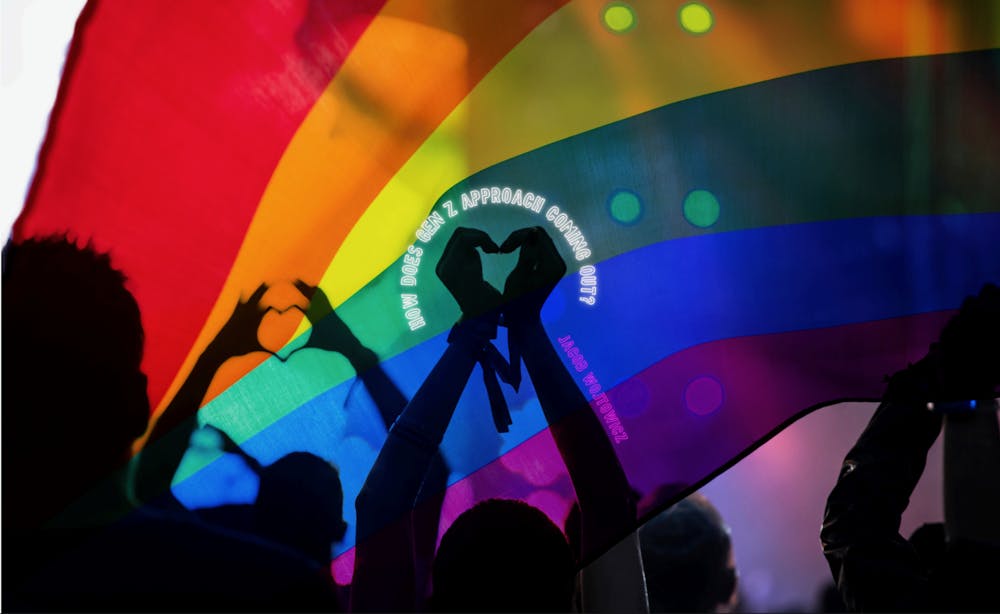
With increasing numbers of young people identifying as LGBTQ+, one must wonder how the concept of coming out has changed over the past decade. Coming out was once — and, to many people, still is — a major event in the lives of many queer individuals. How does Gen Z approach coming out?
Three UB students were interviewed about their experiences and shared their hopes and concerns about the future.
Joseph Chan, a junior from Brooklyn majoring in political science and part of the 3+3 law program, said he came to identify as LGBTQ+ in the eighth grade. He said he struggled with internalized homophobia.
“When I was younger, I did just want to have what I’d say is a ‘normal’ life, which part of that would be being straight,” he said.
He credits musicians like Lady Gaga and Billie Joe Armstrong of Green Day for helping him come to terms with accepting himself.
Chan said he hopes that, at the very least, being gay will be treated “indifferently,” but added that, for the foreseeable future, the coming-out process remains ongoing.
“I feel like sometimes the nicest people might still be a little homophobic… The first time you come out is a really big thing, but people don't talk about how essentially you're coming out all the time with every single person you're meeting,” he said.
This sentiment is shared by Elizabeth O’Boyle, a senior sociology major. Although she had not previously thought of it that way, she said coming out is an ongoing process.
“Especially if it's like an older coworker or something, I do have to sort of think about, do they need to know about this or not? … I'm going to be gay in their mind now. So what does that mean for me? And should I just not talk about it?” she said.
O’Boyle’s response is a testament to the changing nature of coming out. She said she does not think of talking to older co-workers about her relationships as “coming out,” but still approaches those conversations with a moderate degree of apprehension.
O’Boyle, who is from rural Oneida, NY, near Syracuse, said she cannot tell if she has struggled with internalized homophobia because, ultimately, society shapes what people internalize.
“We are what we've lived through, what we've internalized, what we have perceived as normal at the end of the day. I've gone back and forth in my head a lot about, like, do I just want to go and be with a man and have kids or something? And then I'm like, God, no… I have still identified as bisexual, but I’m a lesbian in practice.”
O’Boyle said she did not consider that she was bisexual until she was 17. Both of her siblings are queer, so coming out within her family was not a major event.
“My mom is pretty laissez-faire,” she said.
Another student who did not consider they might be bisexual until after adolescence is J.J. Chen, a sophomore majoring in political science, criminology and law from Brooklyn. He said he began considering he might be bisexual within the last year.
“Maybe I don't really care anymore. It's not high school. My parents are not around. Maybe just go do some stuff I want to do,” he said.
Chen said he witnessed a lot of homophobia growing up in a religious church environment. Many of his friends back home come from similar backgrounds.
“All my friends back home are really religious and they're against that idea and stuff,” he said.
Being at UB has given him a large queer social circle.
“All three of my friends currently for next year to be my roommates are all gay. And then my other friend who's also gay. I have another friend who's bisexual. I have three friends from my other friend who are all lesbians,” he said.
Chen said he has a generally positive outlook regarding LGBTQ+ rights in the future.“I think there is growing acceptance. When people slowly begin to accept cultural change, I'm sure that the majority of them will begin to accept who you are,” he said.
These experiences show that although more people are “out,” society has not reached a point where coming out is no longer necessary. Still, despite recent right-wing pushback, many have a positive outlook on the future.
As O’Boyle said: “My younger sister is a senior in high school. And now I feel like there are so many now that it's not as much of a given that everybody is straight.”
It should be noted that many people are still closeted to varying degrees.
These three stories reflect only the individuals who shared them. Everyone has a different experience. More people were solicited for this story, but only three agreed to be interviewed.
CORRECTION: The article incorrectly stated that J.J. Chen was majoring in sociology and political science. Chen is majoring in political science, law and criminology. We regret this error.
Jacob Wojtowicz is the senior features editor and can be reached at jacob.wojtowicz@ubspectrum.com

 Photo: Wikimedia Commons | Courtesy of Quintin Soloviev