
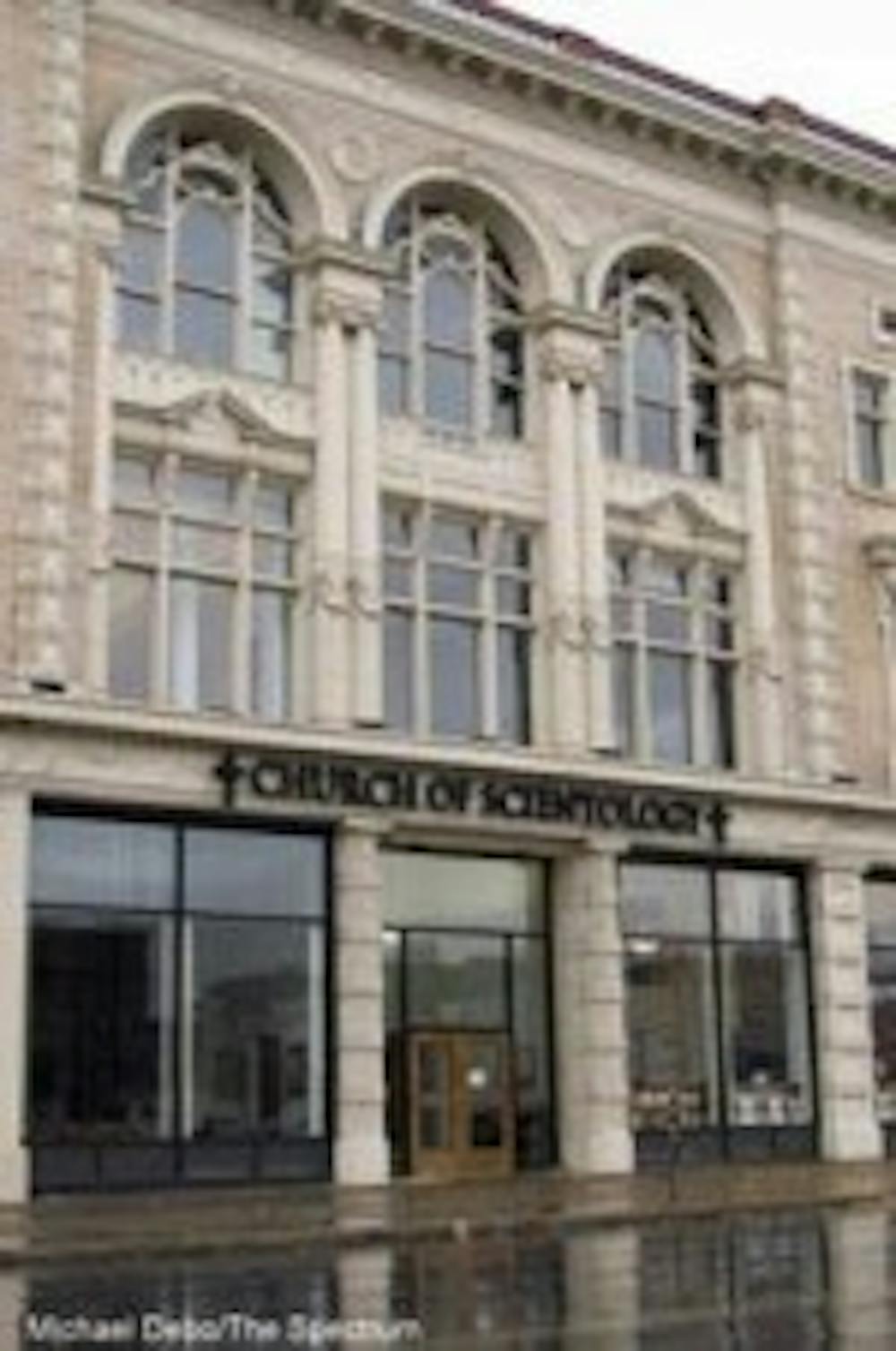
All the Tom Cruise hype aside, Scientology isn't merely alive and well in Buffalo, it's growing. And the next stop on the ambitious church's expansion is none other than UB's North Campus.
Theresa Reile, a Scientologist for 30 years and current president of the Church of Scientology of Buffalo, said the religion focuses the true self of one's spirit and she is eager for UB students to experience it for themselves.
Though UB has no clubs or organizations based on Scientology, the Buffalo church, which is on Main Street, is putting the finishing touches on a new "life improvement center" that is planned to open this week.
Located on the second floor of The Commons, the center will provide information on Scientology, including classes and seminars, movies and profile quizzes to illustrate how Scientology helps people, Reile said.
Despite growing media hype and celebrity promotion of Scientology, many still don't understand what it is as a religion.
"All I know is what is in the media," said sophomore Jessica Collier.
The religion, which has existed since the 1950s and was created by writer L. Ron Hubbard, has goals of creating "a civilization without insanity, without criminals and without war, where the able can prosper and honest beings can have rights, and where man is free to rise to greater heights."
"Scientology is the study of life," said Reile. "It is meant to - as all religions are - free your spirit working through dianetics, which deals with what the soul is doing to the body through the mind. You don't have a soul, you are a soul."
Reile said that a key factor of Scientology is that it works together with many other religions, not in competition against them. Although she was raised Catholic, she said that Scientology gave her a better understanding of Catholicism, which is what many people employ the technologies of Scientology to do.
"Our church works with many congregations," said Reile. "Although I personally don't really follow the doctrines of these many faiths, I understand and respect them because of Scientology. It is not meant to convert people from their beliefs, but rather to strengthen their insight."
Another feature of Scientology is that nothing is based on faith, but rather on observable truths. Its principles are thus applied in one's life, and its results are what are accepted as truth.
"We don't tell people what to believe when they step in the doors of our church," said Reile. "One is expected to think for oneself, and thus what's true for you, is true and real."
Mr. Hubbard has become a spiritual inspiration for its followers, and the religion's official Web site claims that the universal acclaim for the man - including thousands of awards and recognitions - is merely one testament to the effectiveness of his technologies.
Today Scientology is practiced in more than 125 countries and consists of a hierarchy of churches that offer services to educate beginners on the fundamental aspects of the new life experience. The churches also offer exercises for the more "spiritually advanced," meant to raise man out of his routine tribulations and lift him up to never-before foreseen spiritual vistas.
"We have Sunday services, just like at other churches," said Reile. "Every week the minister goes over one concept of life including the issues of communication, affinity and urges, among others."
The concept of life in the church focuses on the eight dynamics, or one's basic role in survival, including in the self, the family, the group, the world, the plant and animal kingdom, with physical materials, the spirit, and supreme being, which according to Reile, can only be understood when one understands life.
Arguably more than any other religious movement started in the 20th century, Scientology has had more than its share of controversy, clashing with governments and police in several countries while drawing the ire of academics for libel lawsuits amid allegations of criminal activities, brainwashing, and controversial deaths.
"The history of the church is something completely out of left field," said Victoria Burhans, a sophomore undecided major. "I don't think many people understand it, because the media distorts and misrepresents the truth behind it. All people want to hear about is Tom Cruise jumping on couches, and then judge their opinions of the entire church on that."
Because of celebrities involved with the religion, the media has often been the main influence on people's impression of it.
"I don't agree with what scientology stands for," said Stacy Travis, a sophomore undecided major. "I don't think stars like Tom Cruise should judge people. Depression is a very hard and personal thing for one to go through and I don't think anyone has the right to judge a person for taking the actions they feel is best for them."
According to Reile, the entire religion is about the improvement and uplifting of the self.
"Our church is non-denominational," said Reile. "We invite everyone to join us in the ultimate goal of understanding life."



