
Over a decade ago, Forbes published an article titled: “Privacy is Completely and Utterly Dead, and We Killed It."
Since then, privacy has become even more salient in the public discourse in the United States.
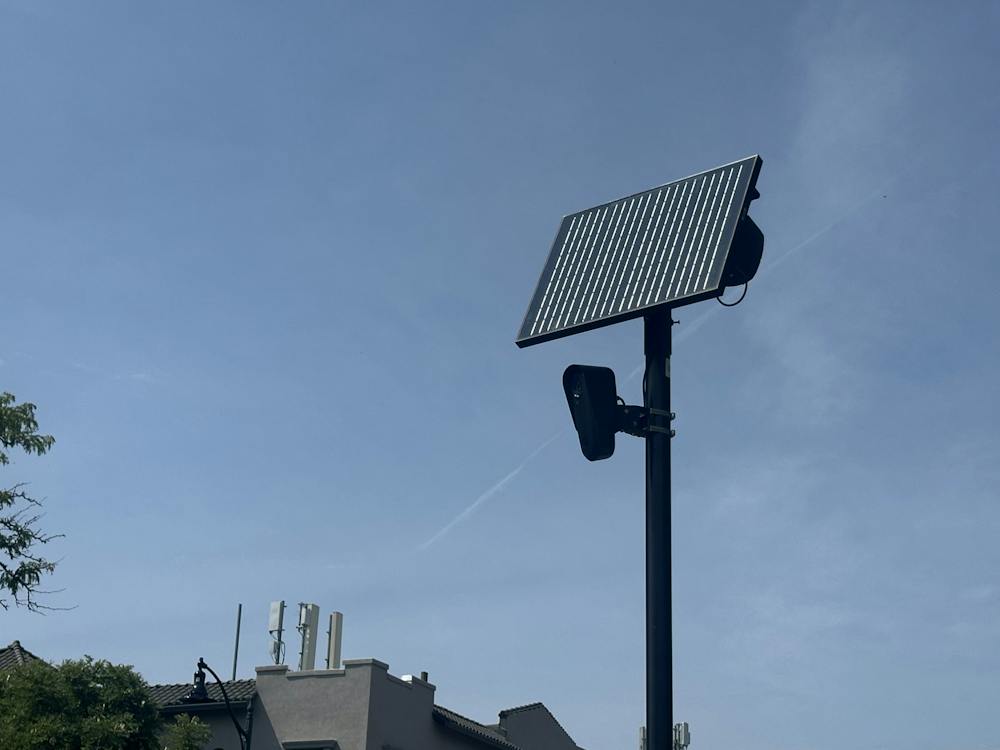
Flock cameras, an automatic license plate reader made by Flock Safety, may be one of the most public faces of this discourse.
Automatic license plate readers (LPR) read and identify license plates — sometimes with the assistance of artificial intelligence, which Flock cameras use — making it possible for law enforcement agencies to track vehicles for investigations. It recently came under fire as police officers were caught abusing the system — such as to track exes — or departments conducting searches on behalf of U.S. Immigrations and Customs Enforcement.
University Police announced that they are considering the installation of approximately 20 Flock cameras throughout the North and South campuses for a 60-day pilot program in an Aug. 26 statement. Specific locations and timelines are not decided yet.
UPD looks to use the cameras for vehicle-related crimes. It said it would opt out of the nationwide database and information would not be used to assist federal agencies such as ICE.
The Spectrum asked students and faculty about their perspectives.
“Creepy,” disgusting” and “obsessive”
Two students — freshman art major Darren D’Arcy and sophomore English education major Apollo Serrano — called the planned installation “disgusting.”
“Your face is there. What you're wearing is there,” Serrano said. “It's an uncomfortable feeling for a place that's supposed to be home for a lot of students, and especially me coming from New York City. It upsets me.”
Anna Shwaber, a first-year criminology major, and Thomas Harvey, a first-year computer science major, included the thought that the university was “doing too much” and that it was “obsessive” respectively.
Rajesh Kumar, a junior economics major, says that the installation sounds “creepy.”
Victor Perez, a senior biomedical engineering major, said he would want to destroy them if UPD puts up the Flock cameras.
“It's a waste of our money, and I will ensure that it's no good because I will break them personally,” Perez said.
Anthony O’Rourke, a law professor, can think of a few reasons why the UB community should have more doubt in UPD’s assurances that they’ve opted out of Flock’s national database and the data deleted after seven days.
The system can still be abused, O’Rourke says.
“Even if this isn't shared in a national database it still creates the potential for abuse by members of the UB Police who have access to the data,” O’Rourke said. “The scope of the UB Police's contemplated use of this would also allow the UB Police to share this information in some circumstances with members of other police jurisdictions who request the information, and that has the potential for abuse. This can be used by the university police in ways that would suppress core constitutional rights.”
O’Rourke cited the forceful arrests of 15 pro-Palestine protesters in spring 2024 after an attempted encampment. He says it could allow for the surveillance and tracking of student protesters.
“The university police could, as a matter of policy, use it to track and survey students who are troublesome from the perspective of the police or the administration but who are engaging in perfectly legal and constitutional activities,” O’Rourke said.
Andrés Buxó-Lugo, a psychology professor, echoed O’Rourke’s concerns about the way that the university handled the protests two years ago.
“I think those things are red flags that have got me worried for the students especially,” Buxó-Lugo said.
Thomas Ouimette, a junior mechanical engineering major, says one should always protect their rights under the Fourth Amendment which protects people from unwarranted and unfair searches.
“You should always protect those rights even if you don't feel necessarily they're relevant in your current situation,” Ouimette said. “If the tables are turned, how would you feel if it's being used against you?”
Sage Daniels, a sophomore majoring in chemical engineering, says things that one thought was not going to be criminalized could be criminalized.
“What was previously not something you had to hide is now something that you very much do have to hide,” Daniels said.
While seemingly rare to find, there are supporters.
Luke Coppola, a senior majoring in computer engineering, believes that Flock cameras are ultimately a net positive for students.
“I don’t know why you would think otherwise that university police or anyone who has this kind of information would be doing something wrong with it.” Coppola said.
Owen Delahunt, a sophomore majoring in chemical engineering, echoed Coppola’s sentiment.
“If you're not doing anything wrong, you're not doing anything wrong,” Delahunt said.
Used to being watched
Multiple students, including Serrano and Daniels, expressed a sentiment that we’re all used to being watched.
Luka Paraskevov, a sophomore majoring in graphic design, said Flock cameras are simply a natural progression of the loss of privacy.
“The world is becoming more and more like cyberpunk,” Paraskevov said.
Elijah Redfield, a sophomore English education major, agrees that this is par for the course in modern society.
“Coming from a big city I feel like you're never really alone. I feel like somebody's always watching you. I don't like it, but what can I do about it?” Redfield said.
Tydeja Kemp, junior communications major, says that transparency is of utmost importance.
“There should be 100% transparency on what information is being taken from them, especially biometrically,” Kemp said.
Dylan Zelko, a second-year enrolled in a master’s robotics program, says that there must be transparency.
“And if they aren't completely honest with it, then I think it's completely up to the students to kinda speak up and talk about the hypocrisy behind that,” he said.
Bryce Flynn, a senior law and sociology major, says the cameras may not even stay past the 60-day trial period if implemented.
“The university hates spending money. I don't see how UB will get anything out of it. The campus is small enough that the university has enough police officers to know where things are happening outside of having the camera,” Flynn said. “I probably have just a little bit too much faith in the university, but from what they have said, I don't believe that they're gonna keep it.”
Jacob Wojtowicz is the senior features editor and can be reached at jacob.wojtowicz@ubspectrum.com.


 Photo: Courtesy of UB Athletics; Credit: Paul Hokanson
