
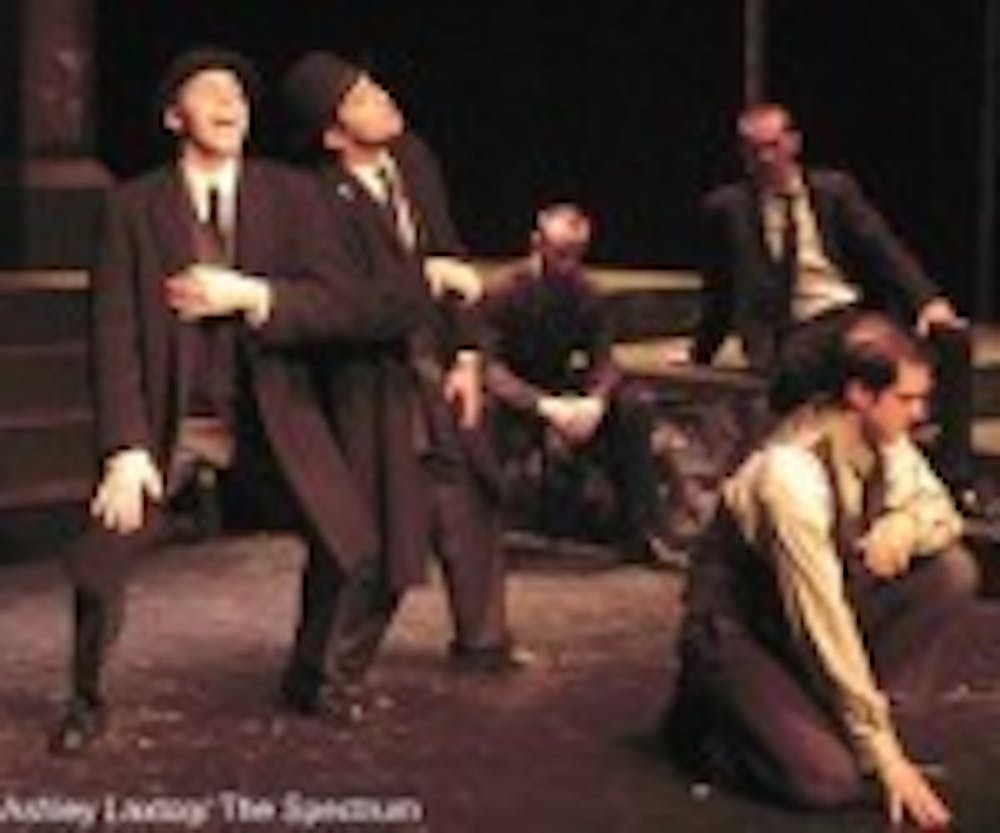
Only in a world originally created by Franz Kafka is it possible for an actress to morph from an exotic dancer to a linen closet.
"The Trial," a play adapted by Steven Berkoff and directed by Vincent O'Neill, debuts Wednesday at 8 p.m. in the Center for the Arts Black Box Theatre. Student tickets cost $8 and general admission is $16.
Kafka's novel makes for a challenging adaptation because it is laden with internal dialogue, dream sequences and subconscious sublimation. By making use of a chorus, Berkoff triumphs in blurring the line between appearance and reality.
"Berkoff utilizes the chorus, rather like the Greek chorus, to move the narrative along," said O'Neill in an interview with The Spectrum. "The chorus represents the two sides of Joseph K's (the protagonist's) brain. You get a conflict between the individual trying to express himself against the citizen who is subsumed into society."
The stage is splendidly stark, which is conducive to reverse anthropomorphism. The actors and actresses become tables, vehicles, environments and thoughts in order to compensate for material things.
It is refreshing to witness a play that beseeches the imagination and intellectual efforts of audience members. The presence the student actors bring to the stage is far more interactive than Victorian furniture and painted cardboard trolleys.
"There's as much emphasis on the physical as there is on the text. The set is deliberately quite bare except for levels and arches," O'Neill said. "That's to allow the actors to create the physical world of the play with their own bodies. Actors become sounds, landscapes, atmospheres. They are constantly shifting grounds and personalities."
In addition to assimilating themselves into the set design, the actors also play multiple roles. Kafka's novel is made hazy by subconscious alterations and stream-of-consciousness prose, so it is necessary for the characters to double up.
"The novel is dream-like and surreal. It's expressionistic," O'Neill said. "There are times when we're not sure Joseph K. is living through something or dreaming it. In the world of nightmare and fantasy, there is a constant metamorphosis of characters, locations and atmospheres."
When asked if this would create ambiguity for the audience, O'Neill said, "I hope so. Kafka doesn't give us answers. He poses problems."
The boisterous cast makes up for the lack of stage tricks with their coordination and charisma. The fight scenes are just as stimulating as the underlying social commentary.
"A massive conflict within Joseph K. is whether he should conform to society and remain safe, or whether he should retain his uniqueness and fight the system, knowing he'd be punished," O'Neill said. "When a bureaucracy or institution creates terror, the individual becomes flexible, and the majority of society will bend towards what they perceive as security. All you need is a catalyst."
Much of the play strives to be problematic by concentrating on the more abstract forms of reality.
"I'm very excited by Berkoff and what he does with literature, how he inverts it, how he explodes it," O'Neill said. "And his selection of language from the novel is extremely visceral. You can feel it on your tongue, and actors like that. Berkoff instinctively understands the dramatic core in literature, and finds the human dynamic that performers can relate to."
"The Trial" runs Wednesday through Saturday at 8 p.m. and again on Saturday and Sunday at 2 p.m. Tickets are available through www.ticketmaster.com.



