
A $2.4 million grant has kept UB’s teacher residency program going this year but can’t fill the hole that the federal cuts left behind.
UB’s Urban Teacher Residency program was left in financial limbo since March, when the sudden termination of $4 million in federal grants prevented the program from onboarding its 2025-26 cohort and left an unclear future of whether it was viable enough to remain running. The program was created to diversify Buffalo’s high-need districts, helping to close the racial disconnect between students — the majority from racial minority backgrounds — and a teacher demographic predominately white. For 16 months, residents would teach alongside a mentor teacher at a high-need school in a Buffalo district for a full school year, as well as handle four semesters of rigorous university coursework. Now under the Accelerated Course to Teaching program, funded by SUNY and New York State’s Office of Strategic Workforce Development, the teacher residency program has been able to continue running.
Though even with state funding, the program has undergone a number of changes: most notably that the residents are no longer required to stay and continue working in Buffalo for three years after they finish. To combat this, the program is prioritizing recruitment of people who want to make a career teaching in Buffalo or Lackawanna city schools.
The program still had to be shrunk down to keep most of the funding safely allocated for the residents themselves, including stipends. A hiring freeze is ongoing, placing the program unable to replace staff that was cut when the federal grants were pulled, and professional learning activities were scrapped. Retention rates are also on the backburner: the program can no longer facilitate research into how residents were transitioning into the profession and what kinds of support could keep them committed.
“I’ve been here since the beginning, since we launched residency, and it was really disheartening to watch what we built, which was really making such an impact, to watch it just be decimated," said Amanda Winkelsas, the program’s director.
Community is the core of the program, says Jetaun Harris who was part of the 2022-23 cohort and continues to teach in Buffalo Public Schools.
“We became a community within ourselves, but we were also given tools and resources within our community to be better educators and to better serve the students that are coming into our classrooms,” Harris said.
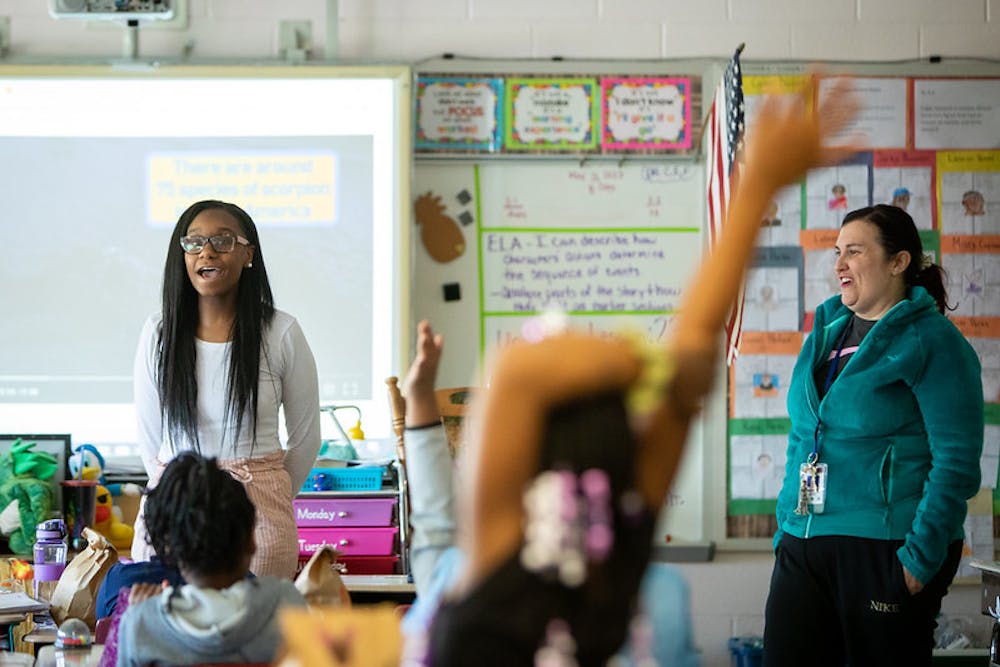
And that translates into the classroom where during morning meetings, Harris encourages students to share different phrases in their own languages to build curiosity and acceptance.
“Racial and linguistic diversity makes a difference to students,” Winkelsas said. “If we are not prioritizing that, and ensuring that students have access to the very best teachers who are well equipped, who are well prepared to do their work, and who reflect the diversity of the students they teach, then I don’t think we realize our goals around student achievement,” Winkelsas said.
Though many alumni are grateful for the program’s continuation, they’re also concerned about the implications that its defunding sends about the importance of diversity in education.
Sydney Favors, an alumni of the 2019-20 cohort and now an advisor of The Frederick Law Olmsted School at Kensington’s Black Student Union, describes the program as “eye-opening, challenging, and relevant.” A former student in Buffalo Public Schools, Favors recounted noticing a racial disconnect between staff and students as there were only two Black teachers despite her school being made up of majority Black students.
“When I looked at the teaching staff, and this was me as a 15-year old, there were only two Black teachers in the core areas in the school,” Favors said. “And in my mind, I’m like, ‘Why do you have two Black teachers and you have a lot of Black students at this school?”
For now, in spite of the cutbacks, the program continues to work towards achieving its mission to make a difference past the residents’ graduation date.
“I think that having someone like me in the classroom allows the students to really think about issues like this, like the lack of representation in education,” Favors said. “And it inspired me to go into leadership because I do see things as a teacher that, in regards to inequities and those cultural mismatches, lead to things that shouldn’t be said in the classroom.”
The news desk can be reached at news@ubspectrum.com.
 Photo: Courtesy of Wikimedia Commons

 Photo: Courtesy of Nicc Williams; photographed by UB Athletics
