Kathleen Sherin’s “Disrupted” and Amanda Maciuba’s “Natural Mythology” exhibits leave its interpretations up to the viewer.
Located in the Western New York Book Arts Center — a nonprofit organization committed to protecting the arts and a hub for modern art — the two exhibits showcase the artists’ imaginations: Sherin’s abstract series of questions and Maciuba’s reimagination of her childhood.
The exhibitions are on view from Sept. 18 to Oct. 17.
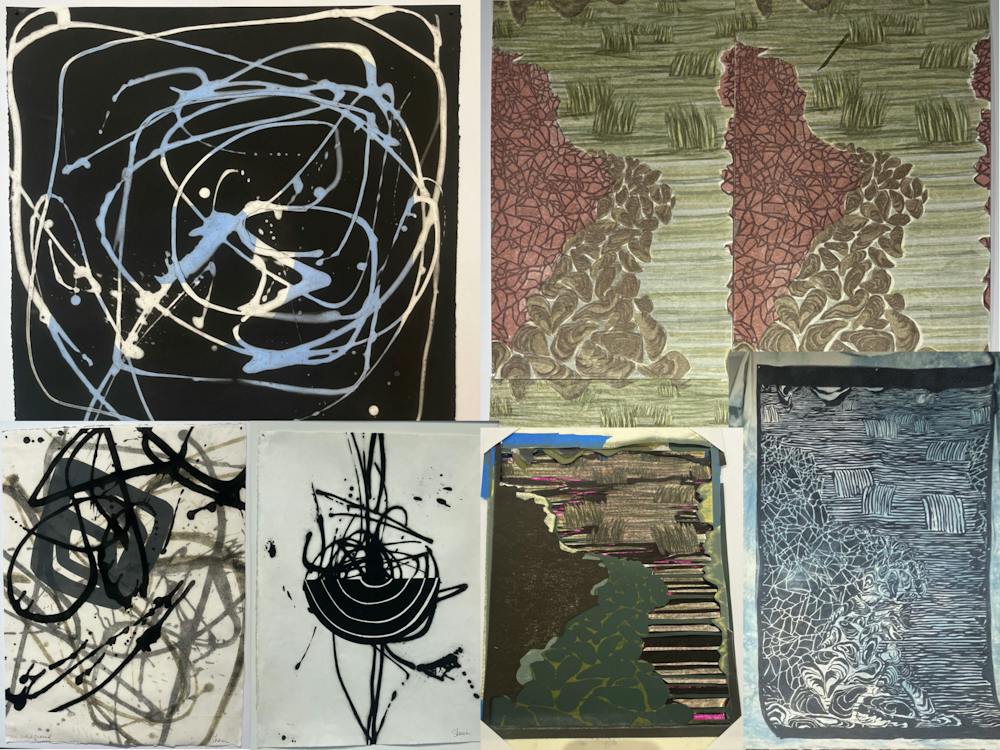
Sherin’s “Disrupted” exhibition — a series of 20 images that reflect her intuitive style — immediately greets visitors at the door.
“Disrupted” is an inquiry-driven series of print pieces, using techniques known as carborundum — a synthetic chemical compound of silicon and carbon — printing and silk aquatint, a printmaking technique that is used with acid.
Black lines intertwine with each other on a white background. Some prints explode with gray and blue hues — the gray a motif of mediation in Sherin’s previous work.
“My work tends to develop through a continuing series of related questions. One image suggests another, and sometimes a direction I think I have left behind reappears later in a different form.” Sherin said, “The questions remain related, but their visual forms continue to change.”
The lines of each piece swirl across the page, creating a vortex of daze and confession, where the only certainty left is uncertainty.
Sherin begins with a “thought or visual possibility” and works intuitively from there.
“Making art has been a continuous journey for me, and increasingly, the work seems to fuel itself. I draw from observations of both internal and external forces — from things experienced, remembered, felt or simply noticed — but I don't begin with the intention of illustrating a particular event or idea.” Sherin said. “What happens in one print often becomes the starting point for the next.”
Continue past the rainbow wall to the studio downstairs, where Maciuba’s “Natural Mythologies” catches the eye with its sheer magnitude of 11 featured pieces.
“Natural Mythology” is a return to Maciuba’s childhood, drawing inspiration from landscapes and environments that she grew up seeing along the shores of Lake Erie and at her family’s cottage at Long Point, Ontario.
“This work is the initial foray of a longer study on how human management has impacted the introduced and native species in the Great Lakes region, and how this has evolved and changed the landscape over time,” said Maciuba.
Whether in color or black and white, these pieces hone in on nature such as mussels, wetlands and garnet sand; clearly contrasted in each piece.
The garnet sand sits to the far left; the mussels are in the middle and the rest of the image is flooded by wetland details.
Maciuba’s pieces were created using a technique called pressure painting. It involves a process in which a type-high solid block of wood or plastic is rolled with ink, then rolled through the press while the plate is placed behind the paper. As a result, a sandwich between the plate and solid block of inked plastic is created.
“Pressure printing is a variable and unpredictable image-making process.” Maciuba continued. “Therefore, while every print uses a variety of the same plates, I often switch the order of printing, color and intensities of the plates I used based on in-the-moment decisions at the press.”
While both artists showcase different ways of expressing themselves, they both highlight a spontaneous aspect of their work, giving the viewer the freedom to experience the artwork in their own way.
The arts desk can be reached at arts@ubspectrum.com.