A University Police officer saved someone from a heroin overdose with Narcan at a UB parking lot in 2015, the first save a SUNY school had with the opioid antidote.
Ten years later, a student had to spearhead efforts to get the familiar red boxes into academic buildings for the first time.
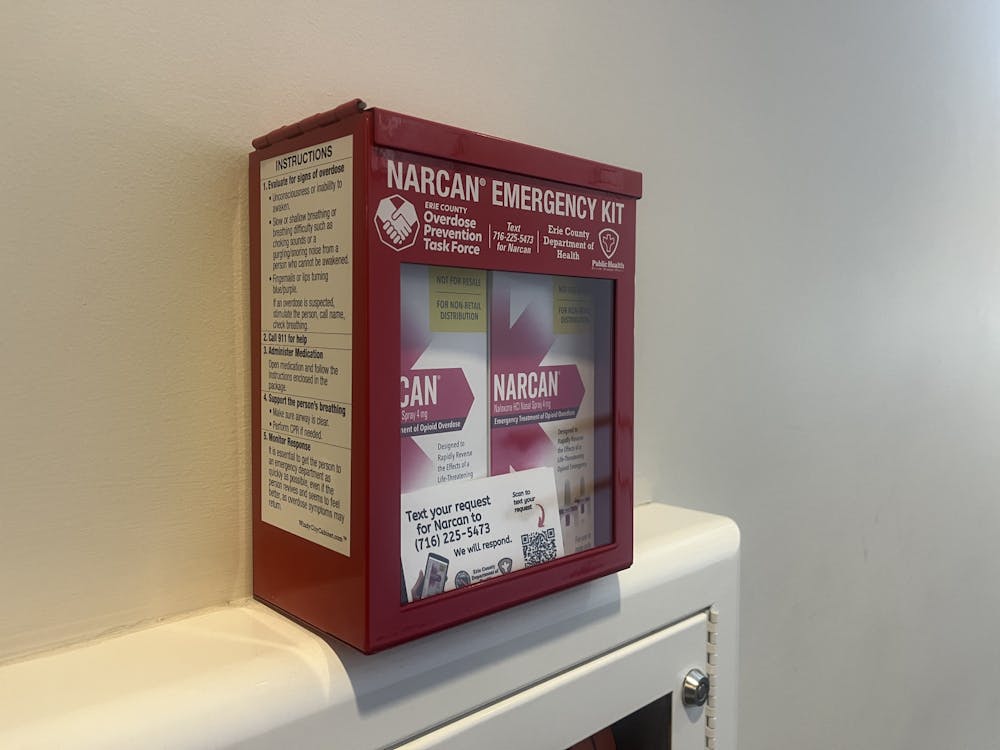
Karina Germakovski, a dual-degree pharmacy and clinical and translational sciences graduate student, obtained 200 boxes of Naloxone Hydrochloride — commonly known as Narcan — under the “Narcan in Our Schools” initiative — started in spring 2023.
The pharmacy building was the first to see the additions in fall 2025, with eight added above the automated external defibrillators (AED).
“My goal was to address this, spearhead this, bring exposure and be out in the community as much as possible,” Germakovski said.
As a required emergency response measure, AEDs are placed in all UB buildings with signs indicating their locations and instructions for when and how to use them. If Narcan followed the same emergency infrastructure implementation, as Germakovski aims to do with her project, emergency response times could decrease.
“I've always seen those AED machines and they're life saving, right? If somebody goes into cardiac arrest, this is the life saving device to get a pulse back in a patient or a person,” Germakovski said. “So the idea was to get Narcan as accessible as AED machines because AED machines are located in very accessible spots.”
UB has had Narcan boxes installed in its residence halls and trained staff on usage since spring 2023, when Governor Kathy Hochul signed legislation mandating all college housing facilities to have a supply of “opioid antagonists.” Narcan can also be found over-the-counter at pharmacies for $44.99.
Yet, the university lagged behind four other SUNYs — Buffalo State, Fredonia, Brockport and Binghamton — in stocking Narcan alongside AEDs.
The university also does not have any policies regarding the availability of Narcan doses that would make it available outside of residence halls.
Even then, Narcan presence alone isn’t enough if students don’t know where it is or how to use it.
Approximately seven out of 10 students interviewed by The Spectrum said that they didn’t know Narcan was present in their residence halls, including Ellicott, Greiner and Clement Halls.
Germakovski aimed to address this, saying that people at the high schools and community centers she visited under the initiative understood it was a life-saving medication but “didn’t understand the full effect.”
Sean Kawa, the national president of the American Pharmacists Association Academy of Student Pharmacists, says it is student leaders like Germakovski that fill the gaps and push for better collaboration in administrative emergency response policies.
A stronger role needs to be taken to educate the community, especially those in environments where they’re more likely to experience or recognize someone experiencing an overdose, to recognize Narcan, where it can be found and how to use it, Kawa says.
“By educating more individuals, telling them where to find it, knowing how to access them, knowing how to use it and what to do afterwards, will only improve the rates of survival,” Kawa said.
Focus was on ‘meeting the regulations’
Campus Living told The Spectrum by email that the focus was on meeting the regulations when the policy was instated, but that conversations about campus health and safety are “ongoing and occur in many forums.”
The university’s Environment, Health and Safety (EHS) department says that it is working with the School of Pharmacy and Pharmaceutical Sciences on “clarifying functional and cost responsibilities between all parties for the maintenance and operations of the Narcan availability program.”
“The process for developing this AED distribution program is within the standard university process for defining shared responsibilities,” EHS told The Spectrum by email.
UPD Chief Kim Beaty says that they’ve seen “very few cases” of opioid overdose at UB, with most unaffiliated with the university; if called to a suspected overdose, all officers carry Narcan and are trained on how to use it.
“This is part of our ongoing commitment to protecting the health and safety of everyone in our campus community,” Beaty wrote in an email to The Spectrum.
With an overall increase in Erie County’s opioid death overdose rates since 2019, the need for better Narcan access and education is more essential than ever.
Approximately 12.7% of UB students could have been exposed to opiates in their lifetime, accounting for cocaine, nonprescription pills and opiate usage, says UB’s Student Health Promotion office.
The office uses data from the American College Health Association’s National College Health Assessment, a national health survey for college students that UB participates in every three years. The latest is from spring 2025, where around 1.6% of 47,194 undergraduate students across 96 schools reported use of opioids.
“However, even though opiate use (whether intentional or accidental) makes up a small percentage of the student population, we recognize that risks associated with this form of substance use are high, which is why we partner with peer-led efforts to educate students on when and how to use naloxone,” Elliott Bystrak, UB’s Alcohol and Other Drug Reduction program coordinator, wrote in an email to The Spectrum.
Dr. Joshua Lynch — founder of the Medication for Addiction Treatment and Electronic Referrals network that provides free Narcan, fentanyl and xylazine test strips in vending machines throughout Buffalo and by request — says that opioid prevention is a collaborative issue and “just putting Narcan there is not enough.”
“The likelihood of someone overdosing in a bathroom at one of the academic buildings may just be as likely as someone you know needing Narcan in the residence,” Lynch said.
If you or someone you know is struggling with substance abuse or would like to get Narcan, call the Substance Abuse and Mental Health Services Administration (SAMHSA)’s hotline: 1 (800) 487-4889.
The news desk can be reached at news@ubspectrum.com.

 Photo: Wikimedia Commons | Courtesy of Quintin Soloviev