
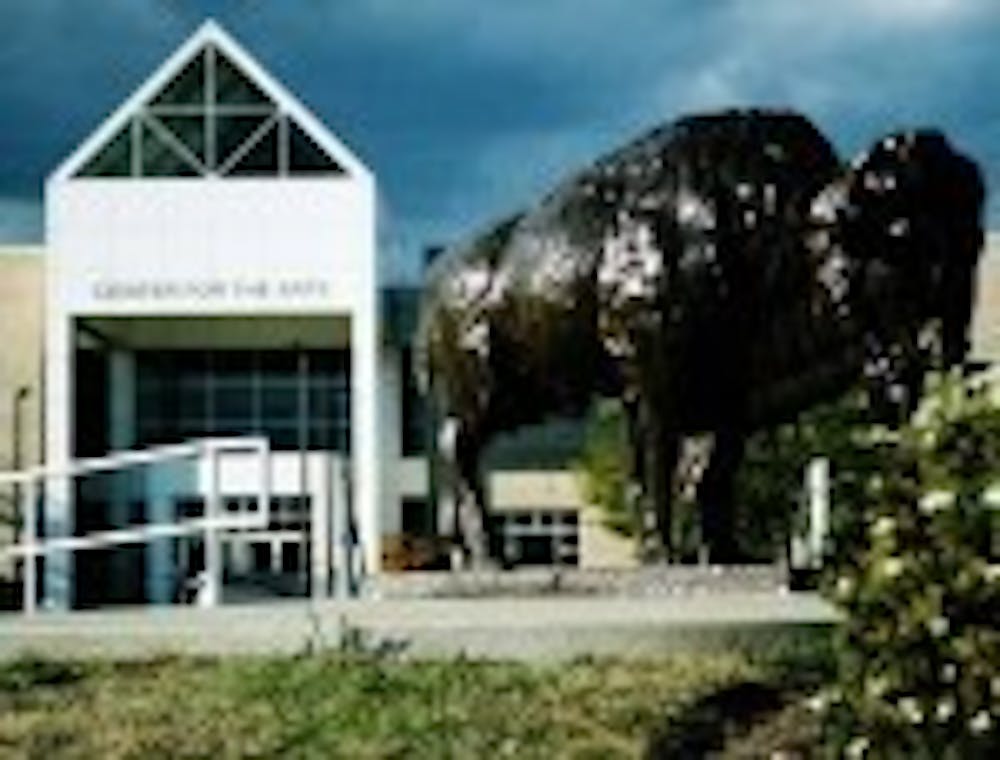
This is the second story in a series that takes a closer look at the history and impact of the Center for the Arts, which is celebrating its 10th anniversary.
When architects set out in 1983 to design a building for the arts at UB, the "big white box" that would eventually hug the shore of Lake LaSalle was still just a glimmer in the eyes of many UB students and faculty.
Eleven years later, when the Center for the Arts opened its doors, the UB community quickly realized its glimmer had become a gem.
"The design of the Center for the Arts definitely broke the mold of the brown brick of every other building on campus," said Tyrone Georgiou, associate dean of the art department. "The brickwork, porticos, and the Atrium made a different architectural statement."
Ever since that first architectural statement 10 years ago, the CFA has continued to assert its special place in the UB community by drawing audiences to its shows and students to its academic programs.
The building did, however, have its growing pains. At first the idea was for the CFA to be focused around the opera and the Buffalo Philharmonic, which would perform on the Mainstage.
That plan didn't sit well with many people in Buffalo, said CFA Production Director Bryan Sidorowicz, because community members were worried about their only source of theater moving all the way to Amherst.
And along with the fear that all the arts would leave the city, "people voiced concerns about losing Shea's (performing arts center)," said Thomas Burrows, director of the CFA for the past eight years.
Many professors and administrators who work at the CFA now have been there from the beginning. As a student, Sidorowicz was one of the first to test out the CFA during construction as work-study before it even opened.
"When I was a student back in 1992, I worked backstage with the lighting and sound system," Sidorowicz said. "There were plenty of kinks to be worked out because all the equipment was brand new."
Kinks were everywhere when the building first opened. For one, although Georgiou said once people saw the CFA, they were relieved it wasn't drab, many compromises had to be made.
"There were always compromises to be made about what the finished product would look like," said Georgiou, who was in charge of designing the art wing and the gallery. "And there's always discussions about expansion because the CFA isn't the perfect facility."
An even bigger kink almost crippled the CFA's diversity as an academic and artistic center, according to Burrows. Shortly after the CFA opened, university-wide budget cuts took away the center's budget - over $300,000.
After an adjustment period, the CFA became "tough as hell" in its funding search, using earned revenue from ticket sales and fundraisers to support itself, Burrows said.
"Fundraising is one of the components that allows the center to function as a self-sufficient entity," said Laura Scala, director of development. "When the center's operating budget was cut, the center needed to create ways to become self-sustaining. This remains true today, and the center still does not receive operating funds from the university."
Many could argue despite any kinks in the beginning, the CFA has far exceeded expectations. With an atrium that seats 600, at least three different theaters that hold about 2,300 people in all, including the state-of-the-art Mainstage, the $50 million building has changed a lot at UB.
"Media studies has grown tremendously and after 10 years in the art wing, we realized there should be more flexible space. (In the nineties), graphic design students sat at desks and now the program depends on computer labs," Georgiou said. "When I first got here, people made art that fits on the wall. Now they're concerned with performing arts and new mediums."
On top of continuously developing programs, there is also the increasing number of shows put on each year, which Burrows and others cite as another sign of the CFA's success. In the CFA's opening 1994-1995 season there were 30 shows, and this year there are 54, along with art workshops between students and performers, and other academic opportunities.



