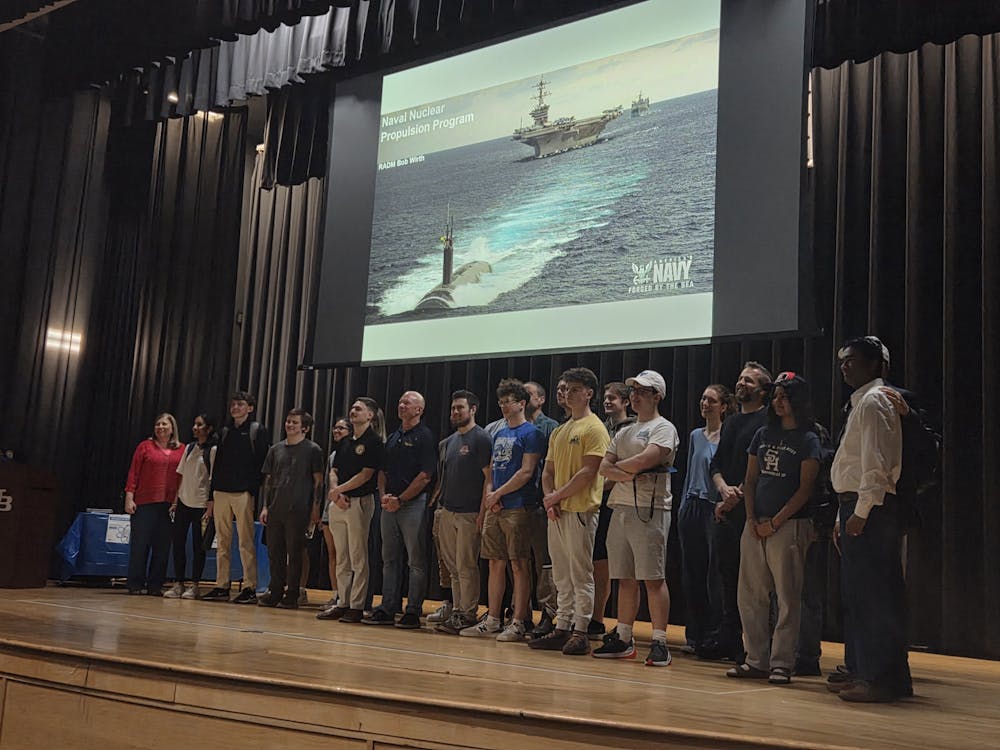
The UB Nuclear in Clean Energy (NiCE) club began with an ambitious goal in November 2024: to bring nuclear engineering education back to campus after its phase out in the early 1980s.
That goal became a reality in March when the university officially approved the Nuclear Engineering minor.
“It seemed ambitious at the time, but it was worthwhile to pursue,” said Maximus Wunderlich, a sophomore engineering major and co-founder.
The idea was initially pushed by alumnus and advisor Thomas O’Connor, who encouraged students to organize after recognizing a gap in nuclear-focused education at UB.
“I’ve seen that clubs can become minors because you shine a light on it,” O’Connor said.
The initiative quickly gained traction, drawing 23 students to its first meeting. Within weeks, the club was presenting their idea to university leadership.
The minor was developed over the course of Fall 2025 by faculty in the chemical and biological engineering department, who worked through course design and university approvals through a series of continuous meetings.
Faculty say that student demand was the main catalyst for turning the idea into a formal academic program.
“The advocacy of the NiCE club brought to our attention the clear student interest,” said David Kofke, a professor of chemical and biological engineering, in an email to The Spectrum.
The first semester’s enrollment exceeded initial expectations and signaled sustained interest in the field according to Mark Swihart, a chemical and biological engineering professor.
“That’s enough to make it worth doing,” Swihart said. “Even if 10 or 15 complete the minor, that’s really pretty good for the first year.”
Kofke is teaching the first course in the curriculum, Intro to Nuclear Engineering, that launched in Spring 2026 with a class of 25 students. Most students are chemical engineering majors, with others mechanical and electrical engineering.
“We set up the course with a goal to make it accessible to students with a broad range of technical backgrounds,” Kofke wrote. “It leaves a stronger impression than anything I can say in the classroom.”
The course includes hands-on learning opportunities, including a visit with UB’s Environment, Health and Safety group on South Campus and its radiation safety team.
Swihart said the program reflects both student demand and broader energy trends.
“There seems to be an appreciation that the coupled challenges of climate change and increasing demand for electricity require us to pursue nuclear technology as one of several sustainable solutions,” Swihart said.
Kofke said the initiative aligns with SUNY’s role in preparing students for evolving industries.
“As part of SUNY, we feel an obligation to provide educational programs that respond to student demand and meet the evolving workforce needs of the state,” he wrote.
While expanding the minor into a full major would require significant investment in faculty and facilities, Swihart emphasized that it remains a long-term possibility and is not an immediate one.
For Wunderlich and the NiCE founders, the outcome of the minor still feels somewhat surreal.
“I was kind of shocked when the minor came about,” Wunderlich said. “It’s such an extraordinary thing.”
The news desk can be reached at news@ubspectrum.com.

 Photo: Wikimedia Commons | Courtesy of Quintin Soloviev