
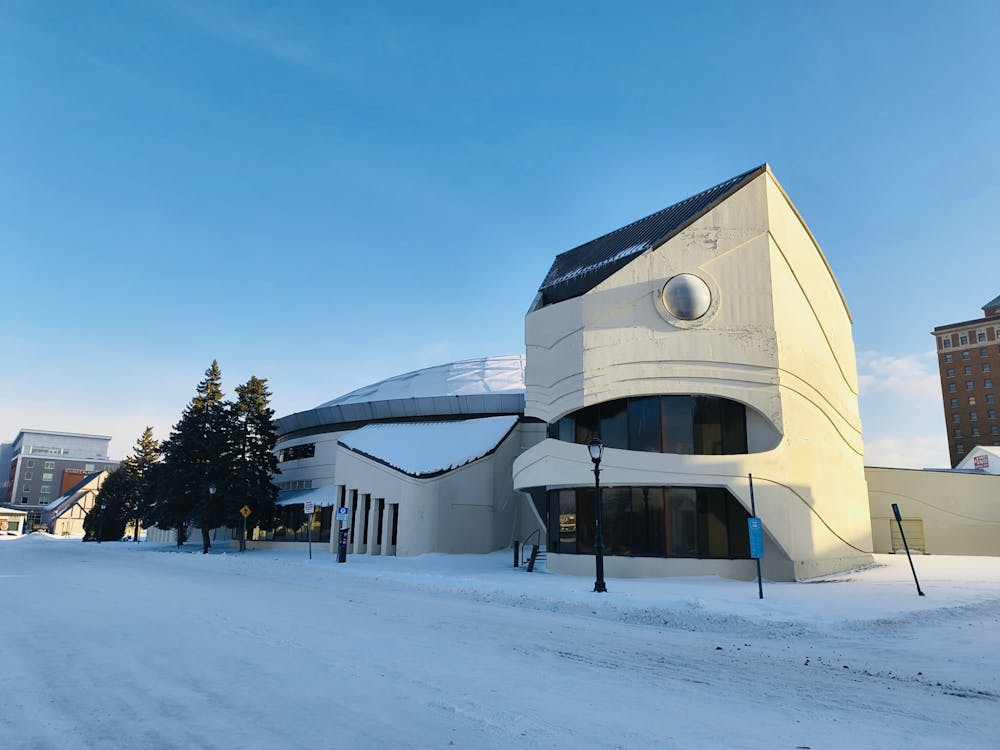
In a city famously known for its powerful sight of natural wonder, Niagara Falls has one other rare and worthwhile sight: the Turtle. On Rainbow Boulevard sits the Turtle building, formally the largest Indigenous Cultural Center for the Living Arts in the eastern United States. While it is still staying true to its size at 67,000 square feet, it has remained unused for 30 years. Once alive with music, dance and art, the Turtle is now one of America’s most endangered places according to the National Trust for Historic Preservation.
Arapaho architect Dennis Sun Rhodes and Tuscarora sculptor Duffy Wilson opened the building in 1981 to reflect Mother Earth in relation to Haudenosaunee creation stories. Until the mid-1990s, exhibitions, concerts, powwows and cultural events were hosted inside, as well as a restaurant, gift shop and art gallery. Julie Frier, a retired Elma, NY resident, says, “the community needs a building where everyone can participate in learning about the Native American culture in depth.”
As seen in previous American culture, community and cultural needs get ignored by large corporations as in the last two years, the building has been painted over to cover up mold and decay. This example of censorship and whitewashing furthers the importance of regaining its vibrant colored shell. As The Turtle faces threats of demolition, it does not stop the visible fight for reawakening the building.
The building is currently owned by Niagara Falls Redevelopment, with Edward and Howard Milstein, Manhattan billionaire brothers, as its owners. The community has already been supportive in many ways, yet an obstacle like this requires constant action and resilience. It is a crawling effort that requires a certain kind of hope that is unprecedented and unheard of.
In the last two years, preservation efforts have gained regional and national attention. Shaun Wilson, President of the Friends of the Niagara Turtle nonprofit, has developed a mindset of why The Turtle should be open, “it would be an opportunity for the community to right a wrong.” Native American cultures have strong themes and holidays surrounding rememberance and resilence. Reawakening the building would be viewed as a move in the correct direction. The Friends of the Niagara Turtle's mission is not just to reawaken The Turtle, which serves as a vision of Indigenous architecture, but as a space for cultural revitalization.
The nonprofit group has stayed active throughout the winter months, developing growth strategies and plans for the upcoming spring and summer. The topic at hand is how The Turtle would serve as an interactive family-friendly service to the community year-round,a crucial factor that Niagara Falls tourism is lacking currently.
To share how important it is to have this cultural symbol open just steps away from the brink of the falls, Di Gao, Senior Director of Research and Development for the National Trust has stated, “It is such a crucial part of the American story, and part of our mission is to tell the full American story by honoring historic places that help define us as a nation.” The storytelling tradition that flows through Haudenosaunee culture is not done with The Turtle.
The nonprofit group works towards continuous efforts and collaboration. ‘It takes a village’ being the most common phrase used throughout Indigenous culture.
The features desk can be reached at features@ubspectrum.com
 Photo: Credit: Kishaun Proctor


