
Editor's Note: This article has been updated to correct the title of the piece "42.84119° N, 78.79326° W." from “Salvaged objects from Cazenovia Creek under I-90” to "42.84119° N, 78.79326° W." The Spectrum apologizes for this error.
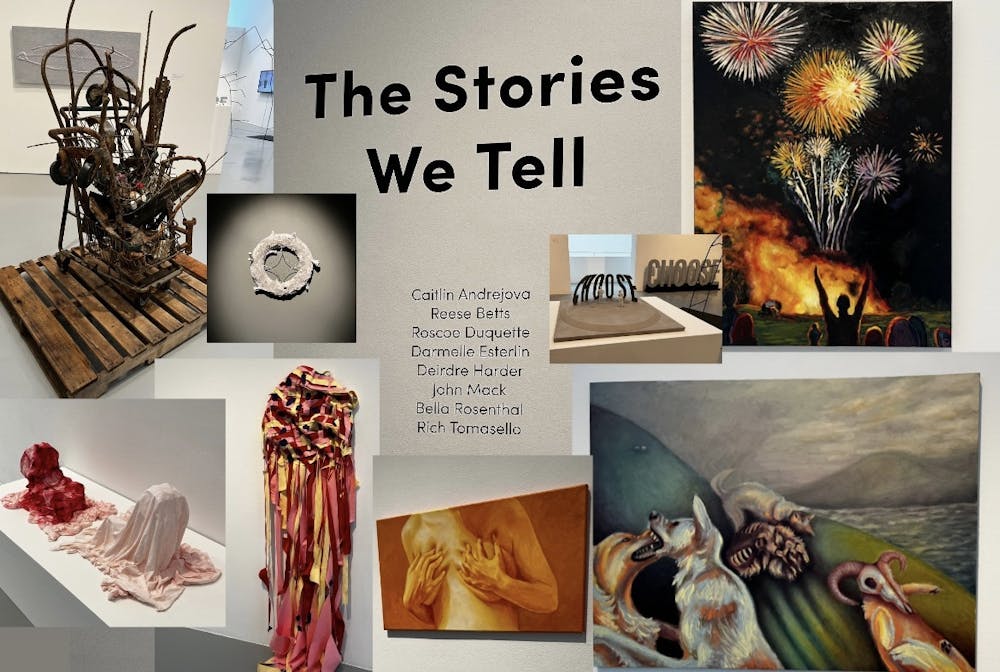
UB’s Center for the Arts hosted its annual first-year MFA exhibition, which remained on display from Feb. 10 to Feb. 21, offering the world a peek at what its cohort of eight talented Master’s candidates had been rigorously working on over the past year.
The gallery saw works emotionally compelling and visually stunning, like “Bi-Monthly” by John Mack, “42.84119° N, 78.79326° W” by Deirdre Harder, “PTSD” by Darmelle Esterlin, “Torment” by Caitlin Andrejova, “First Love” by Roscoe Duquette, “Choose” by Rich Tomasello, “Good Fortune” by Bella Rosenthal, and “It’ll Cost You Something” by Reese Betts.
These art pieces were physical manifestations of their artists’ responses to life events, the current sociopolitical climate and personal reflections expressed through various forms, informed by a year’s worth of heavy experimentation and their lifetime’s worth of experience.
Darmelle Esterlin’s “PTSD” explored her personal traumas and struggles with being an immigrant new to the United States, conveyed through the dichotomy of vibrant fireworks and a person having a Post-Traumatic Stress Disorder (PTSD) episode amid the crowd of celebrating people. The suffering individual brings a new dimension of consideration and solemnity to the people affected by the loud, raucous celebrations we tend to have.
“I don’t tend to talk about myself in a way when I paint… [PTSD] was a therapeutic piece, where I’m painting beautiful colors and detailed backgrounds and the excitement that comes from the holiday.” Darmelle continued, “but it’s also about remembering what it feels like to experience [the sounds of gunfire].”
Deirdre Harder’s first foray into sculpture-making surprised her. “42.84119° N, 78.79326° W” was given form as a combination of her enthusiasm for marine biology and artistry, and consists of several metal trash objects held in the baskets of a rusted shopping cart. She got the idea when she took a field trip near Buffalo’s Cazenovia Creek for an ichthyology course, which had her wading through the water to catch and observe the local fish population. During this project, she observed that there was a substantial amount of industrial metal trash in the water, some of which gets reintegrated into the ecosystem as habitats for the fish, but is ultimately harmful because of their corrosive properties.
Her sculpture is altogether a statement of her love for the natural world, a wake-up call about the accessibility of art and the outdoors and environmental storytelling in a quite literal form.
“This is all from this specific place that is twenty minutes away from here, it’s in our backyard, and anyone can go in and take trash out. You don’t necessarily have to turn it into a sculpture, but anybody can do the same things that I’m doing.” She said, “It’s not because I’m an artist or anything like that… We have, you know, a bit of a duty to take care of [the environment] and be stewards of those ecosystems.”
Reese Betts’ “It’ll Cost You Something,” a mesmerizing piece engaging different aspects of Christian American identity and radicalized evangelical ideology, is told through the medium of flickering video and gravelly sound from a projector. In this room, located toward the back of the gallery, the viewer is enveloped by darkness, tethered to the world outside the display only by the light seeping in from the open doorway through which they entered.
The piece is inspired by her experience growing up in an area of Missouri where evangelicalism was conventional and its ironies and contradictions were never questioned. Through this display of light and sound, she grapples with personal faith and the looming fear of censorship of those whose interpretations of sacred texts diverged from the norm.
“I was interested in drawing attention to the incongruences between the scripture and the political and social ideologies associated with it,” she says.
A common thread between many of the Master's candidates was their passion to not only develop their own craft, but also to teach the craft. To foster a classroom environment that encourages others to blossom and grow as artists and as people is a monumental task, and often a thankless job. After all, teaching in itself is also an art form and a science.
The artists also weighed in on the contentious topic of generative artificial intelligence (GenAI) within the art sphere as individuals who have dedicated so much of their lives to their creative pursuits. Roscoe Duquette, who has taught a class at UB and extensively researched its impacts, is firmly against its use. “A lot of artists also bring up the scraping of their work, and its plagiaristic quality… It’s both the ethical and environmental impacts that I’m not a fan of,” they said. This was a unanimous sentiment among the artists The Spectrum interviewed.
The opening exhibition went extremely well, and many of the artists noted that they loved seeing attendees’ reactions to their works.
Caitlin Andrejova commented, “I really loved the opening! The curators did a really great job with setting up the show and bringing our vision to life.”
The arts desk can be reached at arts@ubspectrum.com

 Photo: Courtesy of SUNY
