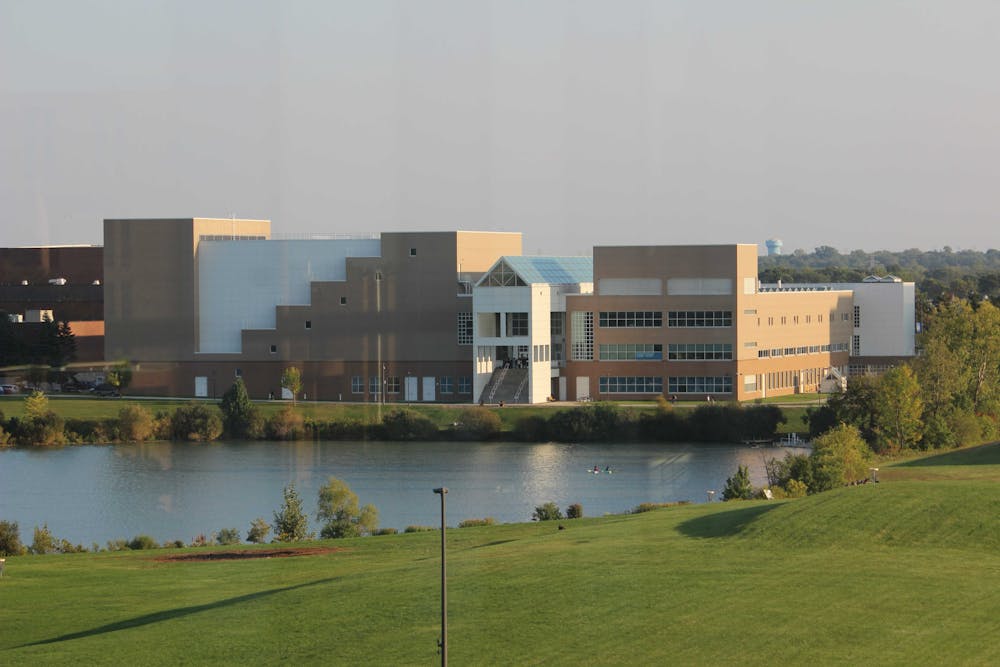
When walking through the Center for the Arts, it’s easy to pass an art gallery without thinking much about what’s inside.
But “Constructed Belief,” a new exhibition held from Sept. 24 to April 30, makes it hard to simply walk past without a second thought.
The exhibit features the work of Mara Baldwin, Ben Cowan, Nicki Green and Muhammad Zaman, where each approached the idea of “belief” differently — how people create meaning through rituals, traditions and repeated experiences. The artwork drew from different religious and cultural backgrounds.
Cowan’s work took inspiration from Renaissance religious paintings. Instead of showing entire scenes, he focused on individual details such as hands, lips, organs and plants. His work is also drawn from the paintings of Hans Memling, particularly the artist’s use of the picture frame and illusion of depth.
“I wanted to isolate that experience of a hand resting on the frame and seeming to come out of the picture, while the face sinks back just behind the picture plane,” Cowan said in an email to The Spectrum. “It creates this strange illusion of a person in the room with me, peering from behind the painting.”
Green used ceramics covered in fungi to explore Judaism, incorporating her research on the Nazi Party’s propaganda that called Jews’ bodies “poisonous mushrooms.” A Jewish and transgender artist, she used fungi as a metaphor for how the two aspects of her identity intersect. Her work connects traditional forms with questions of identity and change, with her handmade pieces symbolizing how traditions can remain meaningful while also growing with the people who practice them.
Zaman’s paintings combined English, Arabic and Bangla in a style described as “calligraffiti.” His work draws from his Muslim faith and explores emotions including grief, joy and contemplation.
Beliefs are not just for the religious, however. They can still exist in everyday life.
For example, the youth organization Girl Scouts and its traditions influenced Baldwin’s drawings. Her work titled “Trust Fall” explores the tension between belonging and loneliness. The title is derived from “trust fall” exercises, where a person falls backwards and trusts their partner to catch them.
“Trust Fall” is an abstract work composed of layered green, yellow and blue vertical strokes. The dense marks create a sense of movement across the entire surface. Because there is no obvious focal point or recognizable subject, the viewer is encouraged to experience the work through its colors, textures and repeated patterns. This piece suggests themes of trust and surrender, while the layered and somewhat unpredictable composition creates a feeling of uncertainty and letting go.
“‘Trust Fall’ grew out of my curiosity about togetherness, community and loneliness,” Baldwin said in an email. “The images may seem to be about belonging, but they’re also empty of people, leaving it unclear whether the viewer is included or excluded. I think loneliness can be just as important as community because being alone helps us understand the value of being together.”
The exhibit does not focus on one definition of belief. Instead, it leaves room for visitors to think about what belief means in their own lives.
College students may find solace in the exhibit. After all, college is full of routines that can eventually become traditions. Meeting the same friends every week, going to club meetings, studying in a favorite spot, or continuing traditions from home can create a sense of familiarity in an environment that is constantly changing.
Those experiences may seem ordinary, but “Constructed Belief” is about how repetition can turn ordinary actions into something meaningful.
For something beyond the usual campus routine, “Constructed Belief” offers an opportunity to slow down and consider the traditions and habits that shape one's life. The exhibit shows that belief does not always have to be something we inherit, but rather something we build ourselves, one repeated experience at a time.
The arts desk can be reached at arts@ubspectrum.com.
 Photo: Paul Hokanson/UB Athletics