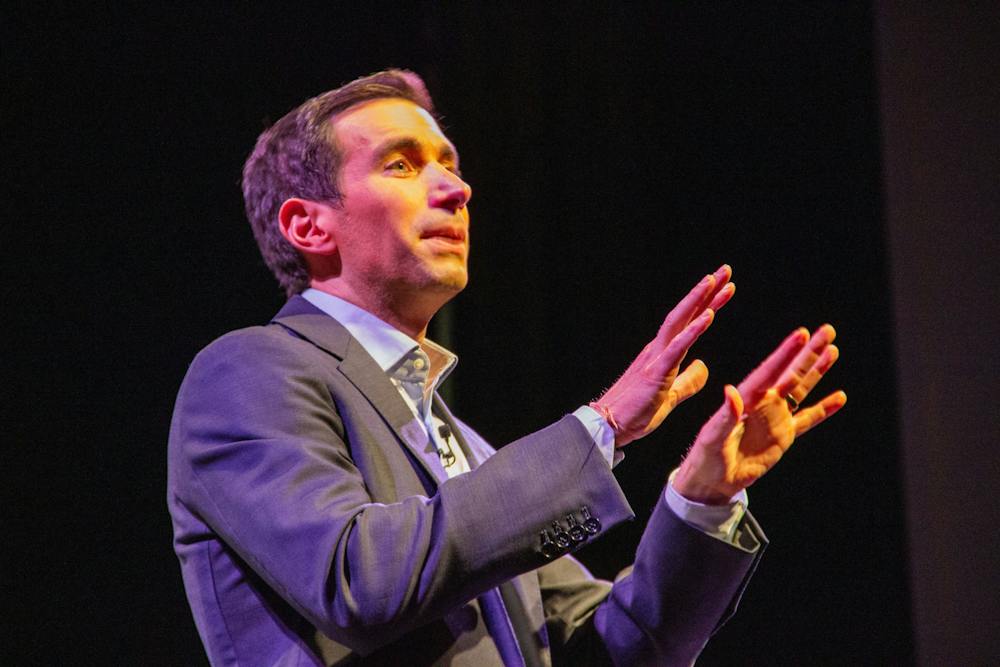
Andrew Sorkin had tough questions for the audience.
“How many people here, by a show of hands, are worried about the economy? How many people here think we are in an AI bubble? How many people here are worried about their job?” Sorkin said. “How many people here are worried about another financial crisis?”
Award-winning New York Times journalist and CNBC’s “Squawk Box” co-anchor Sorkin brought some answers in his talk titled, “Inside the Story of 1929 — Writing Through the Wreckage of the American Dream,” Friday night at the Center for the Arts, kicking off UB’s ‘26-27 Distinguished Speakers series.
Sorkin’s narrative of America’s economic ups and downs throughout history started with a visit to the past — a “moment that we lived through.”
That moment happened at 1:45 a.m. on Sept. 15, 2008: the once fourth-largest investment bank Lehman Brothers filed for bankruptcy, becoming a symbol of the 2008 financial crisis.
“The good news is, you went through it, and we’re here on the other end,” said Sorkin. “But the truth is: a lot of lessons that we learned in 2008, we should have learned a lot earlier in 1929.”
This was Sorkin’s segue into giving a snapshot of his most recent book that explored the circumstances that precipitated the Great Depression, titled “1929: Inside the Greatest Crash in Wall Street History and How It Shattered a Nation.”
Sorkin spent eight years researching and writing the book.
When libraries were closed due to the pandemic, he had to resort to unconventional methods to access niche historical records buried in university research libraries and archives. The nature of these documents meant that only a select few students could access them.
“I'd say, ‘I'll pay you to go through Box 153 for me and take a picture.’ I used to have them take pictures, with their phone, of every single page, and I created sort of elaborate Dropbox systems,” he revealed.
The phrase, “Too big to fail,” which became associated with the government’s response to major financial institutions during the 2008 financial crisis, echoed throughout Sorkin’s talk.
Sorkin used the phrase to describe the growing AI and technology industries, arguing that their size and importance to the economy could eventually make them difficult for the government to allow to collapse. He said the AI industry is helping drive U.S. economic growth, but much of its expansion is being financed through debt.
But if the AI industry fails, the economic bailout strategy used during the 2008 financial crisis and the COVID-19 pandemic may not apply anymore, Sorkin said. He argued that the AI industry could eventually become “too big” to bail out. The difference today is the amount of debt the U.S. has accumulated and the possibility that a future bailout could be significantly larger.
“That check could be a $5 trillion check or more,” said Sorkin. “And we may decide, ‘Okay, we have to write the check the same way we did during COVID.’ But the truth is, if we do that, there could be a moment in which the bond market says, ‘We can’t do this anymore.’”
Sorkin explained that if the bond market reached that point, interest rates on U.S. debt could rise significantly, potentially forcing the country into austerity.
But Sorkin is a “professional optimist” when it comes to the economy. Today’s question is just, “How can we avoid going off the cliff every 20, 30 years or even sooner?”
“Because three out of every four years over the last 100 years, the stock market’s gone up. Statistically, it has made a lot more sense to be optimistic than to be pessimistic,” said Sorkin. “We have found a way, as a country, to do remarkable things. Think about where AI was developed. Think about all of the great technological revolutions in the past 100 years.”
During the Q&A session, Sorkin offered commentary on the journalism industry overall and reflected on how much journalism has changed since he began working at The New York Times at 18 years old.
Sorkin, now 49, said AI could significantly change journalism within the next few years, particularly when it comes to research. However, he argued that technology will not replace the need for journalists to conduct original reporting.
“I think there’s always going to be a need for real journalists to ask real questions and figure real things out,” Sorkin said.
He pointed to reporting that requires journalists to go beyond information that is already publicly available, including going behind the scenes and speaking with sources who may reveal information they are not supposed to share.
“We live in a country where we have often been lied to about lots of things,” Sorkin said. “And I think it's oftentimes the journalists, the actual reporters who go into the reporting.”
It’s not just AI; another major change in journalism is how audiences receive information. People have increasingly become their own reporters by gathering and comparing information across social media platforms.
He criticized the growing amount of commentary surrounding news rather than original reporting.
Audiences increasingly encounter people discussing reporting that was done by someone else, making journalism more important, according to Sorkin.
“Everybody in this room has actually become their own reporter,” Sorkin said.
Rather than relying on one newspaper, radio station or television channel for the day’s news, audiences now move between platforms such as X, Instagram and TikTok.
This shift has changed the way people determine what they believe to be true.
“I think everybody’s trying to find their own truth,” said Sorkin.
Kaden Zhong is the senior arts editor and can be reached at kaden.zhong@ubspectrum.com.
Alejandro Henry-Jackson is an assistant arts editor and can be reached at alejandro.jackson@ubspectrum.com.

 Photo: Wikimedia Commons | Courtesy of Quintin Soloviev