
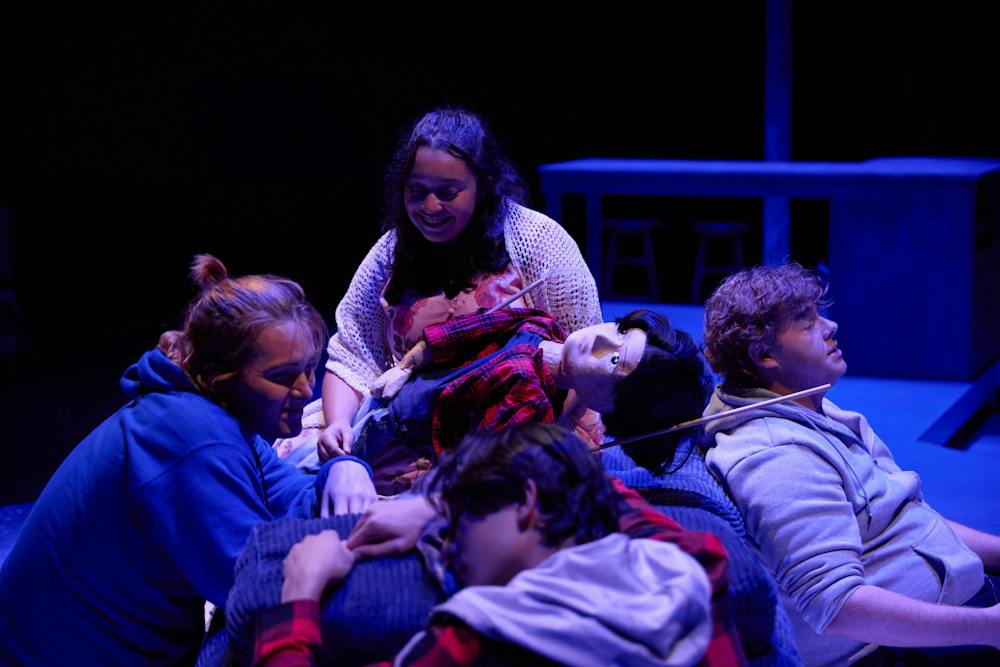
“Wolf Play” details a boy’s search for belonging — his “wolf pack” — amidst a clash between two families; representing an intimate confrontation with dilemmas of identity and acceptance, along with an exploration of the harm and resulting resilience caused by imperfect familial relationships.
The play, written by Hansol Jung, made its debut under the direction of theater professor Janet Werther from Friday, Oct. 2 to Sunday, Oct. 4 at the Center for the Arts’ Black Blox Theatre. It follows Jeenu or “Wolf,” a six-year-old Korean child, as he is pulled between Robin and Ash — a lesbian couple that adopted Jeenu — and his biological father Peter, unaccepting of the couple’s sexuality.
The actors took advantage of the full stage, where the space — according to Werther — asks to “visually notice the other people around you.”
“The Black Box space is very flexible,” Werther said in an email to The Spectrum. “The actors are constantly playing to all four sides.”
Freshman music theatre student Anderson Maziero played two versions of Jeenu throughout the play — Jeenu at six years old and at 18 years old. Also 18 years old, Maziero himself played Jeenu’s adult self but brought Jeenu’s six-year-old self to life in a puppet, which sometimes became aggressive and spontaneous like a wolf emulating its pack.
Maziero was given a large range to improvise how the puppet moved.
“I was able to make the puppet move how I move in real life,” Maziero said in an email to The Spectrum. “Rather than a specific technique, what really helped with coordinating it was the trust given to me by my directors.”
Senior acting major Sophia Brito said she brought a culmination of her techniques she had learned throughout her four years at UB into Robin — the one who hurried Jeenu’s adoption and carried a desperate desire to be a mother.
The show’s emotions ran high throughout as each character eventually came to a clash with each other — such as Robin’s aggressive arguments with her brother Ryan — or even with themselves. The emotions cascade as the audience hopes for a cathartic ending.
But all characters’ stories fall just short of a perfect ending.
The play is meant to end “unresolved,” Werther says, where audiences take “that feeling of the ending being unresolved and think about it in relation to their own lives.”
The arts desk can be reached at arts@ubspectrum.com.
 Photo: Paul Hokanson/UB Athletics


