
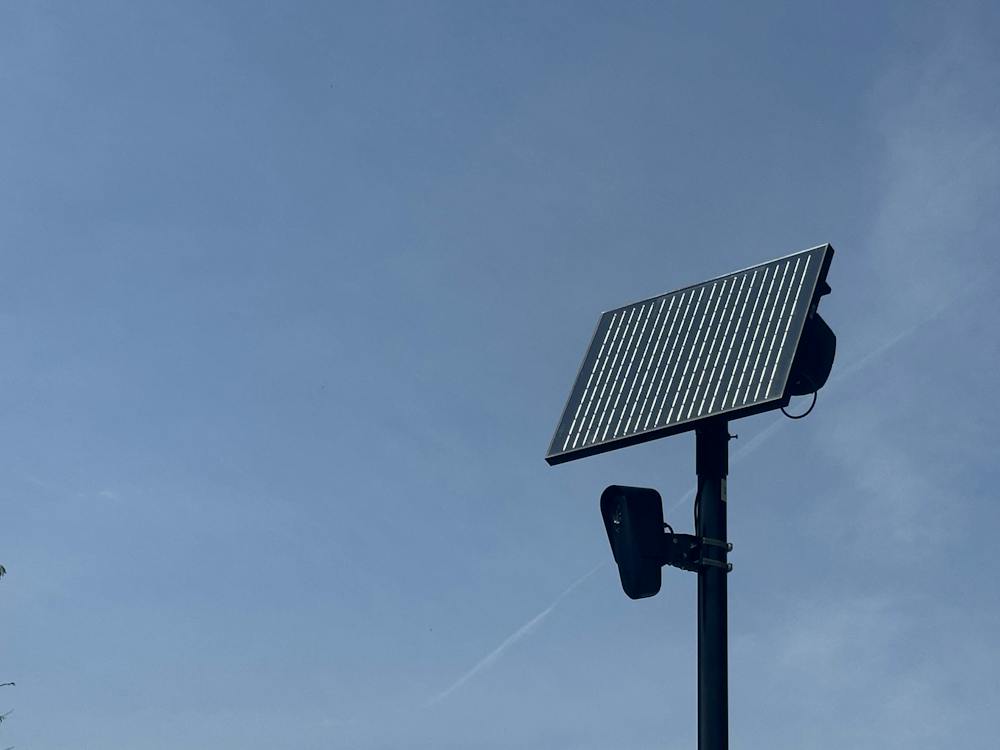
Flock cameras may be a new sight on campus.
University Police is looking to start a 60-day trial of Flock cameras — shorthand used to describe License Plate Reader (LPR) cameras created by Flock Safety — as a “more robust” tool to investigate and solve vehicle-related on-campus crimes, including car thefts, larcenies and hit-and-run accidents, according to a university statement. Conversations on the additions have been underway since last summer.
Twenty cameras are proposed for installation at entrances and exits throughout UB’s North and South campuses. Specific locations, along with a timeline, have not been decided yet.
LPRs automatically scan license plate numbers and document characteristics of vehicles that pass by, along with the time and location of when they pass. The information is stored in a database and flags possible criminal activity, which local law enforcement can use to identify vehicles for investigations.
Flock Safety has risen as one of the most prominent brands, striking deals with over 7,000 — from college campuses to police agencies — to install artificial intelligence-assisted LPRs. Approximately 12 Flock cameras are located throughout Buffalo State University, as reported by Investigative Post.
UB’s campuses are also not completely free of them. According to Deflock’s open-source data, Amherst Police runs a LPR at a roundabout near the Ellicott Creek Trail, and another near University Plaza. The Niagara Frontier Transit Authority maintains a camera at University Station’s park-and-ride lot.
UB’s Parking and Transportation department already uses LPRs, though not owned by Flock, as part of its virtual parking tag initiative. Since fall 2023, cameras mounted on parking enforcement vehicles snap photos of the vehicle and license plate — used to check for valid permits and if needed, issuance of parking citations.
“The safety and security of UB’s campuses — and the privacy of our campus communities — are always among the university’s highest priorities,” Chief of Police Kim Beaty said in the statement.
UPD is also looking at additional security measures, including replacing outdated security cameras and adding more to “expand coverage in public spaces.” Increasing secure access to building entrances are also under evaluation, with UPD considering “technology solutions.”
“These efforts together will be very effective in helping to deter crime on campus and will provide UPD investigators with valuable evidence to solve crimes affecting members of the UB campus community,” a university spokesperson said in an email to The Spectrum.
But the cameras are not coming anytime soon.
Flock cameras have come under public criticism over its widespread surveillance, where misuse can be a privacy violation at best or abuse at worst. A police officer in Milwaukee had used it to track his partner’s plate and their ex.
While Flock does not allow U.S. Immigration and Customs Enforcement (ICE) direct access to its database — even dismantling federal agency access — local and state police can still look up information on their behalf. 404 Media — a journalist-run technology news organization — reported over 4,000 such lookups.
UB Facilities carried these concerns throughout the summer, a staff member — who requested anonymity for fear of retaliation — told The Spectrum, but the department’s approval only rests on whether the installation is compliant with building codes.
So far, the installation of Flock cameras has not been approved by UB Facilities as of yet due to “lacking sufficient details about installation” to do a review on compliance with building codes, they said. The department is awaiting updates.
“I think everyone’s concerns are the same and haven’t gone away,” they wrote in a text message to The Spectrum. “Particularly because Flock is different from other LPR cameras in that it has had a lot of publicly released instances of misuse.”
The university will be opting out of Flock Safety’s national database system, citing New York State prohibitions on assisting ICE for civil immigration enforcement, including the sharing of vehicle data. Data will be routinely deleted after seven days and the cameras do not track individual people, per Flock policy.
“UB recognizes public concern about how personal privacy is affected by LPR technology. The university will establish appropriate safeguards, access restrictions and internal controls,” the statement read. “That includes limiting access to only certain UPD investigators and conducting routine internal audits to ensure the technology is being used as lawfully intended.”
Aiden Dickerson is the senior news editor and can be reached at aiden.dickerson@ubspectrum.com.
Mylien Lai is the editor in chief and can be reached at mylien.lai@ubspectrum.com.

Mylien Lai is the editor-in-chief at The Spectrum. Outside of getting lost in Buffalo, she enjoys practicing the piano and being a bean plant mom. She can be found at @mylien.lai on Instagram.
 Photo: Courtesy of Wikimedia Commons

 Photo: Courtesy of Nicc Williams; photographed by UB Athletics
