
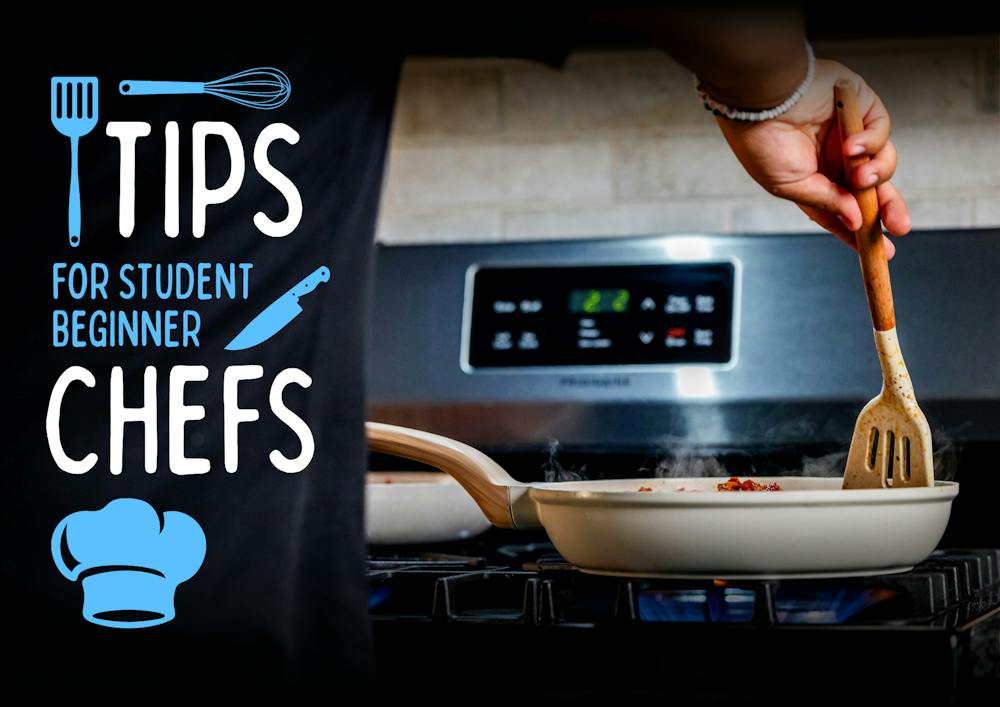
A lot of students struggle cooking for themselves for the first time. Grocery shopping, budgeting, and trying to decide what to make can be stressful and take up a lot of time and money.
Naveed Khan, a junior Mechanical Engineer major, and Gabby Albanese and Angelina Concepcion, two English Education majors, have gone through the trials already.
The first step of making a meal is figuring out what to make. Khan, Concepcion and Albanese all say that starting with a singular ingredient and forming a meal around it is the easiest way to use up ingredients and figure out what to make.
Albanese, a senior, practices the advice and makes dishes around that single ingredient. Along the same lines, Concepcion, a junior, makes a game out of choosing what to eat for dinner where she randomly selects something from her freezer.
When the creativity is low, the three look up recipes on social media or cookbook websites.
“Most times I will look primarily online, like TikTok or these cookbook websites, for making cookies or something like that,” Khan says.
Concepcion also uses cookbooks, but prefers a physical form.
“It’s called ‘The College Cookbook Guide,’ Concepcion says. “It's a bunch of quick, easy and fairly cheap meals for college students to make.”
It’s important to consider how these recipes will last you through the week. Many students like to meal prep individual meals for individual days, but Albanese likes to keep it simple.
“What I’ll usually do is meal prep one big bowl or container of something and then take a portion of it every afternoon or evening,” Albanese said. “I like making pasta, salads, veggie salads, something that has the food groups in it that I can snag off the counter for a quick meal.”
The next step is grocery shopping. Budgeting can be hard to figure out, especially at the beginning of the year before students have had a chance to get used to cooking for themselves.
Both Albanese and Khan don’t rigidly budget, but instead recommend trying to stay under a certain cap. Khan, for example, says he tries to spend under $50 a week on groceries.
Concepcion, on the other hand, splits her paychecks to make sure she’s saving but also getting what she needs for the week.
“I try to practice saving in like a 70 to 30 rule,” Concepcion said. “So I'll put 70% of my pay for the week into my savings account and the other 30% will go towards whatever I need: food, toiletries, things like that.”
Staying healthy is also an important, but hard to master, part of shopping. Khan argues that staying focused is the key to success.
“I think it's easy to eat everything except protein, so my goal is always just focus on protein and worry about everything else later,” Khan says. “So focusing on eating eggs, meat or things with high protein is the best way for me and my goals.”
Albanese, on the other hand, favors organization. Making sure to get everything she needs and hit all the food groups requires order.
“I make my grocery list ahead of time on my phone like on the notes app before I go grocery shopping,” Albanese says. “I make sure I've added at least something from every food group. I try to get meat to cook for dinner, I always make sure to have a fruit and vegetable.”
Albanese and Concepcion also recommend that students get prepacked, aka ready-to-cook meals. These food items are cheap and easy to make, and can be a great option for students with busy schedules and tight budgets.
If students do feel like cooking, Khan recommends his breakfast burrito: ground beef, egg, beef, jalapenos, sour cream, chives and Taco Bell’s original seasoning.
Concepcion suggests a recipe that hits all the food groups: ground turkey or beef, sweet potatoes, broccoli and carrots. The meat would be cooked on the stove while the rest are roasted in the oven.
Cooking can be hard, but it doesn’t have to be if students are informed and prepared.
Agnes Keough is an assistant features editor and can be reached at agnes.keough@ubspectrum.com.


 Photo: Courtesy of Wikimedia Commons
