
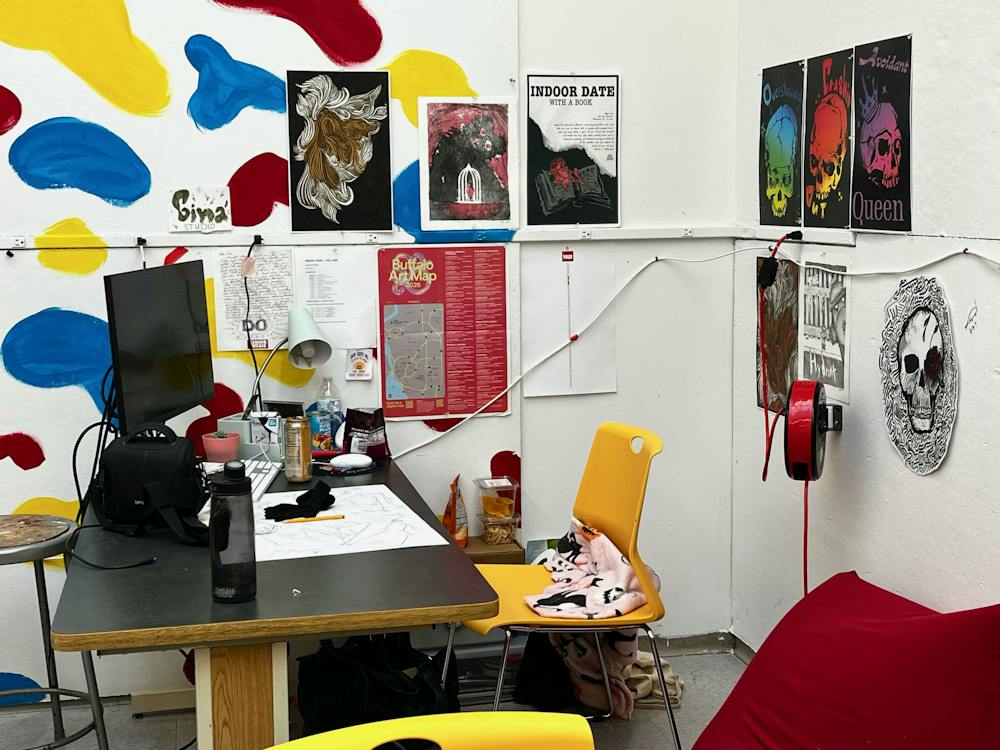
As comedian Demetri Martin once said, “The earth without art is just eh.”
Syanne Adams, Louis Dawes and Eva Hernandez agree. They say art is extremely influential to society and elicits a feeling in the artist that is unlike anything else.
Academic life in the art department starts off like many other degree programs: pick a major and select a concentration within that major. Students are required to complete a variety of art classes, and then a few more specific classes that fit into their concentration.
Adams is a senior majoring in studio art with a graphic design concentration, and Hernandez, a sophomore psychology major, is also pursuing a fine arts degree with a general concentration.
“Truly through and through, we're studio art majors,” Adams said. ” What that means is that each of us have to take the basic courses from each discipline. So, we all have to take a photography class. We all have to take painting, we all have to take sculptures.”
Hernandez and Adams call these courses, “workshop classes,” which last around three hours. The classes are usually in two parts: a short lecture to explain a technique, an artist or the history of a certain artform and then work on individual projects.
Students have to complete 3-4 projects a year with certain criteria and milestones they have to hit at certain times. Despite the criteria and timeline given by their professors, students have full creative freedom.
“It's very much you come to the table with your own aesthetic, with your own idea and then we help you cultivate that rather than, ‘Oh, this is what we want you to produce, and this is how you're gonna go about doing it,” Adams says. “So it's very open-ended, challenging how we see art, how we think about art, how we view art rather than just rules and regulations to creating it.”
Dawes says the small classes create a space that encourages friendship and support.
“We all come together, and we have a place where we can all talk about art,” said Dawes. “Like, we aren't afraid to say things, because the group is so little, and we all know that each other, like, have each other's back, if that makes sense.”
Days can easily get long with the classes and the extra time needed to finish projects. Despite this, Adams and Hernandez say time can go by quickly once they “get in a flow,” as Hernandez puts it.
“There’s something so freeing and amazing about having an idea and then coming to the table and just being able to, you know, create it and see it out in the world,” Adams said.
Seeing how others interpret her work is a feeling unlike any other, Hernandez says.
“I just enjoy being able to create work that reflects my personal life and my experiences and the things that I love, and putting that out there and letting people interpret that to what they want and connecting with others,” said Hernandez.
Dawes doesn’t have the same schedule as Hernandez or Adams as a first-year graduate student majoring in arts leadership and cultural management. His classes are mostly lectures, and — instead of focusing on the creation of art — focus on how to manage the arts organizations, from daily maintenance to exhibitions.
Dawes wants to create a space where artists can continue creating the work that he admires.
“Because, I'm not very artistic myself, but I enjoy art,” Dawes said. “So, like, I want to make areas that artists can come and create whatever they want to in a safe environment.”
Hernandez and Adams both feel that art, and the pursuit of an education in it, is perceived by others as not as important as other fields. They argue that art is everywhere and that it is extremely influential and important to society.
“I feel like people don't really recognize how much art contributes to a lot of things,” Adams argues. “When you recognize how art is always being influenced by social chains, social opinions, by the values of a specific society at a certain point in time, you really recognize just how much the things that you're interacting with in your daily life are rooted in things that are beyond what you might think.”
Agnes Keough is the assistant features editor and can be reached at agnes.keough@ubspectrum.com.
 Photo: Courtesy of Wikimedia Commons

 Photo: Courtesy of Nicc Williams; photographed by UB Athletics
