
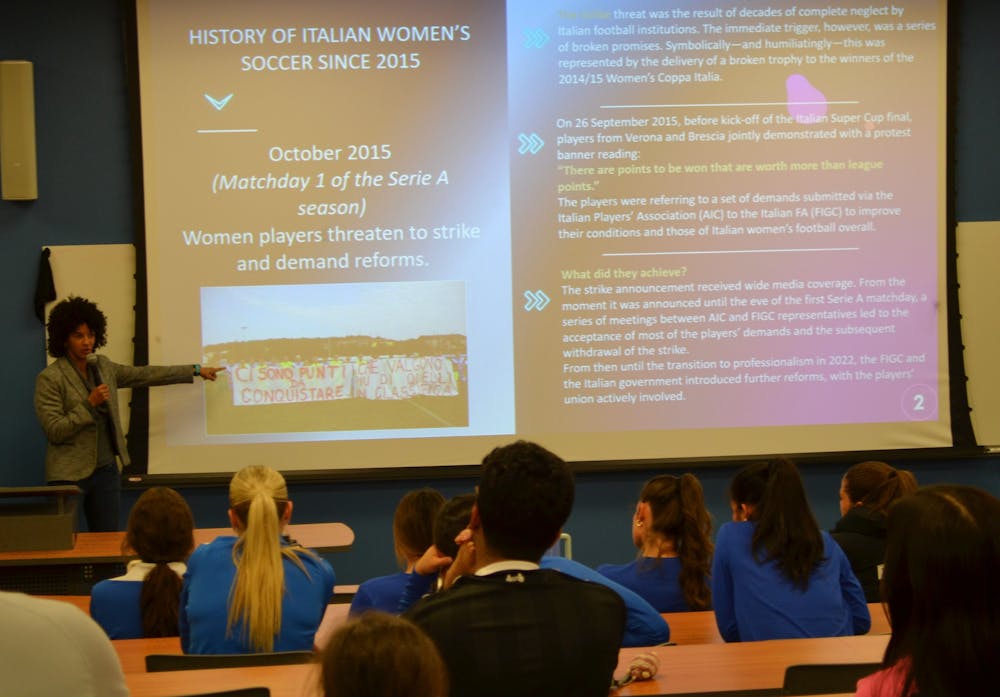
Former captain of Italy’s national team and vice president of the Italian Footballers’ Association, Sara Gama visited UB on Monday evening to give a talk on leadership, advocacy and change in women’s soccer. Throughout her career, Gama has captained Juventus Football Club (FC), represented Italy on the world stage and helped lead the fight to secure professional status for women’s soccer in Italy.
Moderated by Dr. Paola Ugolini of the Department of Romance Languages and Literatures (RLL), the conversation focused on the rapid evolution of women’s soccer in Italy in the 2010s. Dr. Marco Faini opened the event by crediting women’s soccer with “reviving the community” within the sport, before welcoming Gama to the floor.
“When I got my first call up to the national team… I didn't even know we had a national team,” Gama said, reflecting on the early years of her career.
In 2006, when she made her national debut, Gama was playing domestically for Tavagnacco in northern Italy. With no professional women’s league at the time, many of Italy’s top players, including Gama, eventually went abroad to develop their careers. After an injury, she returned to Italy in 2015 to play for Brescia, where she and her teammates began pushing for structural change.
“You play in a final, you want to think about the final, but we were thinking about other things,” Gama said. “We were asking for the type of things that don’t even cost a thing.”
During this time, women’s teams were still classified as amateur and could not offer proper contracts, leaving players without stability or long‑term planning. Reform began to sprout after protests led by Gama and her teammates. Gama explained that changes at the Federal Council allowed men’s professional clubs to acquire women’s amateur teams, opening the door to investment and growth. The overhaul also created U16 and U23 national programs.
When Juventus began their women’s team, they immediately signed Gama and made her a captain. Her leadership helped transform the club into a powerhouse and made her a household name in Italian soccer, giving her the power to begin demanding change.
“We got to the World Cup in 2019, and it was 20 years before then that Italy participated in a World Cup,” said Gama. The team’s success marked a turning point that showed that investment in women’s soccer yields results.
“Very often we were told in the end you don't produce money, you know, you don't produce revenue so that's why we don't invest any money, but it doesn't work like this,” explained Gama.
Gama made it clear to the audience that this success was because of investment in the game, and emphasized the fact that nothing will grow if you do not first nurture it. These assertions directly confront a lot of the common arguments against investing in women’s sports on the basis that they do not generate revenue.
Gama also stressed that progress requires collaboration rather than competition between men’s and women’s soccer.
“Very often there is this narrative of men against women… but we are all in the same system and it’s good if everyone does well,” she said.
Gama noted that framing the sport as a gendered battleground distorts reality and it fuels resentment while creating backlash that harms female athletes.
When the conversation turned towards leadership, Gama highlighted the importance of representation in decision‑making spaces. She explained that real change occurred only when she and other women entered boards, committees, and federations, because those are the places where policies are shaped and resources are allocated. Being in the room allowed her to advocate directly for younger players and ensure that reforms were lasting and structural, rather than just symbolic.
The message was clear: representation matters not just on the field, but in the institutions that govern the sport. By stepping into leadership roles, Gama has helped reshape Italian soccer from within and she encouraged the audience to see advocacy as a long‑term, collective effort.
Ciah Courtney is the Senior Sports Editor and can be reached at ciah.courtney@ubspectrum.com


