
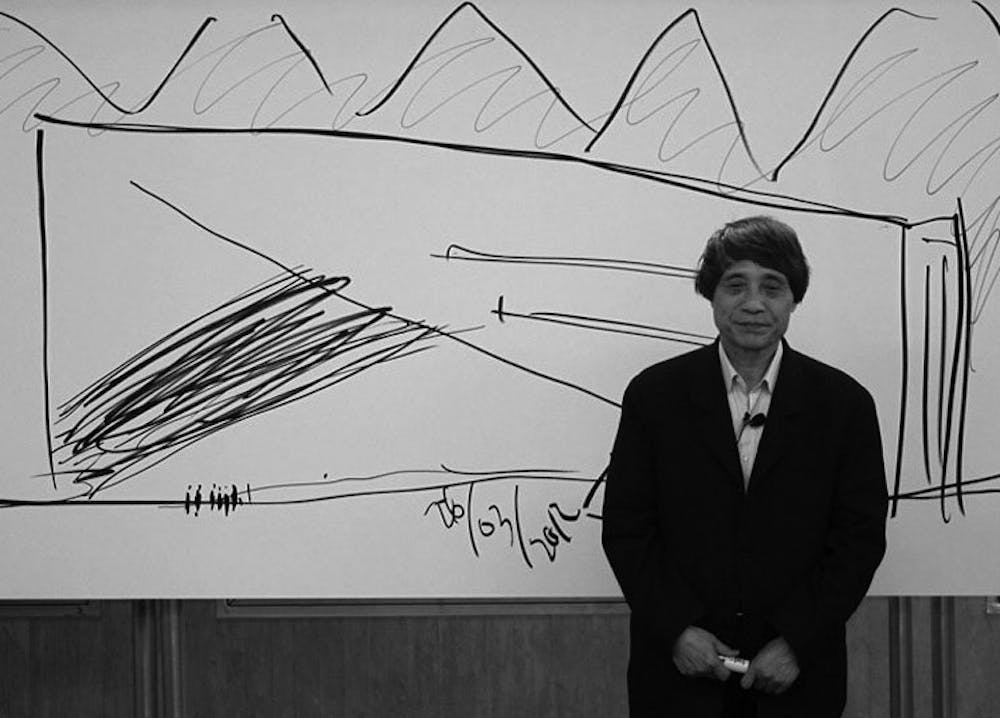
The most celebrated architect of his generation never took a single architecture class.
Tadao Ando, the self-taught Japanese architect who won the 1995 Pritzker Prize — the field’s highest honor — built his career on exposed concrete, natural light and a philosophy of discomfort. He has no degree, no formal training and no clear reason he should have succeeded. His buildings have changed how the world thinks of architecture and what architects believe is possible.
Ando was born Sept. 13, 1941, in Osaka, Japan, and raised by his great-grandmother in a working class neighborhood. He grew up watching craftsmen work and decided early on that school had nothing to teach him. At 17, he became a professional boxer and would eventually be known as “the Great Ando.”
This career took him across Asia, but it was during a trip to Bangkok, where he visited Buddhist temples, that he experienced his first spark of interest in designed space. He quit boxing, apprenticed with a carpenter, and began the journey of educating himself. In 1964, after Japan lifted its international travel ban, Ando boarded a train to Europe to study the buildings he had only seen in books. He sketched Le Corbusier’s work in France, walked the Parthenon in Greece, and returned to Osaka in 1969 to open his own firm.
In 1976, he made his breakthrough into the architecture industry with the completion of The Azuma House — also known as the Row House in Sumiyoshi. This windowless, concrete house features one key element where residents are required to pass through an open-air courtyard just to move between rooms, demonstrating Ando’s intentional use of discomfort and his belief that architecture should confront people with nature rather than insulate them from it. He received the Architectural Institute of Japan’s Annual Prize in 1979, but international recognition did not come until the late 1980s.
“In all my works, light is an important controlling factor,” Ando has said. “I create enclosed spaces mainly by means of thick concrete walls. The primary reason is to create a place for the individual, a zone for oneself within society.”
That philosophy can be seen throughout every project. His architecture draws from Zen Buddhism’s treatment of emptiness as presence — what he calls the “haiku effect.” Fewer elements leads to deeper meaning. The Church of Light, completed in Osaka in 1989, represents the sacred through a single cruciform cut into the concrete wall, using natural sunlight to bring the space to life each day. It is not famous for what it has. It is famous for what it doesn’t.
“I don’t believe architecture has to speak too much,” Ando once said. “It should remain silent and let nature in the guise of sunlight and wind.”
In 1995, the Pritzker Prize jury awarded Ando and described his work as “an assemblage of artistically composed surprises in space and form that both serve and inspire, with never a predictable moment as one moves throughout his buildings.”
It was the highest recognition his field could offer, and it went to a man who spent decades building outside the conventional path of architecture. He has since built museums, cultural institutions, and private residences across four continents. He taught at Yale, Columbia and Harvard. A generation of architects cite him as the reason they pursued the field. His influence can be seen across concrete walls, geometric skylights, and intentional silences built into contemporary architecture worldwide.
Ando’s work is not defined by performance or decoration, but by restraint. In doing so, he reshaped what it means to build and what it means to experience space.
The arts desk can be reached at arts@ubspectrum.com
 Photo: Courtesy of Wikimedia Commons

 Photo: Courtesy of Nicc Williams; photographed by UB Athletics


