
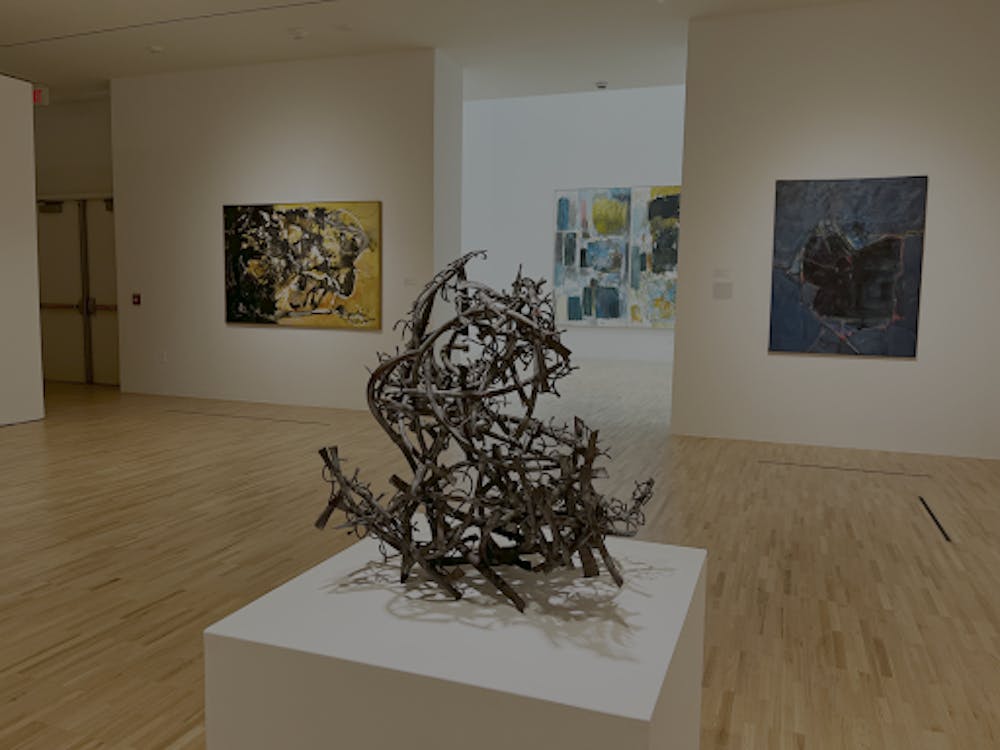
Stepping through the main entrance on the first floor of UB’s Center for the Arts (CFA), the CFA Gallery stands directly to one’s left-hand side. An A-frame sign on the ground displays graphics for the current available exhibitions, and greets everyone who passes through the sleek white doors.
The CFAs’ “Martha Jackson in Paris” exhibit opened on Sept. 4, 2025, and runs through May 17, 2026. Guests and students alike have plenty of time to visit the mesmerizing artworks on display, but it’s definitely not something to put off. Like most of the exhibits located within the CFA Gallery, the exhibition offers free admission to the public during the six-hour window that the gallery opens, on Tuesdays through Saturdays from 11:00 A.M. to 5:00 P.M.
The debut of “Martha Jackson in Paris” was part of UB Art Galleries’ 25th anniversary celebration. The collection has grown to a grand scale thanks to the many generous donations from philanthropic parties, private collectors and alumni.
Martha Jackson, a Buffalo native, was a prominent art dealer and collector who went on to found a New York City-based gallery, aptly named the Martha Jackson Gallery. There, she displayed the works of artists both renowned and niche. What made her galleries so captivating was the multicultural, “cross-Atlantic” diversity present in the works she and her curators chose to put on view.
Her vast collection made it to UB through a series of interesting events. After Jackson had passed, her son, David K. Anderson, a UB alumnus and art dealer just like his mother, took over her collection and worked closely with running the Martha Jackson Gallery in New York City to continue her legacy and work.
31 years after her passing in 2000, Anderson made an immensely pivotal and generous donation to the school. He presented the university with 1,200 pieces of artwork, the archives of his and Jackson’s galleries, and a trust to partially fund the exhibitions, thus forming the basis for the organization known as UB Art Galleries. The UB Anderson Gallery, located just off of South Campus, was built to honor him.
Today, at the “Martha Jackson in Paris” exhibition, a guest can view the artworks of the artists with whom she often collaborated. A long white case containing several correspondences, photographs and gallery posters loosely organized across its interior sits at the front of the gallery.
Jackson used her connections and influence within the art sphere as a collector, making waves and spreading the visual profundities of artists around the world despite the societal and legal barriers women in the 1900s faced. Paris, in particular, was a place that seemed limitless to artists; many female, queer and non-white artists sought out Paris as a place where they could find safety, openness and liberation in their identities and art. Naturally, Jackson also found herself where great artists of the century thrived doing what they loved.
Within the exhibition, “Egyptian Basilisk” by Paul Jenkins immediately grabbed my attention. Its use of gold, white, and black, with tones of orange, came together to create a warm, luxurious-looking piece formed by organic, lively strokes and blots. The painting resembles a complex Rorschach test, littered with endless interpretations.
Hisao Domoto’s “Cyclades,” “Les Montagnards” by Jean Dubuffet, and the section dedicated to Karel Appel’s expressionist works were also well worth mentioning.
All in all, this gallery dedicated to Jackson and the artists she grew close to and amplified weaves together a tapestry of people of different cultures, backgrounds and artistic values in a world that felt divided after the events of World War II.
In a letter to Jackson, Jenkins writes, “All of Paris asks when you are coming. The season isn’t officially underway until you come on the scene these days. They await with bated breath and I don’t blame them.”
The arts desk can be reached at arts@ubspectrum.com
 Photo: Credit: Kishaun Proctor


