
Cheryl Strayed knows what it’s like to feel buried under grief. She struggled to cope with the sudden death of her mother and felt weighed down at every step.
And on the first day of what would be a 94-day hike, Strayed felt the heaviness of something else – her backpack.
It contained all the necessities for her trip of self-discovery that would eventually turn into a New York Times best-selling memoir and soon, a feature film. But she couldn’t lift the bag.
It was in that moment Strayed understand why she needed to tell her story.
“You’ve all at some point been alone, in the metaphorical, with something you can’t lift and you have to,” Strayed told a crowd at UB’s Alumni Arena. “And you have to walk out the door with it on your back and you have to keep walking.”
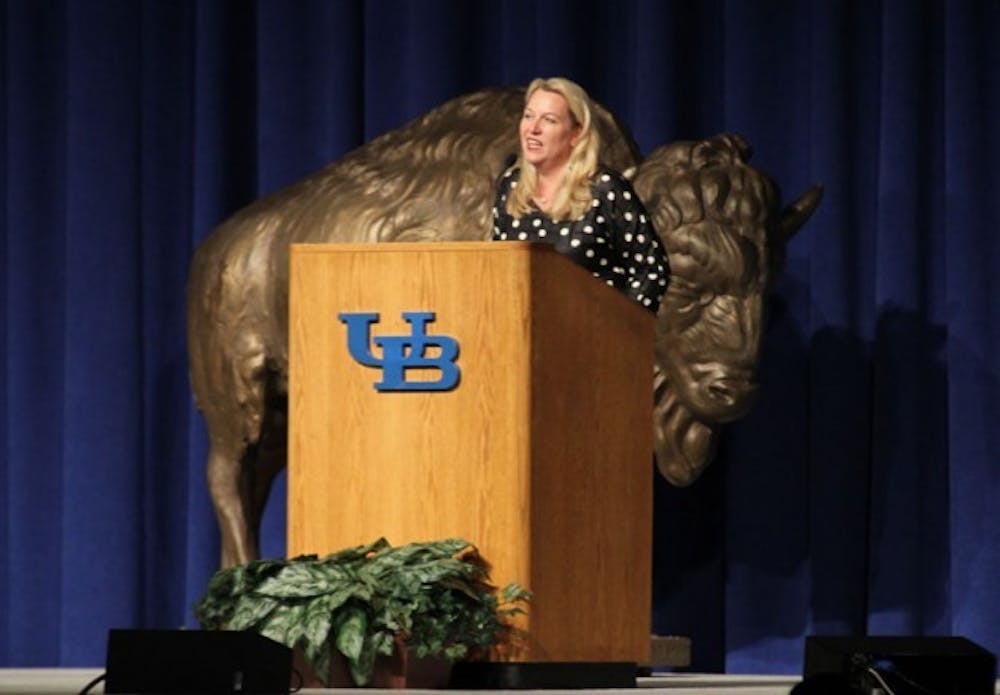
On Wednesday evening, Strayed spoke about the story leading to her journey across the Pacific Crest Trail into her memoir, “Wild.” Strayed, the first speaker of this year’s Distinguished Speaker Series, spoke of her perils with drug abuse and of her mother’s death to cancer, both of which led her to go on a grueling hike.
She urged the members of the audience to find their own adventures.
The Pacific Crest Trail, which travelers often call the PCT, is a hiking path that stretches from the U.S. border of Mexico to Manning Park in British Columbia, Canada. It’s more than 2,500 miles long. Strayed’s memoir “Wild: From Lost to Found on the Pacific Crest Trail” details her own 1,100-mile trek.
Strayed believes the intense physical aspect of her trip – the boots she wore caused her to lose nearly all her toenails – forced the “truest version” of herself to emerge. Strayed’s mother was an integral part of her life and she was unsure how to move past the death. But she said the hike helped her discover the person she “always intended to be.”
“Just get comfortable with being uncomfortable, not just on the trail but in life,” she told The Spectrum. “Because so many of the best things in life has come to me when I can settle into that and just accept, sometimes misery makes the best memories.”
Her mother found out about the cancer only seven weeks before she died. Strayed was 22 years old.
When Strayed was a child, her father left her family. Her mother was left to fill the role of both parents, which led to a close-knit bond between the two women.
Strayed, now 45, realized the “sustaining power of having been loved well” by her mother would be “never ending.” She used that loss and love to fuel her PCT trip.
“We can live with sorrow and still thrive,” she said.
When Strayed attended the University at St. Thomas, a small college in Minnesota, her mother enrolled into the same college. Students’ parents were able to take classes for free, Strayed said. She joked to the crowd about how mortifying it was to have her mother attend the same school. After transferring to University of Minnesota, her mother transferred as well but to a different campus – much to the relief of Strayed.
Strayed’ mother died during the then college senior’s spring break. Her mother was only two classes away from a bachelor’s degree.
This was the start of Strayed’s spiral into self-destruction. She remarked she now understands how untrue the idea was, but at the time, she wanted to grieve “so wildly” and “so savagely,” as to let the world know how much she loved her mother.
That’s when she started using heroin. The drug became a “self-destructive cure” because it was the “first thing that took away [the] pain” of her mother’s death.
After reaching this “bottom point,” Strayed knew she had to change her life.
She found her answer in a Pacific Crest Trail guidebook on the cashier counter of a R.E.I., an outdoors equipment store, in Minnesota. Strayed knew then she was going to tackle the PCT.
She grew up in 40 acres of wilderness and this rawness of nature was “home” to her.
“I just thought …‘I’m going to do this thing,’” she told Alumni Arena. “It seemed such a simple, but good idea to go to the place – the wilderness – that made me feel the most gathered and at home and at peace with myself.”
Strayed transformed on her journey, enduring intense physical pain. She said it took several years for her toenails to grow back. Strayed even offered to show the audience the current normal state of her nails.
Holly Kistner, a senior environmental geoscience major, was excited to hear Strayed was coming to UB. After reading “Wild,” Kistner admired the steps Strayed took to change the unfortunate circumstances of her life.
She said what stood out most in Strayed’s talk was how she did not mean the book to be “inspiring” or to “have a message.”
“It was a book meant to tell a story about carrying on in your life with an enormous weight,” Kistner said in an email.
Strayed stressed the book’s intention isn’t to congratulate herself on hiking the PCT. She said she wanted to tell her story of loss and how she found her own meaning of happiness on the trail.
Strayed’s book has been adapted into a film of the same name, which wil be released in December. It stars Reese Witherspoon as Strayed. During the production of the film, which Strayed was heavily involved in, Strayed asked Witherspoon why she wanted to play the role.
“She’s like, ‘I’ve never seen a film where the main character, a woman, has no money, and no man and no home, and nothing, and you know she’s going to be totally OK,’” Strayed said. “And that’s how I felt that day. I knew I was going to be OK, because I had myself back.”
Strayed said all she ever when wanted was to have her mother back, but it was the one thing she could never attain. Writing “Wild” gave her the opportunity to create a version of her mother that lives on in her life and, now, in the rest of the world.
“Your happiness doesn’t obliterate your sorrow,” Strayed said. “But you also can’t let your sorrow obliterate your happiness, no matter what that sorrow is.”
email: news@ubspectrum.com



