
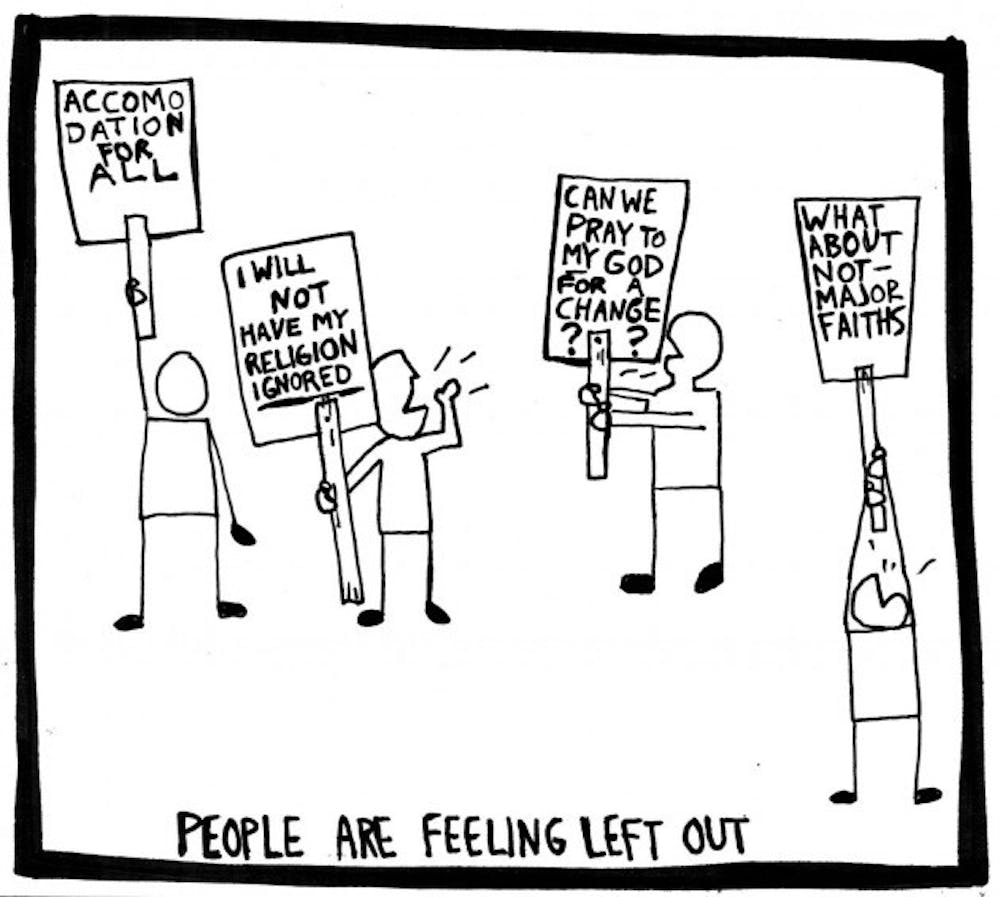
This week, the Supreme Court will consider the role of prayer in a legislative setting for the first time in 30 years. The case comes to Washington, D.C., from upstate New York.
On Wednesday, the court will hear oral argument in Town of Greece v. Galloway - a case in which two residents sued the Town of Greece for violating the Establishment Clause of the First Amendment by organizing prayers that have been exclusively Christian before monthly town board meetings for the last nine years.
Many of these prayers included language such as "in the name of the Lord and Savior Jesus Christ, who lives with you and the Holy Spirit, one God for ever and ever." For those who are not Christian, this is uncomfortable and, by beginning a town board meeting this way, effectively forces residents to partake in such a prayer in order to attend the meeting.
The U.S. Court of Appeals for the Second Circuit was right to rule for the plaintiffs. As it was established in Marsh v. Chambers that prayer before legislative sessions does not violate the First Amendment, there are important distinctions in this case that make the Town of Greece's actions unconstitutional.
Given the "unique history" of the United States, using prayer in the legislature is appropriate as it is accepted that lawmakers may seek "divine guidance" in their decision-making. The dominance of the prayers before Greece's town board meetings being explicitly Christian, however, takes one step too far in "respecting an establishment of religion" - which is precisely what the Establishment Clause prohibits.
There are still those who defend the practice of the town board and maintain the ruling in Marsh v. Chambers supports their ability to conduct a prayer before the meeting. They insist that anyone may deliver a prayer.
But that is not what this is about. A government entity appearing to support one specific religion at all is problematic. The role of any particular religious belief template should not be injected into governmental procedures.
Justice Sandra Day O'Connor once wrote in an opinion that when the government creates even the appearance of supporting one religion it "sends a message to nonadherents that they are outsiders, not full members of the political community."
And this has been validated more so by the case.
After the lawsuit was filed, one of the town members who sued the town received a letter that said, "If you feel 'unwanted'... it's probably because you are." The letter was signed "666."
When a chaplain calls upon Jesus Christ or the Holy Spirit to guide the deliberations of the town council members, he creates a feeling of exclusion among those who don't share that belief and it also allows religion to intersect with the state in a way the framers deemed inappropriate.
And so do we.
With America becoming increasingly diverse, it is also becoming increasingly complicated to draw the boundaries between religion and public life. With this case, the court will have the chance to rule on the limits of prayers in a legislative setting.
Former Chief Justice Warren Burger once said in regard to Marsh v. Chambers that "the unambiguous and unbroken history of more than two hundred years" ruled in favor of upholding the practice of legislative chaplains.
But he did specify that no legislative prayer should proselytize nor denigrate any other faith. Making participants in a town board meeting - which any resident can attend - partake in a prayer specific to one religion falls outside the boundaries of our First Amendment protections.
The Supreme Court should be acutely aware of that this week as they consider the ever importance of impartiality toward religions in our government and public life.
email: editorial@ubspectrum.com
 Photo: The Spectrum Archives


