
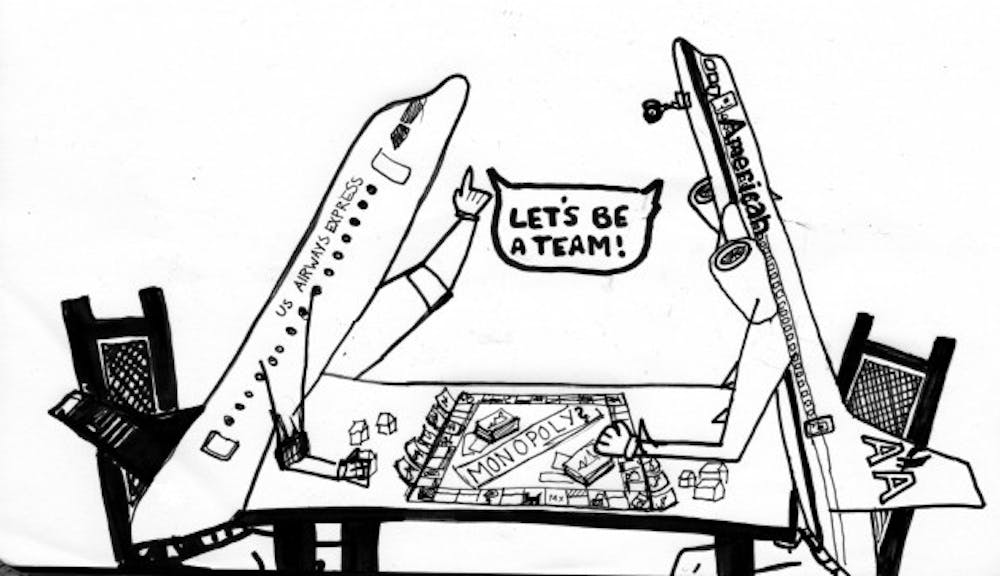
In a month, American Airlines will be the largest airline in the world. After months of hurdles and complications, the Justice Department announced on Tuesday that it approved the merger of American Airlines and US Airways after a settlement was reached.
The settlement involves the newly established airline to give up an array of spaces at various airports in order to ensure enough competition in the airline industry to keep fares down.
But let there be no mistake about it: Such a stipulation is not satisfactory in attempting to alleviate the probable consequences of there only being four major airline carriers in the United States.
This consolidation will cause 80 percent of all domestic-travel business to come out of three airlines - leaving no room for competition from smaller companies and will inevitably allow cushion for these major airlines to keep prices high.
Without substantial competition, incentive to keep prices low diminishes. It will be travelers and consumers that will have to bear the brunt of the damage to manifest from this outcome.
This merger will make over 1,000 routes dominated by only two airlines - giving them the cushion of a near monopoly to control the costs of traveling from those destinations.
American Airlines will now have 69 percent of the limited takeoff and landing spots at Ronald Reagan International Airport just outside of Washington, D.C., granting it near complete control of one of the largest airports in the nation.
The Justice Department made a colossal error in judgment by neglecting the original arguments made in the lawsuit filed in August. The settlement reached last week does not address the problem of reduced competition - it only shifts the focus away from the real problem.
Overwhelming levels of statistics demonstrate that this consolidation is unwise and will leave very little room for the smaller companies to be a factor in air travel. And it will be the low-cost airlines, such as Southwest Airlines and Jet Blue, that will suffer for it.
Consequentially, consumers will get hammered with higher prices; they won't even have a choice for an enormous number of routes. This may turn out to be a poor business model for the industry, as it will inevitably cause a large portion of Americans to decide they can no longer afford to travel by plane.
The Justice Department should have known better and should have considered past examples of mergers that were prevented due to the deadly potential had they come to fruition.
You may recall the proposed merger of AT&T and T-Mobile, which was blocked by the government because it was clear the unification would lead to higher prices and there would be less room for innovation - monopolization facilitates complacency.
It was also propagated that the merger of the cell phone businesses would leave no room for smaller companies. It is the same problem, just a different industry.
Theoretically, there could still be incentive for large airlines to keep prices low if smaller airlines were charging lower fees for their routes. The problem with that is the smaller airlines will not have that leverage, as they won't have as many direct routes as the larger airlines.
Now, with only four major airlines - Delta, Southwest, United and the new American - Americans will have to pay much more for air travel, as there will be fewer options to choose from.
email: editorial@ubspectrum.com
 Photo: The Spectrum Archives


