
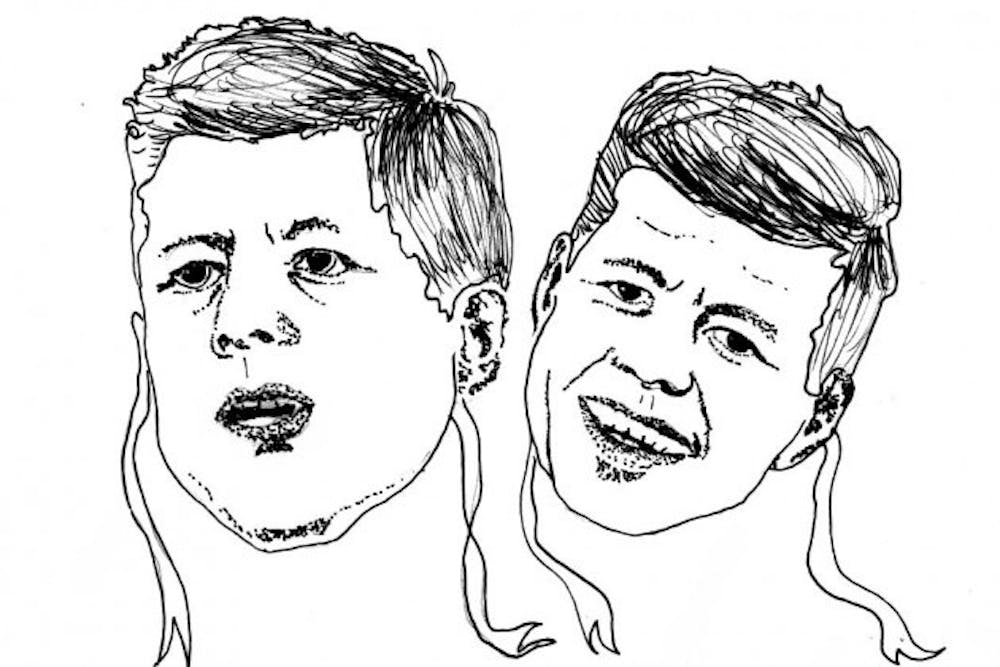
What he was, he was:
What he is fated to become
Depends on us.
- W.H. Auden, "Elegy for JFK" (1964)
It is hardly just the 50th anniversary of former President John F. Kennedy's assassination when we reflect on his life and death. And it is hardly just those who were alive when it happened who mourn the loss of an elegant and inspiring leader.
For our generation, of those young and in college now, he still means a great deal. But for us, it is not that we lament losing a president we admired - we weren't there for it; it's that we lament the loss of an attitude he cultivated in others - a youthful confidence in the possibilities of participating in the political process.
Kennedy's legacy will always belong to the young - the young in age and the young in spirit. More so than any other figure in American history, it was he who motivated America's youth to become involved in public service.
He came to symbolize that politics is a noble calling and that government is an engine that can solve our greatest problems.
It says something that both sides - liberals and conservatives - want to claim him as one of their own. The meaning of his life is still deeply embedded in the vision of America to which many want to cling: a sense of widespread belief in the country's potential.
Most of the historical evidence points to that he began his political career as more of a conservative and wound up as more of a liberal; the significant speeches toward the end of his life about the need for civil rights, nuclear disarmament and peace have become a rallying cry for liberalism and American progressivism.
And the ideological course his brothers Bob and Ted would take, and the rest of the Kennedys who would go on to run for office, further indicate the former president's political principles and shape images of his legacy.
Nevertheless, the question of what he means for the young people of today still beckons further consideration. It was not long ago that another senator who ran for president gave a large amount of people a great deal of hope - and excited young people in particular. As Robin Williams said in a stand-up bit in 2008, "Obama may be Kenyan for Kennedy."
Even as Obama, well into the fifth year of his presidency, disappoints the campaign he led of "hope and change" that so many deeply believed in, like Kennedy, he carries with him the mark of a celebrity president.
But on this anniversary, very few are comparing Kennedy's political life to Obama's, as much as his death to Sept. 11, 2001. When young people today talk to their parents or grandparents about Kennedy's assassination, the first thing they say is where they were that day or what they were doing.
Those of us in college now do have an experience similar to that - we all remember where we were on Sept. 11.
Each of these two events were tragic and signified desolate meanings of massive implications. But we know who carried out the 2001 attacks; we know who the mastermind was behind it. But there is still a large cloud of mystery looming over Kennedy's death.
Any visit to any bookstore throughout the country will verify how many writers (and readers) are still obsessed with the facts surrounding that fateful day.
The uncertainty of everything deserves the relentless attention of historians and those who dare to undertake one of the most vexing questions in American history. But for us, today's youth, the question we should be focusing on is quite different.
In 1963, after the assassination, the American journalist Mary McGrory cried to Senator Daniel Patrick Moynihan, "We'll never laugh again." To which, Moynihan replied: "Heavens Mary, we'll laugh again. It's just that we will never be young again."
This is true of us, too - we will never be young again. But we are young now. And we should remember how the power of youth (and believing in youth) has impacted our nation's history.
Today, as the country remembers Kennedy and all his vigor and sense of incipient dreams, pay attention to how much Americans miss the sense of youth that he brought to America.
It is probably because of how badly we still need it.
email: editorial@ubspectrum.com
 Photo: The Spectrum Archives


