
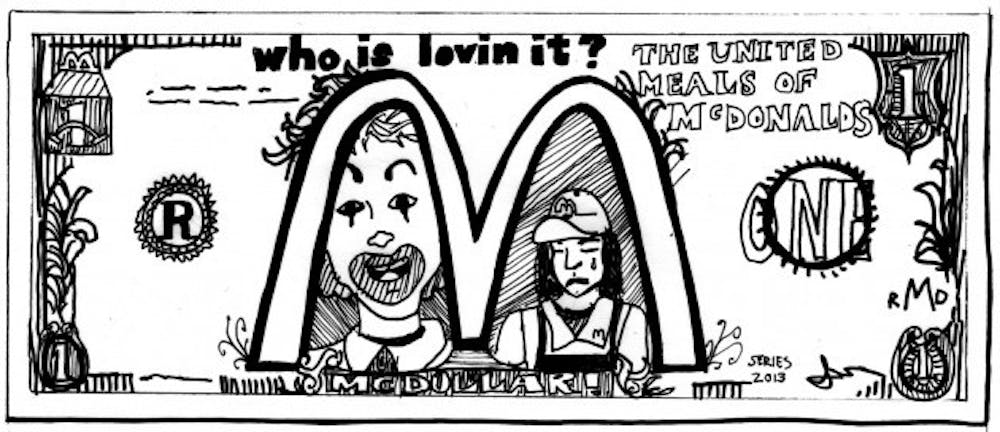
Last week, McDonald's announced it made $1.5 billion in the third quarter. That puts the world's largest food chain up 5 percent from last year.
But last week, it was also announced that taxpayers are paying $1.2 billion in public assistance to the McDonald's workforce.
Those numbers are merely a coincidence but draw attention to how the McDonald's Corporation is making enormous profits as its employees struggle to pay for food, housing and medical care.
Low Pay Is Not OK, an advocacy group, recorded a telephone call Nancy Salgado made to McResource, a helpline for McDonald's workers, in which the representative assured Salgado she would have no issue receiving assistance from government programs.
Without ever asking Salgado much she makes an hour or how many hours she works, the representative assured her she could qualify for food stamps and heating assistance. What has come to light since Low Pay Is Not OK has publicized this call is that McDonald's encourages its employees to seek out these programs.
All the while, McDonald's keep its employees' wages unacceptably low.
But this should come as no surprise to the fast food industry, as more than half of fast food workers rely on public assistance programs for support because their wages are not enough to live on, according to CNN.
Salgado's recorded phone call supports what thousands of fast food workers have been complaining about for years: Their pay is too low and they don't receive enough benefits.
In July, McDonald's received scrutiny and criticism on this matter after providing a "budget planning guide" for its employees without taking into consideration gasoline or food. Not to mention, the budget left room for a second job, indicating an admission that the corporation recognized the wages it provided are insufficient.
The median wage of frontline fast food workers is $8.94 an hour, according to Reuters. These workers, who work anywhere from 25-40 hours a week, barely make $15,000 a year. With wages that low, of course fast food workers are more likely to need public assistance programs.
Public tax dollars are subsidizing fast food workers. As the fast food industry rakes in billions of dollars each year, the public pays for the assistance programs these companies impose on their workers.
Those who defend the fast food industry claim these companies must pay their workers low wages because the business relies on small profits. This is nonsense. As McDonald's makes billions of dollars in profit, many of its workers live beneath the poverty line.
For years, McDonald's (like Wal-Mart) has resisted unionization. It makes sense why - unions would help its workers formulate a strategy to protect themselves. Unions have the ability to organize strikes and focus attention toward what is impacting whom they represent.
Most low-wage workers at fast food chains are not teenagers working a part-time job - most are adults trying to support themselves (and some are trying to support families, too).
Fast food workers deserve a union to move arguments for employees forward through fundamental organization, and a group to put pressure on state legislatures and Congress to raise the minimum wage - something we desperately need.
It is time for changes for fast food workers; they can no longer afford to be stifled by a billion-dollar industry that profits from them.
email: editorial@ubspectrum.com
 Photo: The Spectrum Archives


