
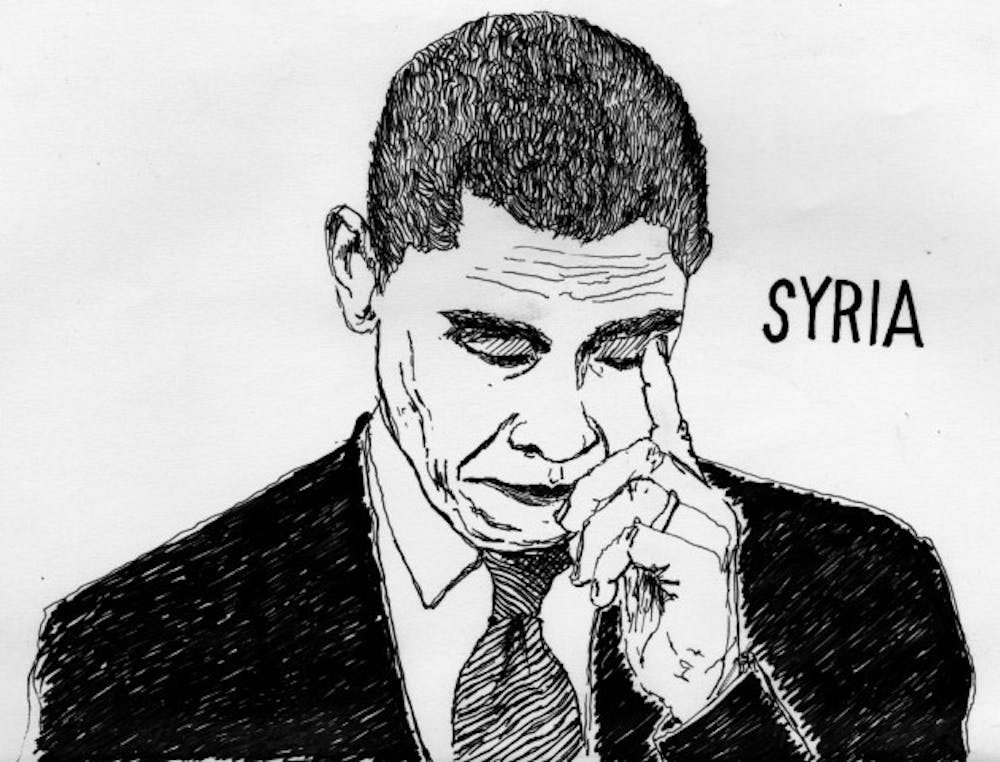
Not since the Vietnam War has the prospect of U.S. engagement in a foreign conflict engendered more collective skepticism and less public support. A Reuters/Ipsos survey conducted last week found that just 25 percent of Americans support military intervention following an alleged chemical weapons attack in Syria.
After more than a decade of war in Afghanistan and Iraq, rendering the public weary of more military activity in a region teetering on the precipice of cataclysmic collapse, there is legitimate cause for concern in becoming entangled in a conflict again.
President Obama has made the right call in seeking congressional approval before carrying out his plan for a series of attacks against Syria. The need for public dialogue over the use of military force is vital right now, as there needs to be transparency and clarity from top officials about the scope and duration of any strikes, along with a cogent outline of the potential ramifications of even the most limited, narrow actions.
It is an important part of the democratic process that the people's elected members in the House and Senate be able to review the facts and decide if a series of punitive strikes is an appropriate measure to take at the current time.
The international ban on the use of poison gas was established after the atrocities committed in World War I, and chemical weapons use has since been understood as a violation of international norms. In the past, the president has made clear that the use of such weapons would demand a response. What is important to recognize is that this red line was not initiated by President Obama; this line was drawn by international conventions in 1925.
When Bashar al-Assad unleashed this form of weaponry - which kills men, women and children non-selectively on a massive scale - he committed a nefarious crime that he knew would prompt other nations to call for repercussions.
It is disappointing that the British Parliament would vote against providing military aid for the strikes and shameful that Russia would use its veto power in the United Nations Security Council, blocking the president's attempt to assemble a broad coalition. While collective action would obviously be better, the United States cannot disregard the moral monstrosities occurring in Syria. Such action taken to deter any future use of chemical weapons would be in our national security interest - and universal humanitarian interest.
Neglecting to take action in this moment isn't just for the purpose of preventing use of these weapons in Syria, but to preserve and protect this long-standing ban for the future. If the use of chemical weapons is given slack now, what kind of precedent would this be to set to the rest of the world? A statement needs to be made that weapons of mass destruction will not be tolerated.
We understand the potential ripple effects of U.S. military action; and we think Congress should strongly consider the possibility that if Iran attacks Israel, the United States needs to be prepared to provide immediate assistance.
As The New York Times has reported, Israeli Prime Minister Benjamin Netanyahu has remained reticent to insert his opinion about the possibility of American intervention in the conflict, but certainly, Israel understands the importance of foreign aid in alleviating crimes against humanity.
Looking through the lens of history, would anyone say we should have had a non-interventionist foreign policy as Nazi Germany was working to exterminate Jews in Europe? Would anyone say we shouldn't have intervened as genocide was being committed in Rwanda? Or when there was ethnic cleansing happening in the Balkans?
Though there have been no indications from the president or Secretary of State John Kerry that they intend to fully embroil us in the ongoing civil war in Syria, and the issue is not whether to try and end the war that has already taken over 100,000 lives, we think Congress should authorize the president to draw this line in the sand.
Of course, there are risks involved in taking action, and the possibility that these strikes could cause the situation to escalate is a precarious element of this debate.
We don't want the United States to become ensnared in this conflict, and we want Congress to impose clear and narrow limitations in the resolution to launch the attacks. Any action must be purely punitive and to prevent any future use of chemical weapons.
We cannot open the door to large-scale military involvement in Syria, but we also cannot stand idle as these gross violations occur.
On Tuesday, Speaker John Boehner said he "supported the president's call for action." There has long been the feeling by many on Capitol Hill that it may take a crisis to bring the two parties together. As Congress prepares to return from recess on Sept. 9, our hope is that some earnest ambitions of our elected officials may help manifest a democratic resolution from our national leaders.
Email: editorial@ubspectrum.com
 Photo: The Spectrum Archives


