
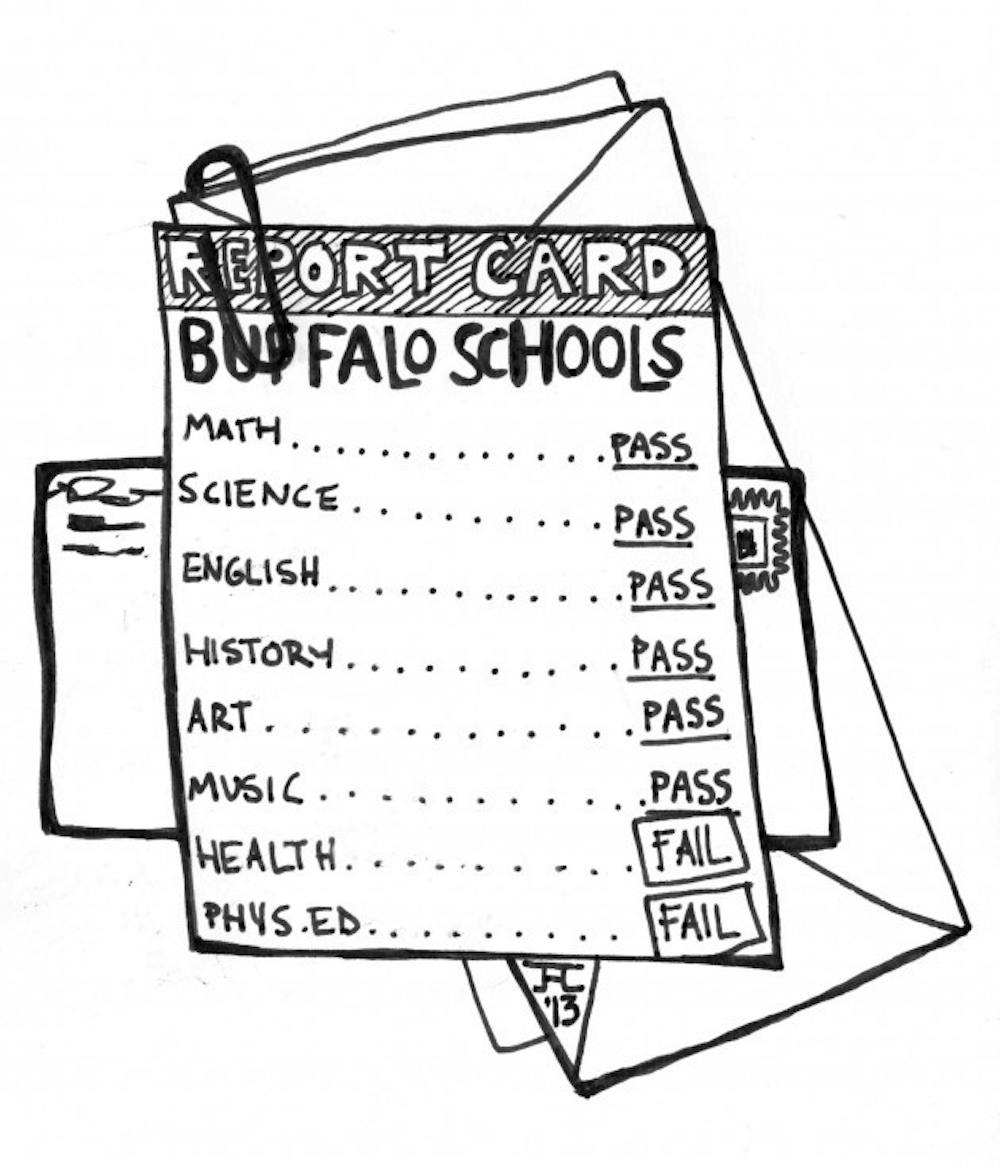
On Wednesday, the Investigative Post, a non-profit investigative reporting center in Buffalo, released data from a 2011 survey that revealed 90 percent of Buffalo high school students did not attend physical education classes daily - 36 percent higher than the national average.
Students in kindergarten through third grade are only getting physical education once every six days, according to the survey, and there isn't a comprehensive health education program throughout the Buffalo Public School District.
All children in grades K-3 must take part in a phys-ed class on a daily basis, and grades 4-12 must have gym class at least three times a week, according to the New York State Department of Education. To meet state regulations, the district would have to hire 30 more physical education teachers.
The Buffalo school system as a whole isn't in compliance with state regulations for its physical and health education programs, and it hasn't been for a least a decade, according to thePost.
This is unacceptable.
Buffalo schools are failing - graduation rates in the city sat at 47 percent in 2012 - and it doesn't seem to be getting better. One in three adults living in the City of Buffalo is illiterate, according to Say Yes to Education, a national non-profit committed to increasing high school and college graduation rates for inner-city youth.
Forty-five percent of Buffalo's seventh graders are overweight, according to the Post, and obesity has been proven to impact academic performance.
Seventy-six percent of high school students nationwide who scored grades of D and F on their report cards in 2009 didn't exercise for five or more days per week, according to the Centers for Disease Control and Prevention. Fifty-four percent of these students were also sexually active, according to the same survey.
Two years ago, a survey found that about 51 percent of Buffalo high school students said they had sex - five percentage points higher than the national average. A lot of these students - 30.8 percent of high school students - said they did not regularly use condoms during sexual intercourse. More than 200 student pregnancies were reported in the district last year.
For a district that spends over $750 million per year, it's shocking that health - something that seems to be at the core of any type of success, whether academic or otherwise - has taken a backseat. If Buffalo schools want to start seeing academic success, they must first see physical success in the form of health and fitness. The district cannot ignore such a vital part of childhood and adolescent education any longer.
Buffalo schools, whether it falls in the hands of the district or in the hands of the Board of Education, must meet regulations immediately. Whoever made the decision to cut physical and health education classes needs to be removed immediately. Something needs to change.
The district has started by finally complying with federal nutrition guidelines, and it has screened 2,000 students for dental hygiene and has paid for those who couldn't afford the visits. But it isn't enough.
"It seems that the state is not necessarily guaranteeing that a lot of their own regulations are being complied with," Jessica Bauer Walker, the executive director of the Community Health Worker Network and second vice president of the District Parent Coordinating Council of Buffalo, told the Investigative Post. "We as parents and the community are trying to shine a light on it and ask the state to actually enforce their own regulations as well."
We live in an increasingly digital society. Kids today spend more time playing video games, playing with iPhones or other technological toys and watching television than ever before - 43.4 percent of Buffalo high school students watched TV for three or more hours per day, and 33.4 percent used computers three or more hours per day in 2011.
You can't blame any of the obesity, academic success or sexual activity numbers on Buffalo's long, cold winters or the accessibility of technology. You can't blame these numbers on just the students or their parents, either. In 2011, about 31 percent of people in Buffalo were living below the poverty line, according to Census Bureau data.
If students are more worried about their financial status - where their meals are coming from or what they will go home to after school - they're not going to perform well academically and they certainly aren't going to worry about their health.
The district needs to meet state regulations and set up programs that teach students about healthy living, wellness and safe sex practices with the help of the Department of Education. Without these basic human needs, students just aren't going to excel scholastically.
Email: editorial@ubspectrum.com
 Photo: The Spectrum Archives


