
Don't start excitedly circling the holidays on your fall calendar quite yet - UB has some big changes in the works.
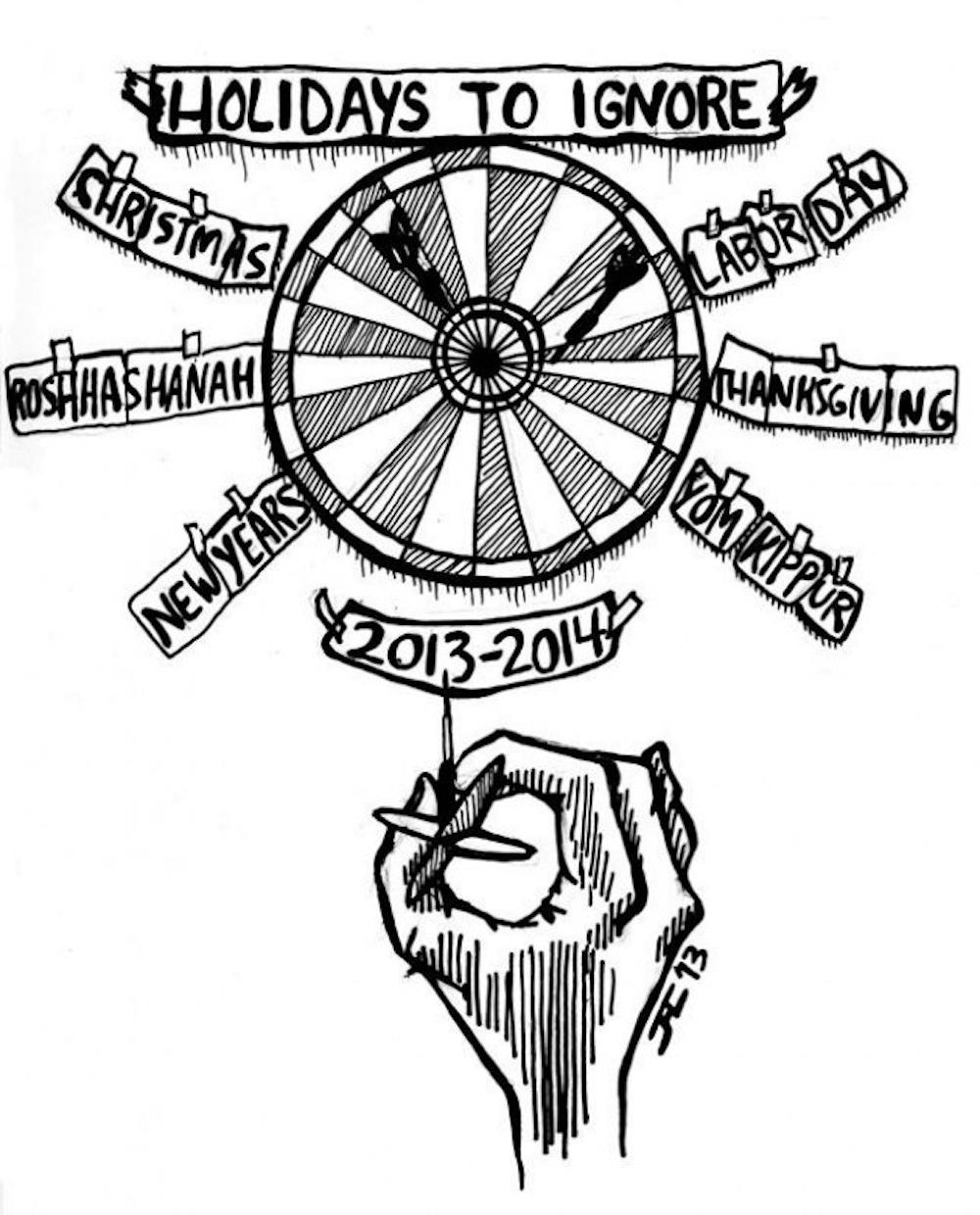
Last Wednesday, the Faculty Senate Executive Committee met and voted to alter UB's academic calendar in a few big ways: class sessions would be added over winter break, classes would be held on Labor Day to make Thanksgiving break a week long and classes would be held on Jewish holidays.
The proposals, of course, still await decision from President Tripathi, as well as an opportunity to allow students to express their opinions on the alteration, but if the final decision approves it, the changes would most likely go in affect for fall semester.
You may hem and haw over the some of the aspects - specifically the holiday class proposals - but overall, the potential changes are beneficial to the university.
There should be no debate over the option of winter intersession. UB is currently the only SUNY University Center out of the four (University at Albany, University at Binghamton, Stony Brook University and UB) that does not offer winter courses, leaving students in need of more credits to spend their money at other schools to make up for lost time.
Add the headache of transcript requests and credit transfers, and students are fed up with even the idea of more school by the time spring semester starts. There's an understandable amount of prudence in regards to finding professors willing to give up their winter break, but any "understandable amount" should be diminished by the financial implications. As mentioned in an article we ran in Monday's issue, Kara Saunders, university registrar, cited Stony Brook's winter session as an example. Two thousand two hundred students at the SUNY school yield approximately $2 million.
The actual controversy lies in the details of when students are required to go to school. Whether students will be loading onto the Stampede and into lecture halls on Labor Day is the first thing to consider in the proposal. While it is ideal to say Labor Day should be given off so people can celebrate it with their families and reflect on what the holiday means, let's be honest: we are a self-involved society, and the benefit of Labor Day to us is that we get off class.
We'd be willing to bet the majority of students are just concerned about losing a day to lie in the comfort of their beds. If that's what people are really concerned about, then they're ignoring the trade-off. In return for required attendance on Labor Day, the days off for Thanksgiving will be extended to a full week off. Fair trade. Professors and the Executive Committee are likely concerned about how disruptive Labor Day is to the beginning of the semester - the change would eliminate that concern.
But the majority of outrage and angry anticipation is coming as a reaction to the suggestion of holding classes on Jewish holidays. Edward Herman, secretary of the Faculty Senate, said, "the reasoning is that one religion should not get favorable treatment over others in the academic year."
If the plan goes into place, attendance will be required on Yom Kippur and Rosh Hashanah, which UB currently has both off for in the fall semester. Twenty-two of the 29 four-year SUNY campuses, including Stony Brook and New Paltz, do not cancel classes on Jewish holidays, and both recently implemented the policy.
The Jewish community argues the change would force them to choose between their school and faith. However, there is nothing that says they would not be able to take off school for religious practices, as is currently the policy in most classes. Professors are and should be required to respect that, meaning no exams or important projects should be scheduled on those days, and no student should be penalized for missing class to practice his or her faith. That is common sense.
If it moves along the curriculum and doesn't tack on any more days to the summer, then we're willing to get on board with the benefits of a few more classes, even if means - God forbid - we have to set our alarm clocks in the morning.
Email: editorial@ubspectrum.com
 Photo: The Spectrum Archives


