
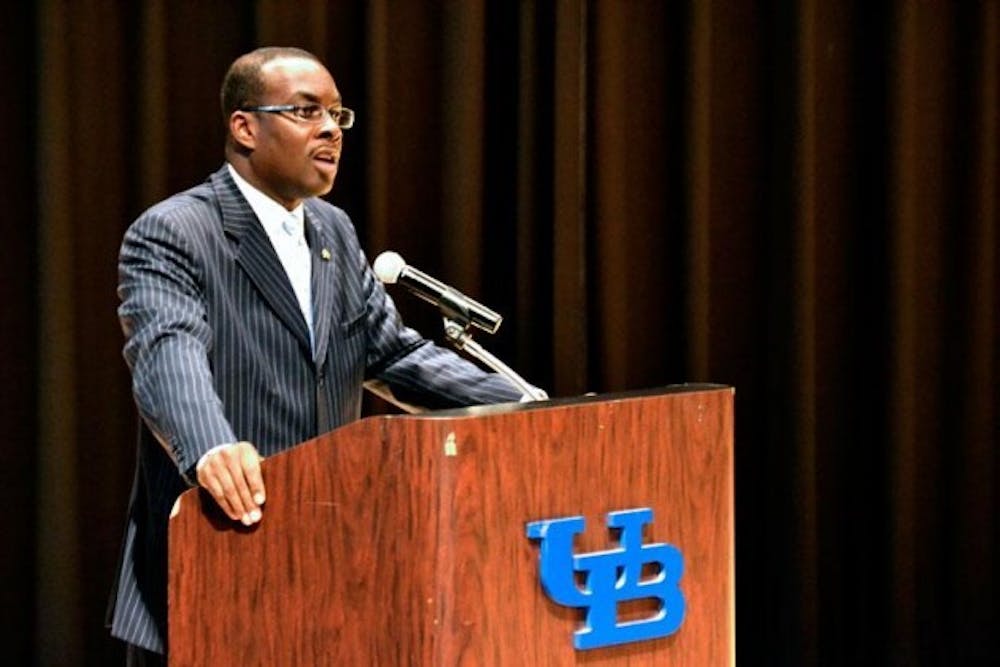
With the presidential election drawing closer, Buffalo's highest-ranking city official came to UB with a message for students: get involved.
Last Wednesday, the Black Student Union hosted Mayor Byron Brown in the Student Union theater as a part of political awareness week. Brown, a New York City native and graduate of Buffalo State College, used his speech to talk about local economic issues and to encourage students to participate in the political process. He also held a question and answer session regarding topics ranging from his position on health care to his motivation for entering politics.
Brown has been the mayor of Buffalo since 2006, and he was elected for a second term in 2010. He is known for his work in developing Buffalo's under-utilized waterfront property and for taking part in a mayoral coalition to increase gun control.
When talking to UB students this past Wednesday, he focused on the economic issues that have taken center stage during this election.
"We are seeing now a time increasingly where the economy is slow," Brown said. "And while jobs are being created, they are not being created as quickly as anyone would like to see."
This is particularly true of the greater Buffalo area.
According to the Department of Labor (DOL), from Aug. 2011 to Aug. 2012, Western New York saw a job increase of 200, or as the DOL characterized it, a job growth rate of 0 percent.
Despite this, the mayor expressed optimism about Buffalo's future economic prospects, citing $400 million in economic development projects either completed or announced in 2012 alone. Brown also discussed the creation of 5,000 jobs in the next five years through the cultivation of UB's medical school plans on the Buffalo Niagara Medical Campus.
"This is an exciting time to be a young person in the city of Buffalo," Brown said. "There are a lot of opportunities coming online."
Brown began his speech by highlighting the importance UB plays in the economic development of Western New York, calling the university an essential part of Buffalo's economic transformation. This past year, educational and health services - two fields UB is intricately involved in - were listed by the DOL as Buffalo's highest growth sectors.
Brown specifically credited university President Satish Tripathi for Buffalo's economic development, citing his work with the New York State government.
"The President of UB, Satish Tripathi, is one of the co-chairs of the western region's economic developments council," Brown said. "And last year, in a very competitive state process, Buffalo and the Western [New York] region received the largest economic development award in the state, in large measure because of the leadership of Satish Tripathi."
The main point of Brown's speech was to call on students to participate in politics by being aware of the candidates' positions on issues.
More importantly, Brown urged students to vote. An opportunity Brown believes is not being taken advantage of by the youth of America.
"For minority students and all students, it is critically important for you to be involved in the political process," Brown said. "Often times, you don't realize the critical value the political process has on your lives and on your futures."
Brown said this election specifically will have a drastic impact on college students because of the differing policies each candidate has on government spending and student financial aid.
He worries young people don't put enough importance on the political process.
In the 2008 presidential election, only 49 percent of 18- to 24-year-olds voted, a 2 percent increase from the 2004 presidential election. It still was the lowest of any age group eligible to vote.
Some students believe these numbers are the result of disillusionment with the electoral process.
"You look at a system like the Electoral College and you realize that votes in certain counties or states matter a lot more than others," said Andrew Kothen, a junior cognitive science major. "It's discouraging."
But worries like these are of small concern to Brown, who considers voting and political participation both the object of long struggles for social equality for minorities and women. He believes the best way to effect change in a society is by voting.
"All of the gains that have been made in this country - for minorities, for women, for people of all races and for students - have been made by people being involved," Brown said. "People have fought, died, struggled, organized, met secretly, done all kinds of things to achieve the precious right to vote ... [to have] that life changing, transformational opportunity to cast a ballot."
Brown also spoke about the controversial subject of 'fracking,' the method of retrieving natural gas by pumping fluid into the ground, which is suspected of being especially harmful to the environment. Brown emphasized taking a scientific perspective of the issue, a perspective which he thinks that those opposed to fracking sometimes lack.
"We have to look at [fracking] in a non-emotional way and really look at the science of it," Brown said. "I think a lot of the people who are against fracking have an emotional reason [for their position]."
Brown mentioned the economic benefits that fracking has provided for other states, particularly Pennsylvania, where people have become millionaires from the benefits of fracking, according to Brown.
The pro-fracking sentiment and Brown's claim that those against fracking base their beliefs off of an emotion didn't sit well with many students.
"People get emotional about fracking because it's an emotional issue," said Dan Kelly, a senior mental health major. "People care about the environment. You shouldn't disregard a person's opinion because they're passionate about it."
Since it's campaign season, many expected the firmly democratic mayor to use this venue to endorse some of his fellow democrats running for office. But Brown intentionally avoided conversation about the upcoming elections, although he did make a few hints in the democtratic direction.
"I'm on a college campus and I'm not trying to give you a partisan speech," Brown said. "But I think if you look at the candidates, it's pretty clear which one is going to best benefit college students."
Email: features@ubspectrum.com



