
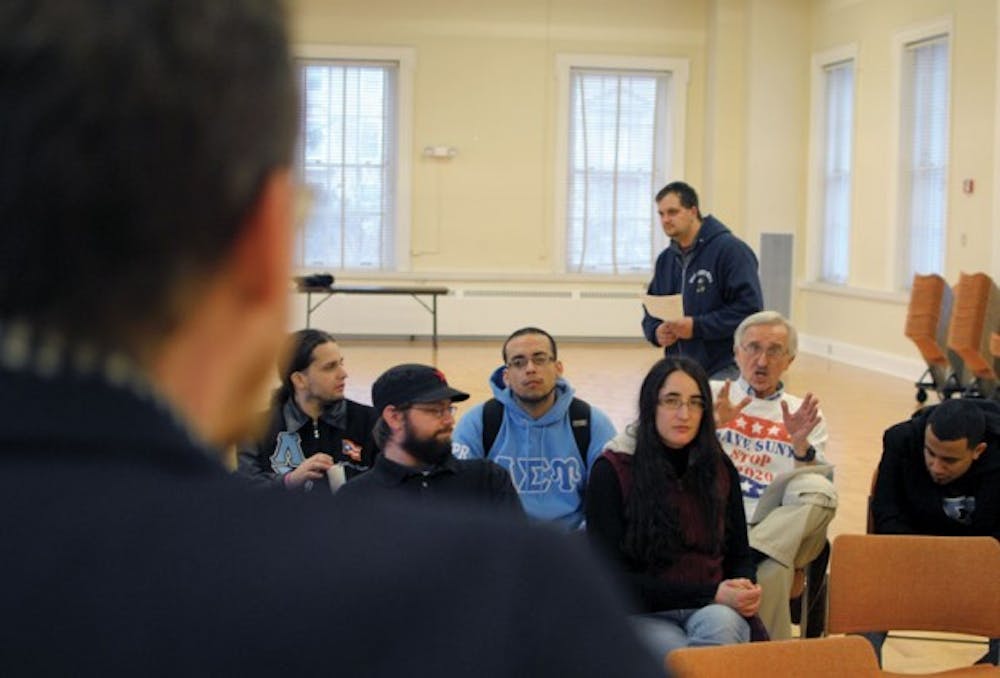
On Wednesday, the Defend Our Education Coalition called a town hall meeting to discuss issues facing public higher education in the City of Buffalo. The meeting was held in Harriman Hall on South Campus and was open for public forum.
The coalition is a group of undergraduate and graduate student groups, faculty, staff, and community members that disapprove of the "increasing privatization" of the SUNY system. The coalition argues that as tuition levels rise and the administration becomes inaccessible, students are denied their basic human right to education, according to the group's website.
"One of the important definitions of public is that it belongs to the people and it comes from the people and members of the community which it serves." said Cayden Mak, an organizer with the Defend Our Education Coalition and an M.F.A. candidate in media study. "One of the important roles that our university can take is creating a space for discourse and a space for conversation about the most pressing issues of our day."
The coalition outlines four major tenets that it believes should characterize a public institution of higher learning, aspects that Mak said new legislation proposed by UB and Governor Andrew Cuomo neglect.
"The SUNY system should strive for [affordability, accessibility, accountability, and quality] rather than looking for ways to sell off our resources to private companies and use students as a part of the revenue," Mak said.
With the potential passage of UB 2020, the university will hold the right to bypass New York State budget oversights and will hold more freedom to determine how funding is dispersed. If the plan passes, the university would be allowed to raise tuition by 6 to 8 percent per year without approval by state legislature.
UB 2020 is more than just a plan for the university; it is a plan to rejuvenate the economy of the Buffalo-Niagara region. On March 2, the bill supporting UB 2020 passed through the State Senate, 55-1.
"SUNY's job is to provide affordable education for all who want it," said Jordan Dalton, an M.F.A. candidate in media study. "[Its purpose is] not to rejuvenate a region, not to provide cheap resources to private companies, but to provide affordable education for all."
UB would also be able to lease or sell property that is a part of its campuses to private, outside companies. Private entities would control parts of the campus, which in turn will silence taxpayers' voices in university affairs.
"State regulations are there for a reason," said Chris Buckman, an organizer with the Graduate Student Employees Union and a graduate student in philosophy. "They're there so that taxpayers' money doesn't get wasted, that it's not just handed off to the pockets of business people who are not going to reinvest in the university."
Those involved in the coalition are concerned that if UB is granted the authority to independently manage the tuition and economic resources, students who rely on the relative low expense of public institutions will be unable to continue with higher education.
"With education, you really have power," said Clifford Cawthon, a senior political science major at Buffalo State College and a member of the coalition. "It is your birthright to be able to advance yourself without being burdened by debt and without being economically subjugated."
UB students and other members of the Western New York community took this opportunity to voice their concerns with the UB 2020 plan and other SUNY budget cuts. Many expressed concern that the university's expansion downtown will eliminate affordable residential space for community members in need.
Recently, the UB Foundation, a private group that supports developing and managing real property on behalf of the university, purchased the McCarley Gardens, a subsidized housing community, for $15 million from St. John the Baptist Church. This recent installment in the UB 2020 plan will help expand the university's downtown medical campus.
Michael Pietkiewicz, assistant vice president for government and community relations, was in attendance and provided the university's perspective on the coalition's grievances.
Pietkiewicz stressed that communication between community members and university officials is lacking, which leads to speculation and accusation. He also stressed that the reason the UB Foundation seems to be "closed off" to communication about funding is because foundations, essentially, are private entities.
Major donors to the university who provide scholarships to students may want to remain anonymous or do not want the public to know how much was donated. The UB Foundation is not required to provide the names of donors, according to the Freedom of Information Law in New York State.
The majority of funds provided through the UB Foundation are also held-over from when UB was a private institution before being purchased by the SUNY system in the 1960s, according to Pietkiewicz.
This public forum was only the first step in the coalition's attempt to raise awareness and begin dialogue between the community, university officials, and state legislators. Although the coalition has no set plans for future actions, it believes student and community activism can pay off.
The coalition also staged a mock New Orleans-style jazz funeral for public higher education that paraded through North Campus on Wednesday afternoon.
"The parade was so much fun," Dalton said. "We were at serious risk and maybe already lost public education. We're mourning, but we're also celebrating what it was. There's no reason this sort of political interaction can't be fun."
Email: news@ubspectrum.com



