
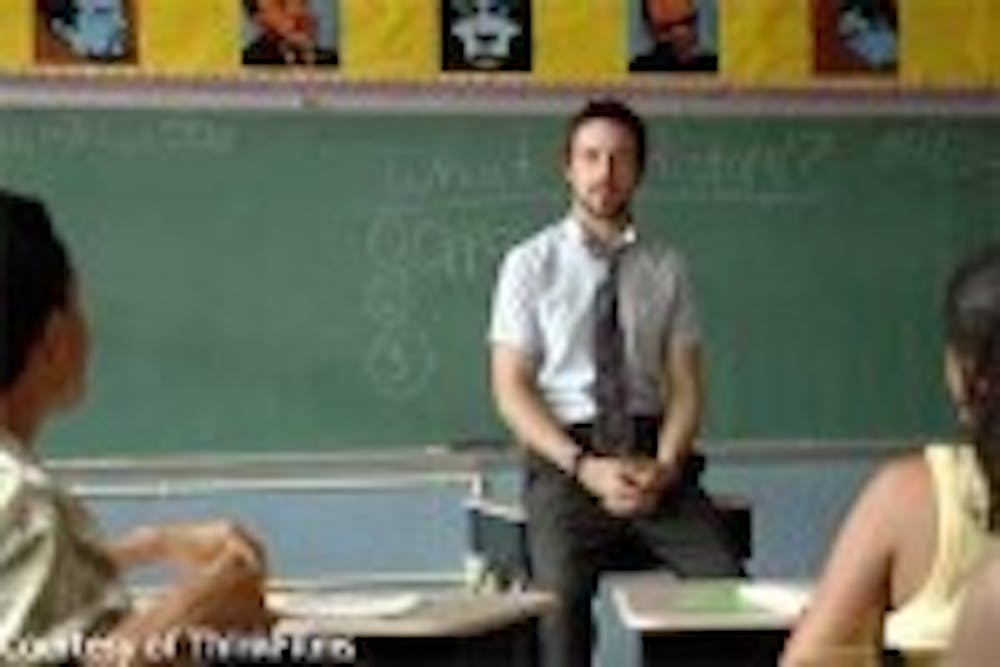
"Half Nelson," written by Anna Boden and Ryan Fleck, is a film that succeeds not through its ability to overwhelm its viewer with esoteric dialogue or scenes that were created for the Oscars, but through the natural telling of a tragically inspiring story.
Ryan Gosling stars as Dan Dunne, a young inner-city schoolteacher whose ambitions for teaching collide with a vicious drug addiction, a far stretch from Gosling's role in "The Notebook."
Dunne is the coach of the school's girls' basketball team. Predictably, a familiar scene takes place. One of Dunne's players, Drey (Shareeka Epps) walks into the locker room and catches Dunne sniffing cocaine. From this scene comes a relationship between student and teacher that blur the lines of responsibility.
Both characters find a common ground in each other's struggle. Dunne is an educator who seems to have come from a loving family, but his own mistakes have led him to self-destruction. Drey is an inner city child whose family history and family friends are only guiding her to a life of self-destruction.
The movie was originally created to be a short film, but was then stretched into a full-length feature. With certain passing scenes comes a pitted feeling that is often characteristic of slow-paced indie films. It exudes the sensation of a movie that has lost its edge and fallen victim to the Sundance formula that so many "artsy" films often spiral into. Despite these shaky moments, the movie manages to exceed expectations.
The high points of the film are the many comedic scenes and witticisms. With a film so deep and dramatic, laughing may come as a surprise. However, the real world blends tragedy and comedy, thus "Half Nelson" is made more relatable through its sense of humor. Every character feels real and grounded. There are no heroes and in many ways no villains.
The film chooses to study the complex ground between right and wrong. In one of the best scenes, Dunne confronts his drug dealer Frank (Anthony Mackie, "Crossover"). Thus begins a moral battle between dealer and hophead; they're both trying to protect Drey from the other. Frank asks if it's any better for Drey to be around a hypocritical teacher than a drug dealer. Dunne bewilderedly responds, "I don't know."
Ambiguity swarms these characters as they struggle to become genuine people. Frank's unsound intentions make him appear as the villain towards the end of the film, but it is evident he feels there's something he can give to the young girl that she won't get from anyone else.
The viewer walks with Dunne as he spirals into a life that is less about teaching and more about learning. His inability to cope with the news of his newly engaged ex-girlfriend and his inability to function as a teacher while curbing his constant hangovers are clear signs that this young man has lost control of his life.
Drey begins to function not as his savior, but rather his partner. Even though both characters make mistakes and often fail to "do the right thing," they have each other to pick themselves up at the end of the day.
Gosling's performance is outstanding. After his breakout presentation in "The Believer," Gosling has become increasingly stronger with each of his roles in "the United States of Leland," "The Notebook," and "Stay." He has finally found a movie that harnesses his talents while accentuating the superb supporting talents of both Epps and Mackie.
The film is remarkable for one reason: it's candid.



