
Art. Not framed works hung at convenient heights, but massive works that absorb their audiences. Art that requires its audience to become involved, either physically or mentally, differs from traditional viewing experiences.
Two installations in the UB Art Gallery, "Niagara Falls" by Adam Cvijanovic and "Scene from 'Olympus Manger' " by Kelly Kaczynski are forcing viewers to look at art in a completely different way. In fact, the size and design of the installations require the audience to put physical effort into just looking at the work in full.
"Scene from 'Olympus Manger' " takes up much of the gallery floor space in the form of a wooden stage. The "scene" is contained within the constructed stage and in order to see it, the viewer must walk up onto the stage platform, kneel down, and stick his or her head into one of small holes.
On the inside, with blood quickly flowing to the head as the viewer contorts their bodies to take in everything, an alien landscape reveals itself. Commonplace materials such as tarps, rubber and plastic sheeting, cut, unfinished wood, perforated cardboard and lights make up scenery that implies depth and vastness despite its enclosure.
The piece is physically disorienting and discomforting for the viewer. "Scene from 'Olympus Manger' " does well in immersing the audience in a strange and somewhat uncomfortable place.
Only one person is able to look at a scene at any time, which makes for an individual experience. An onlooker would only see a person laying on a stage, with their head in a hole. Sounds strange, but the experience is actually very entertaining.
The exterior stage is so unimposing that it is easily overlooked. The viewer's attention is drawn to the end of the room, where light is pouring in from a large opening.
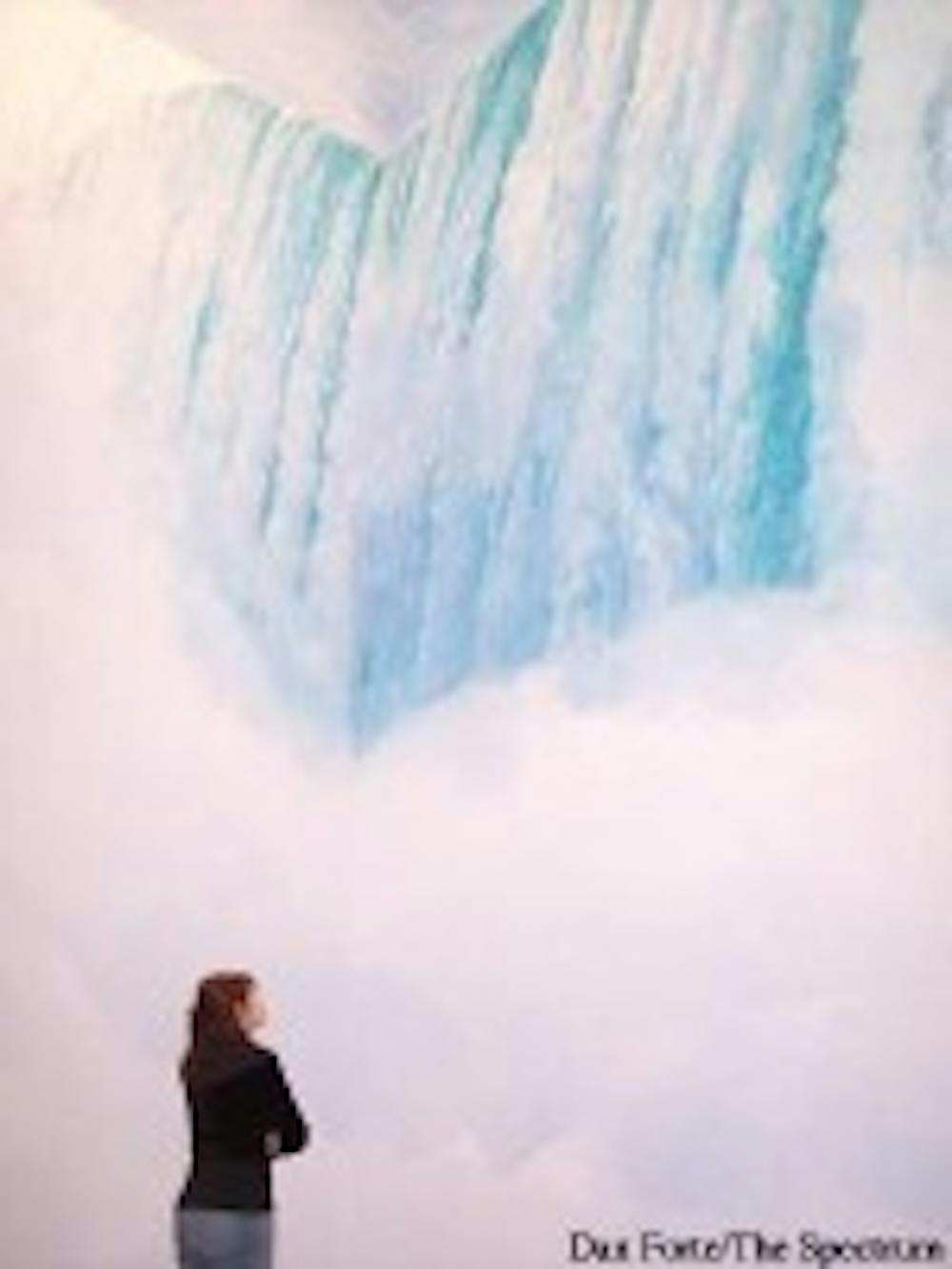
The opening leads into "Niagara Falls," a painting that covers three walls of the Lightwell Gallery, 35 feet in height. Most of the painting is high above the floor, requiring the viewer to look up to see the top of the falls and the sky.
Similar to Kaczynski's work, "Niagara Falls" also envelops the audience with art that can be walked into. The immersive quality of Niagara Falls, however, is different from "Scene from 'Olympus Manger' " as "Niagara Falls" conveys depth, mostly through height, but does not confine or enclose.
Natural light brightens the room. The blue color of the falls creates a very open space. And still, the power of the falls is present. The top of the falls looms over you under the sky and the ceiling of the room. Water surges down into steam clouds at eye-level.
Both works have successful immersive qualities while remaining simple, unobtrusive and welcoming.
In "Niagara Falls," the large strokes make the texture of the paint clear. In "Scene from 'Olympus Manger', " the material is so identifiable that, at first, it's hard to distinguish what is depicted.
This is art that alters the environment, and subsequently, the viewer's perception. It should be intriguing to anyone simply because these works of art are as enjoyable as they are provoking.
Both installations definitely warrant the short walk to the Center for the Arts. Admission to the UB Art Gallery is free. Cvijanovic's "Niagara Falls" will be on view until July 29. Kaczynski's "Scene from 'Olympus Manger' " will be open until May 13.



