
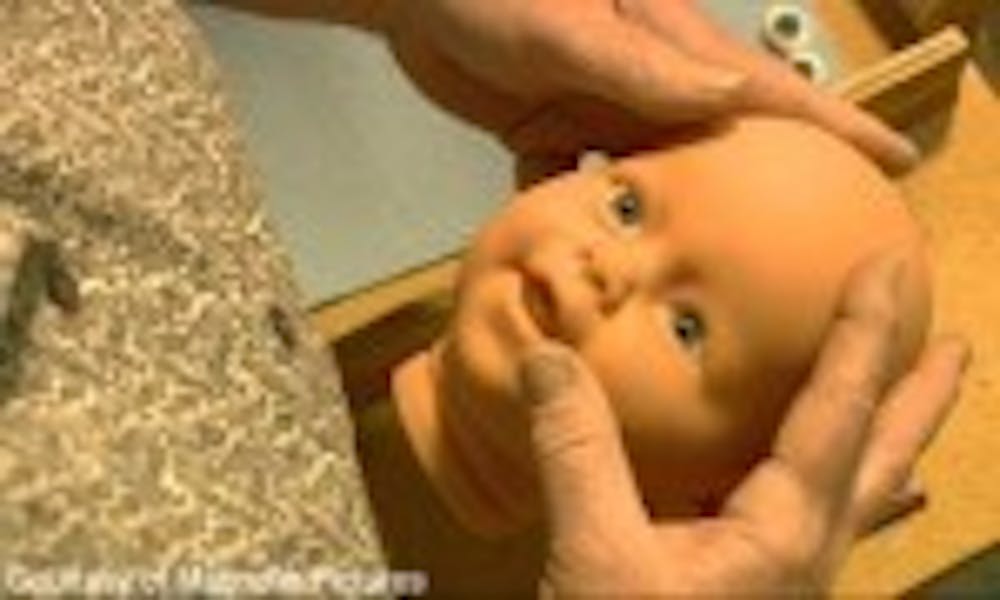
The image of a plastic baby doll's head being blown up like a balloon on the verge of popping is just something that stays with you.
Set in a small town in the Midwest, "Bubble" focuses on the lives of three people that work at a doll factory. Each character is extremely lonely, and hardened by the miserable manual labor that they must endure in order to survive in a town whose economy is in ruins.
Martha is a dumpy, middle-aged, unmarried woman who lives with and cares for her elderly father. Her only friend is Kyle, a 20-something pothead who has social anxiety disorder. Neither of them has much of a life. Their relationship is based on loneliness and routine, but they are seemingly happy within it.
The sense of normalcy presented early in the film is interrupted by the introduction of Rose, a young single mother who is hired at the factory. Immediately it's clear that Rose and Kyle are attracted to one another, a fact that shakes Martha's foundations and causes the formation of an odd love triangle upon which the film is hinged.
The inclusion of a murder into the plot causes the otherwise-stable lives of these characters to be called into question, and pulls into light more and more of who these people are.
"Bubble" is the latest effort by director Steven Soderbergh, a man who has produced many critically and commercially successful films ("Traffic," "Ocean's 11"). Soderbergh is not above bringing more obscure, riskier projects like "Sex, Lies and Videotape" and "Solaris" into the mainstream. "Bubble" falls into the latter category.
This is the first of six films directed by Soderbergh as part of a deal made with HDNet Films. Each film will be released on DVD, in theaters, and on the HDNet movie channel all at the same time. The release is an exciting new development in film. No other director has given the audience this freedom to choose before.
Intent on taking a different approach, Soderbergh decided to cast all non-actors into the film. They are all residents of a small town in Ohio similar to the one depicted in the film.
However, the story and dialogue are both so sparse that the skill of the actors isn't called into question. The dialogue consists of things that someone would actually talk about in real life. The dull conversations and lack of any real storyline beyond the relationships of the characters to one another is intentional. Soderbergh seems to want the audience to focus on these people, which gives the film an element of starkness and realism that makes it appealing.
The chemistry between Kyle and Martha is quite potent. Dustin James Ashley, who works at a pizza shop when he's not acting, plays Kyle. Ashley plays Kyle's personality as almost nonexistent, and yet his silence is endearing. It is what he holds back that causes the audience to become immersed in figuring out who he is.
Debbie Doebereiner, a retired KFC employee, adds a deep desperation to Martha that becomes more disturbing as the film moves ahead. Her character has nothing besides her job at the factory and her father. Kyle really is her only friend, and when this is threatened, the shift in her personality is subtle, but shocking.
Misty Dawn Wilkins, a hair stylist, also brings an anxiety to Rose, but hers is more motivated by the desire to seek safety for herself and her young daughter. She too has been beaten down by the crumbling economy in the small town, one that seems to be dependent upon factories.
There are several shots of the doll-making process, which emphasize that much of the characters' lives are spent doing tedious menial labor. The repeating image on screen of identical plastic dolls threatens that the people within this small town are in danger of becoming indistinguishable from one another.
The title of the film is meant not only to be a visual metaphor for the doll's heads, it's also a way to conceptualize the town itself as a place trapped, encapsulated, which exists and operates on the principles of repetition and immobility.



