
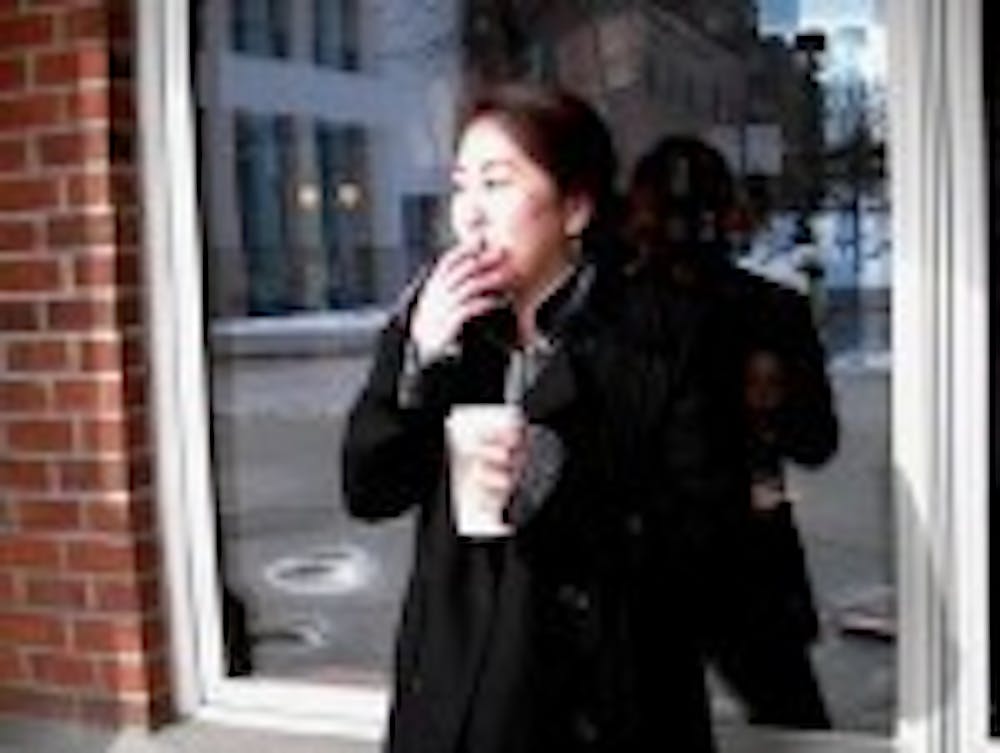
The return to wintry weather in Buffalo has pushed many students back into the shelter of the walkways and tunnels this week, but those who choose to smoke in between classes remain out in the cold.
The falling temperature and snow-laden gusts did not keep sophomore nursing major Ashley Cleveland from smoking a cigarette before going to study in the library.
"I just do it for stress," Cleveland said between puffs, when asked why she smokes. "I quit over Christmas break when I was home for two weeks."
Once the semester began, however, and stress began to build up, Cleveland wasted no time in picking up smoking again.
According to Wellness Education Services, roughly seven percent of UB students consider themselves to be current smokers, a rate that is just slightly above the national average. In 1994 UB adopted a smoke-free policy, implemented to help provide a safe environment for its students, employees and visitors, free of second-hand smoke.
According to the smoke-free policy, smoking is prohibited in all university-owned and operated buildings, stadiums and vehicles, as well as doorway areas and loading docks.
Smoke-free however, is a relative term. To accommodate smokers on campus, five areas were named designated smoking areas. There are two smoking areas on South Campus, the Biomedical Education Building Atrium area and in front of the patient area of Squire Hall. The remaining three smoking areas on North Campus are in front of the north side of the Student Union, one in between Capen and Norton halls, and one on the other side of Capen, on the ground level.
Not only is smoking prohibited in the academic buildings on campus, but since July 2003 all residence halls have been smoke-free as well, in accordance with the New York State Clean Indoor Air Act.
The purpose of the Clean Indoor Air Act, as well as UB's smoke-free policy, is not to simply keep the smokers out, but to encourage them to quit, an obstacle which many students are attempting to tackle.
Samantha Niedbalski, a sophomore psychology major, has been smoking for about four years, and said she averages about a half pack of cigarettes a day. She started to smoke during high school to "look cool," and is finding it difficult to quit now.
"When you have friends who smoke, and you're the only one not smoking, it's hard," said Niedbalski.
In 2007, UB will join over 250 other colleges by participating in the National College Health Assessment (NCHA). Wellness Education Services will lead this effort at UB by conducting an online survey dealing with health topics, including tobacco usage.
According to the Wellness Education Services Web site, this online survey is to be completed by 1,000 students and will help provide a benchmark for the campus health promotion efforts.
When it comes to UB officials' efforts to help students quit smoking, Wellness Education Services is at the forefront. Their Web site provides phone numbers for counseling as well as links for information on how to quit. Students who wish to quit smoking can also contact Health Services on South Campus to make an appointment with a provider.
Other Web sites, such as www.nysmokefree.com, offer free nicotine patches. Also available is detailed information on all the medications available to help smokers quit. Patches, gum, pills, inhalers, lozenges, and even nasal spray are just a few of the options out there.
A walk across campus will show that despite being 'smoke-free,' there are still many student smokers. The dangers of smoking may be taught from elementary school and up, but some students still choose to smoke.
According to smokers, quitting is definitely no easy task. Sarah Hinterberger, a sophomore management major, said that she left quitting off of her New Year's resolution list entirely this year. For her, quitting right now is simply not realistic.
In the end it is ultimately up to the individual to decide when they are ready to make the step to a healthier lifestyle.
"I know (smoking) is bad for you, it makes your breath stink and it causes cancer," said Hinterberger. "I could quit if I wanted to, I have the will power, I just don't want to quit."



