
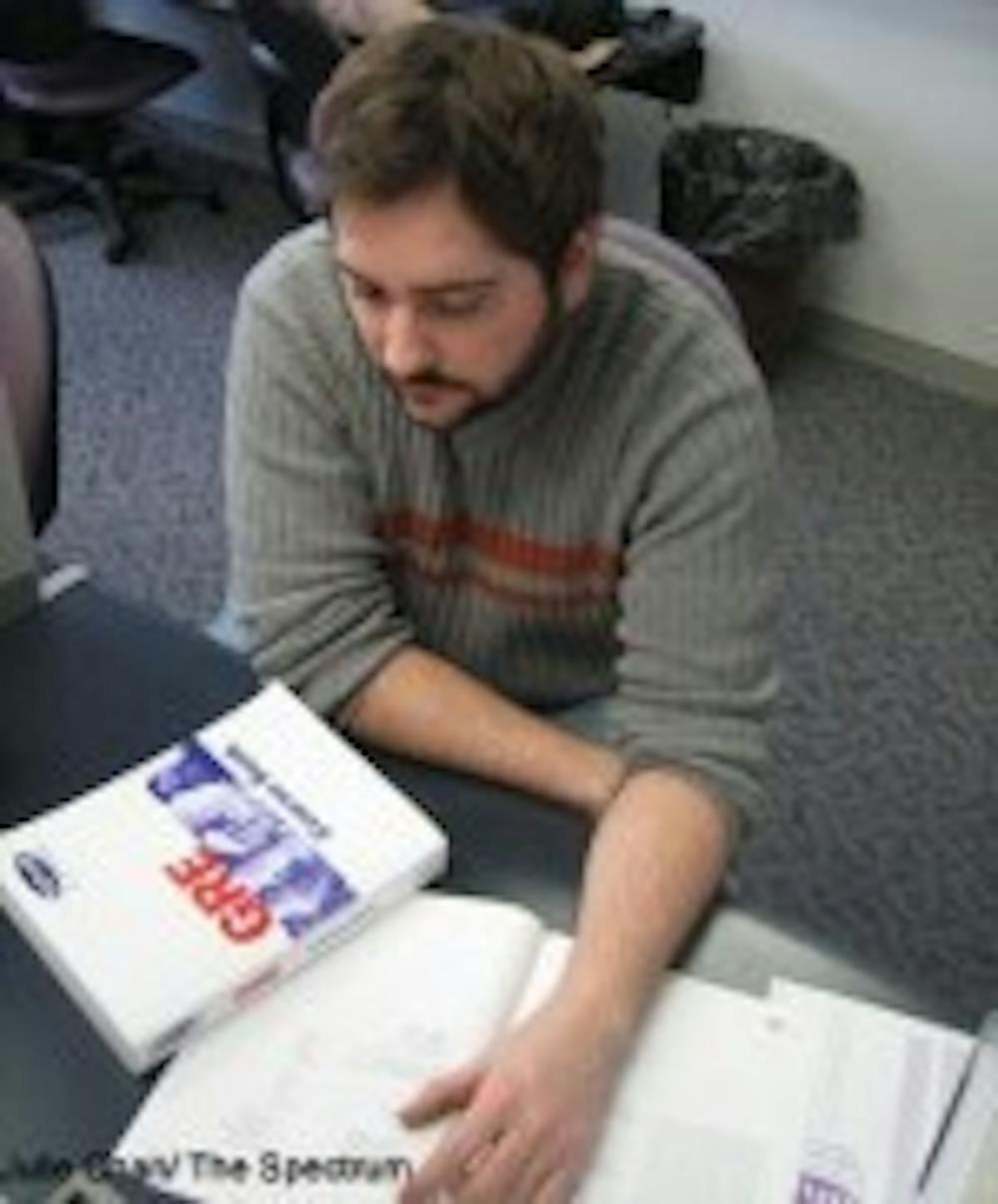
Last week's swirling windstorm that tore through campus wasn't just a force of nature: it was the sighs of relief from potential graduate students everywhere.
Students who were dreading a harder Graduate Record Examination (GRE) dodged a bullet last week when the Educational Testing Service announced the new GRE would not be introduced until fall 2007. ETS had originally scheduled to launch the new, less-forgiving GRE this October but after wide criticism decided to allow test takers and graduate schools an additional year to ensure a smooth transition.
Both the structure and content of the GRE will change with new types of questions, a new scoring scale and fewer testing dates. The test, which most graduate schools require for admission, will still consist of three sections: Analytical Writing, Verbal and Quantitative. However, the new exam will have a 60-minute essay section, two 40-minute Verbal sections, and two 40-minute Quantitative sections.
"They are moving towards more critical thinking and away from memorization," said Victoria Grantham, senior communication manager of Kaplan Prep Test and Admissions. According to ETS, several changes are being made to improve the test's format and validity.
"They're looking for a better predictor of graduate school success. ETS's objective is a good one. Time will tell if it will be effective, but it seems like a step in the right direction," Grantham said.
The biggest change will be a shift from a computer-adaptive test to a computer-based linear test. This means the test will be much more standardized.
Currently, the GRE adapts to your performance so the question pool varies by test taker. You start with a question of medium difficulty. If you answer it correctly, the testing engine serves a harder question and the more correct answers you give, the more difficult the questions get. The new computer-based format means the text would be fixed. Everyone takes the exam on the same day at the same time and receives the same questions in the same order, much like the SAT taken in high school.
The new exam will also be about four hours long, a significant increase from its current two-hour length.
While the new GRE might be a big change for test takers, most UB graduate programs said it would not change how they evaluate scores for admissions.
"I don't think it will really affect how we interpret (the scores). We've never really known how to interpret from one test to the other. We kind of use baseline exams," said Scott Mackay, director of Graduate Studies for the geography program. "We just look at the scores and essentially rank our applicants. GREs aren't the only thing that we use."
Tina Thurston, director of Graduate Studies for the anthropology department, said the last GRE changes did improve the test.
"The writing has really helped," she said. "People do really well on writing where they don't do well on verbal. Moving towards critical thinking would be a good thing. That's supposedly what colleges are supposed to teach."
ETS has also decided to offer the GRE on fixed testing dates rather than ongoing test dates throughout the year. ETS plans to offer the test on 30 dates per year, limiting students the flexibility of scheduling an exam that best fits their schedule, as it currently does.
"Currently our lab offers the GREs to 18 students a day. The new setup will require a much larger venue but with less dates. So we might go up to 40 students tested for that day," said Wayne Porterfield, UB's senior career-planning and development associate. "There is a lot of availability to take it at UB and the results are good for five years."
Grantham said because of the changes, the delayed release is ultimately better for students.
"Delay gives students better opportunity to prepare for the test. We are encouraging students to take the test as it is (now) because it will be substantially changed. Double length will be especially challenging for some people."



