
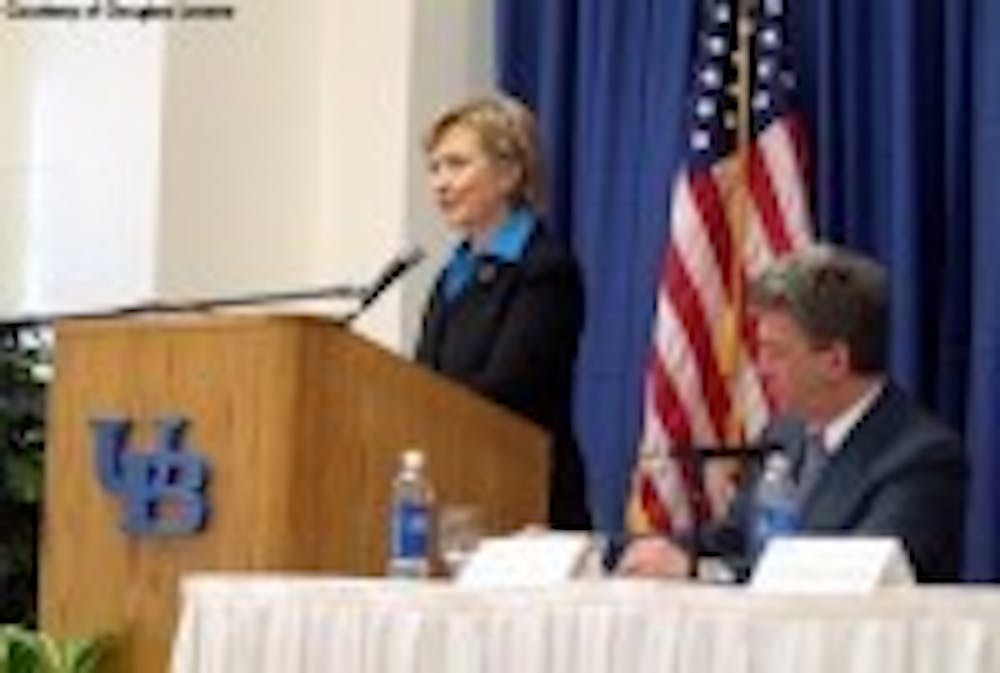
It seemed like a forum that should have been held in Washington, D.C., or maybe Manhattan, but Sen. Hillary Rodham Clinton insisted Buffalo was a fitting place to talk about health care reform.
"The medical community is a leader in the economy in Buffalo as it transitions from manufacturing to technology," Clinton, D-N.Y., told a standing-room-only crowd on UB's Harriman Hall on Monday. "Working with the University at Buffalo and others in elected office, I believe it will continue to be a real driver of change and opportunity."
As the headliner for a panel discussion on some of health care's most pressing issues, Clinton urged a new approach to major health reforms and criticized President Bush for misguided plans that she said hurts the neediest Americans.
The rare visit to UB's South Campus especially drew members of Buffalo's medical community who were familiar with Clinton's history on health care. When she was first lady in 1993, Clinton unsuccessfully pushed for an overhaul of the entire system.
"Twelve years ago we tried to do too much, too fast," she said.
But now, Clinton said the need for reform is just as pressing, if not more in some areas, than it was during her husband's presidency.
The senator, who is running for a second term and is considered a potential Democratic nominee for president in 2008, pointed to several statistics: the United States spends more on health care than any other country, but life expectancy here ranks 34th; medical bills cause half of all U.S. bankruptcies; and if the current pace of spending continues, within 30 years the United States will be putting one-third of its entire Gross Domestic Product into health care costs.
To stop current problems from spiraling further out of control, Clinton called for an emphasis on "evidence-based medicine," the use of scientific research to determine what treatments are effective and which are wastes of federal money.
"We're seeing efforts to turn Washington into an evidence-free zone," she said.
In response to the health care crisis, Clinton said politicians are cutting Medicaid, eroding patient protection, shifting risk, and promoting increased costs while reducing access to care. She blamed the Bush administration for the message that patients are on their own.
Two of the biggest problems, Clinton said, are that the current system gives incentives to companies that cut benefits, and then the payment process doesn't get money to the right people.
"The system will pay tens of thousands of dollars for amputations, but not a low-cost visit to a podiatrist that could have, over time, saved a person's foot," she said.
Private health accounts, Clinton added, "may be a good deal for some people who are wealthy enough to stock away thousands of dollars in tax-free accounts that they can then use to pay their healthcare bills," but not for the poor.
David L. Dunn, UB's vice president for health sciences, said the purpose of the forum was to raise health care issues and have a grassroots discussion about possible solutions to today's problems of disparity.
When the Founding Fathers created the Bill of Rights, they didn't write in health care, Dunn said, but "had they known what things would look like in the current climate, they would have included it."
Following Clinton's half-hour speech, the five-person panel - which included the CEO of Kaleida Health, a plant manager of a local manufacturing company, and UB's head of the new bioinformatics center - covered topics ranging from diabetes treatments to medical negligence damages.
In her opening remarks, Clinton said that to solve health care's ills, Americans must first look towards what is positive about the system.
"We have dedicated, skilled, caring doctors and nurses and other healthcare personnel," she said. "We have medial innovation that is second to none. We have forward-looking businesses that understand the stakes."
In Buffalo's $600 million per year medical economy, she pointed to successes at the Buffalo-Niagara Medical Campus for multiple sclerosis and sickle cell research, pioneering studies at Roswell Cancer Institute for lung cancer, and the importance of UB's supercomputing center for managing mass amounts of data.
But as employers further shift health costs to their workers - as 83 percent did in 2004 - the system also puts a burden on companies trying to do some good.
"We're losing jobs because we haven't figured out how to help companies pay for health care," Clinton said.
If Americans want better health care, she said, those in Washington need to change their priorities.
"While we're ending the estate tax at a cost of $339 billion to our treasury, we are saying that Medicare faces a shortfall because we are raiding the Medicare trust fund to spend it on other things," Clinton said.
Stepping in a different direction from the sweeping reforms she pushed in the early '90s, Clinton targeted a number of narrower changes: furthering technology to better organize crucial health records, opening communication between separate providers like Kaleida and Erie County, and creating an atmosphere with better-informed choices for consumers.
With the rise of direct-to-consumer advertising, Clinton said pharmaceutical companies spend billions on commercials where people are running thru fields of flowers, the product is described and you don't hear this drug will cause the following 25 complications.
"It makes it very difficult for physicians to say that this drug, which no one is running through a field in, is the drug for you," she said.
"It's about health care and the economy," Clinton added. "But it's also about our moral values as a country."



