
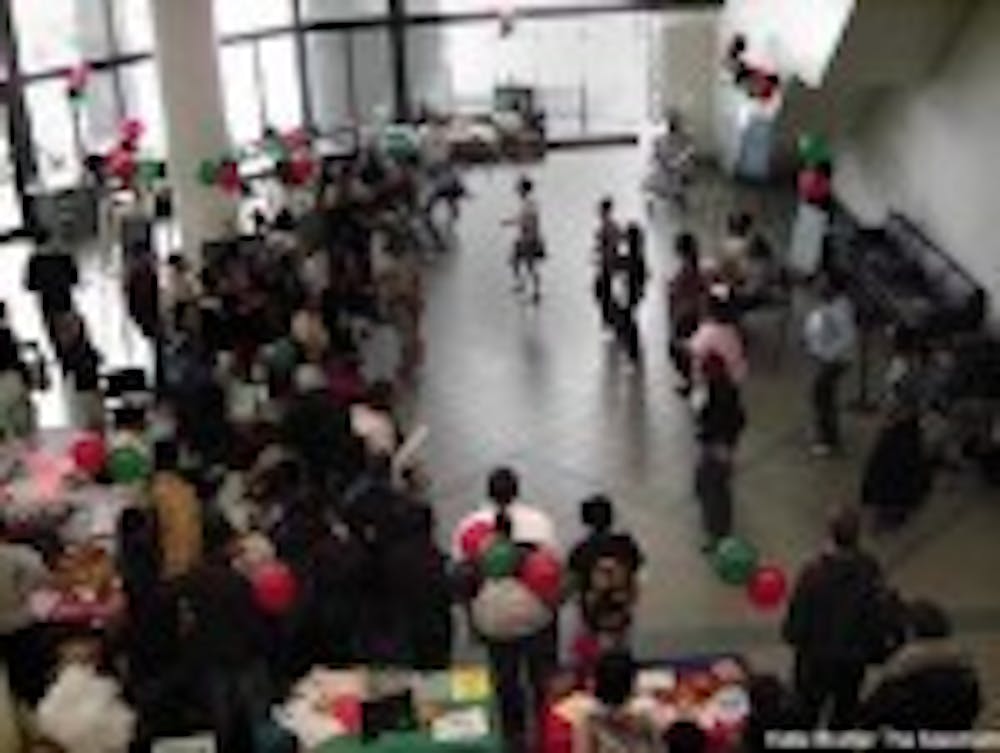
For a decade now, the African Bazaar has annually descended on the Student Union, each year searching for a different theme, a new way to present a familiar event.
On Wednesday, students and clubs celebrated the 10th anniversary of the February bazaar focusing on the theme "Oral Traditions," giving participants the chance to share stories, proverbs, art and traditional African food with both each other and the UB community.
The centerpiece event was the "Proverbial" Open Mic, where students had a chance to read an African proverb to passersby and those gathered for the bazaar.
"Suffering and happiness are twins," read one student, who was greeted by applause. The moral of the proverb was that life contained both joy and sadness, and when one accepted both it was a sign of maturity.
Food has always been a big draw for the bazaar, and this year was no different. The Palm Tree Restaurant provided enough cuisine for about 200 people, including jerk chicken, brown chicken stew, rice and peas, vegetable patties and flan.
"We ran out of food, so that's always a good sign," said Dawn Whited, program coordinator for the Intercultural and Diversity Center.
Benita Lupu, a sophomore biology major, said her favorite activity at the bazaar, pillow-making, allowed students a chance to work together.
"It's different," Lupu said. "Every part of it is reaching out, it's crafty."
Lupu also enjoyed the African music being played throughout the event.
"It shows their culture, and gives a background to everything," she said.
Tianna Porter, a psychology and sociology major, said she always likes coming to the different bazaars that are held. She also said pillow-making was her favorite activity.
"Pillow-making is definitely my favorite, because you can keep that forever and you can never have enough pillows," she said.
Porter said she also enjoyed celebrating the diversity found at UB.
"It's great to be aware of the different cultures here at Buffalo," she said.
The series of informative posters on display were also read and appreciated by many students. There were several that discussed large cities in Africa such as Nairobi, Cairo and Johannesburg.
"Students commented that they liked the poster boards that we had," Whited said.
Others told ancient legends, such as the Bura folktale of the "Eagle and the Buzzard," or the "Legend of Luanda Magere," about an invincible Luo warrior, who was sent a beautiful girl by his enemies. He fell in love and married her, and his first wife suspected that it was a plot against his life. He ignored her, and accused her of being jealous. When he fell ill, he told his new wife to treat him by making little cuts on his body with a blade and rubbing herbs into the bleeding cuts.
When Luanda Magere did not bleed, he told her to cut his shadow. His secret was out, and his new wife ran back to her people. After their next battle, an enemy warrior speared Luanda's shadow, killing him.
Other posters discussed Africa "Beyond Legends and Folklore." Modern cities and technology, as well as a wealth of natural resources and history, are found on the continent.
Giseline Michel, a senior health and human services major, said she liked all aspects of the bazaar.
"I'm waiting for the dance, to see how that's going to come out," she said.
Michel was referring to the African dance instruction, held in the Student Union Theater. Student volunteers were taught the dance, and then later performed it in front of everyone, towards the end of the program.
"The event concluded with students that had learned African dance," Whited said. "It was a dance that they had just learned, and they were awesome."
A table was set up for the creation of cowry-shell bracelets and necklaces. A nearby poster discussed the small shell, which is found in the Indian Ocean. The cowry, which is used in jewelry-making or as a religious accessory, was also used as currency in African countries such as Nigeria, as well as other parts of the world.
Whited explained that the bazaar's success was due in large part to the work of students in the planning committee.
"We have a planning committee for each of our bazaars, that's open to all students who want to get involved," she said. "It's kind of short term."
Whited said that past and present volunteers of the Intercultural and Diversity Center often comprise much of the committees, but anyone was welcome.
"The bazaar was a success," she said. "Students who attended took advantage of all that was being offered."
"I've had students I've never met before come and help out," she added.
The next bazaar for the Intercultural and Diversity Center is the Asian Bazaar on April 12.



