
This is the first of two stories on Gov. Pataki's proposed budget. Wednesday's story will examine legislation to cut TAP and speed up graduation rates.
In Miriam Kramer's perfect world, raising SUNY tuition isn't even an option, especially when New York State is facing a $2 billion surplus.
Unfortunately for Kramer, a higher education coordinator for New York Public Interest Research Group, Gov. George Pataki sees things differently.
In the last state budget Pataki will propose as the governor, students are once again looking at the possibility of a tuition increase, this time to the tune of $500. That price hike, however, is only one highlight in a proposal laced with reforms and cuts that could heavily impact undergraduates across the state.
Some of the budget's educational points, like the hike and a long-term tuition plan, are hardly new and have failed to pass in previous years. Other ideas, like reforms to cut the Tuition Assistance Program by $190 million, will be debated in the state legislature for the first time.
To Kramer, the most pertinent - and precarious - issue is the tuition increase and an accompanying plan to peg SUNY tuition to a price index. Under that scenario, tuition would increase each year based on the index and inflation, but students would only pay the price from the year they started college, at least for four years.
"Things that go in the budget always have a chance of going through," Kramer said. "But what's most dangerous about the tuition proposal is that it sounds good if you don't read between the lines."
According to Kramer, there's a massive caveat to the index plan, also referred to as the rational tuition plan.
"If the state budget is not passed by the start of SUNY's fiscal year and if the state doesn't provide status quo funding" - such as energy costs - "then the SUNY Board of Trustees can raise tuition as much as they want for any student," Kramer said. "All bets are off."
State Senator Kenneth LaValle, who chairs the higher education committee, is a proponent of the rational plan who says it would guarantee both students and taxpayers a degree of predictability.
"We haven't done a good enough job to say, number one, whatever your tuition is, that's it for four years," LaValle said. "And number two, those dollars are going to invest in the system so you can get the courses you need and you don't have to worry about not graduating on time because you can't get a course."
Until such a long-term plan is in place, though, LaValle opposes any other tuition increases. And because of his stance and the similar opinions of other politicians, LaValle flatly believes the tuition increase isn't going to happen this year, despite the way Pataki laid out the budget.
"As chair I'm going to do everything possible to find some dollars," LaValle said. "On the other hand, we're going to ask SUNY to look into every nook and cranny to make things function."
Where will LaValle find those dollars? Ron Canestrari, chair of the State Assembly's committee on higher education, speculates that legislators will shift the money from tax cuts Pataki wants for the wealthy and upper class.
"There's a $2 billion-plus surplus," Canestrari said. "I believe we can afford to increase operating aid without forcing students to pay more."
If SUNY Chancellor John Ryan has his way, the state will pick up the entire tab for Pataki's $85 million gap that has created the need to raise tuition or find money elsewhere. Some have taken umbrage with the fact that Pataki buried the hike deep in the budget's political language. LaValle said he doesn't think much of it: since this is an election year, no one wants to talk about tuition straight on.
Meanwhile, Ryan told the Board of Trustees last week he would ask the state legislature to increase SUNY's funding, but added it was too early to tell whether any changes were needed for tuition. The state budget is due April 1, and between now and then, there will be plenty of political posturing, argument, and debate.
Kramer, of NYPIRG, said she's been impressed with Ryan's "gung-ho attitude." She, too, said it's too early to tell what will happen between the Senate and Assembly, which will ultimately approve the budget.
"We're in the very beginning stages of a many-months budget process," she said. "This is just the governor's proposal, and thankfully he's not a tyrant who gets to make all the decisions."
Still, as UB's President John B. Simpson points out, it's valuable to start the discussion early.
"It serves to tell people like me and other SUNY folks in position of leadership, we've got some work to do," Simpson said. "The risks of not getting the job done are too high to ignore them, to ignore these proposals at this time."
Simpson, who supports the index plan as long as it's tempered with necessary financial aid, said the chance for a tuition hike would make for an interesting conversation in the legislature, but he worries such debate may "distract from the larger discussion of rational and predicable policy."
Kramer, however, believes neither conversation should be going on.
"At least for now we need to take tuition off the table and talk creatively about state support for the public colleges," she said. "We're not talking NYU and Columbia here."
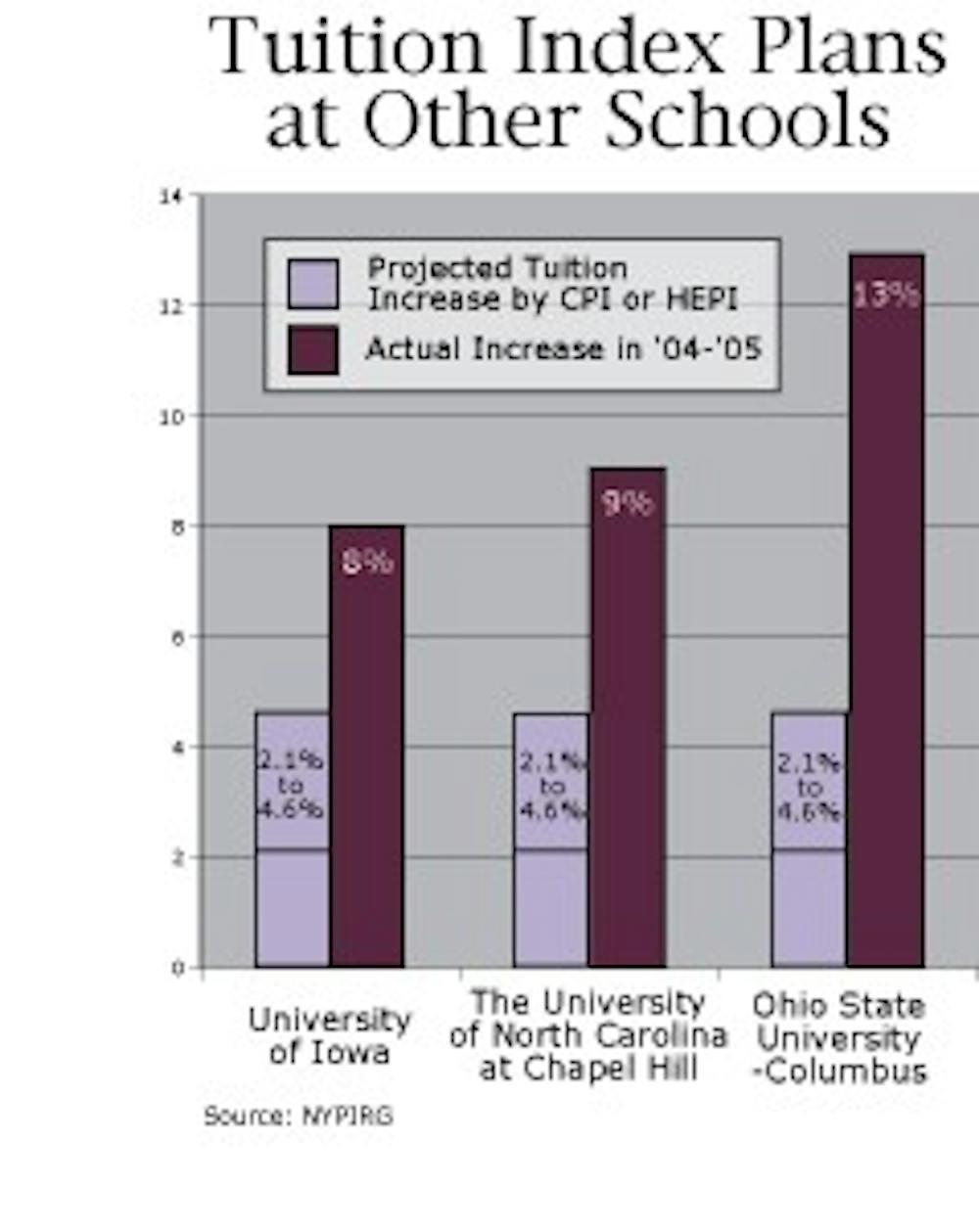
Other schools have already used similar index plans, Kramer said, and there hasn't been any predictability. At Ohio State, the consumer price index indicated tuition would rise by 2.1 to 4.6 percent, but in actuality it jumped by 13 percent last year. Similarly, at Iowa University the higher education price index suggested an increase below five percent, but when all was said and done, tuition there was hiked eight percent.
"They're billing this as a guarantee," Kramer said, "but you can't guarantee tuition."



